
Fertilizer technology has changed enormously over the past century, from manure and guano to synthetic granules, crystal powders and liquid concentrates. Each of these formats has its limits: granules dissolve unevenly, powders can cake in humid storage, and liquids are heavy and expensive to ship. Dragon Ferti, a Jordanian NPK fertilizer producer, developed a different delivery system, NPK paste fertilizer, which addresses these problems through colloid chemistry, a deliberately acidic pH and a highly concentrated format.
This article explains the science behind Dragon's paste technology and why agronomists, distributors and large farms see it as a strong alternative to conventional specialty NPK fertilizers.
What is an NPK paste fertilizer?
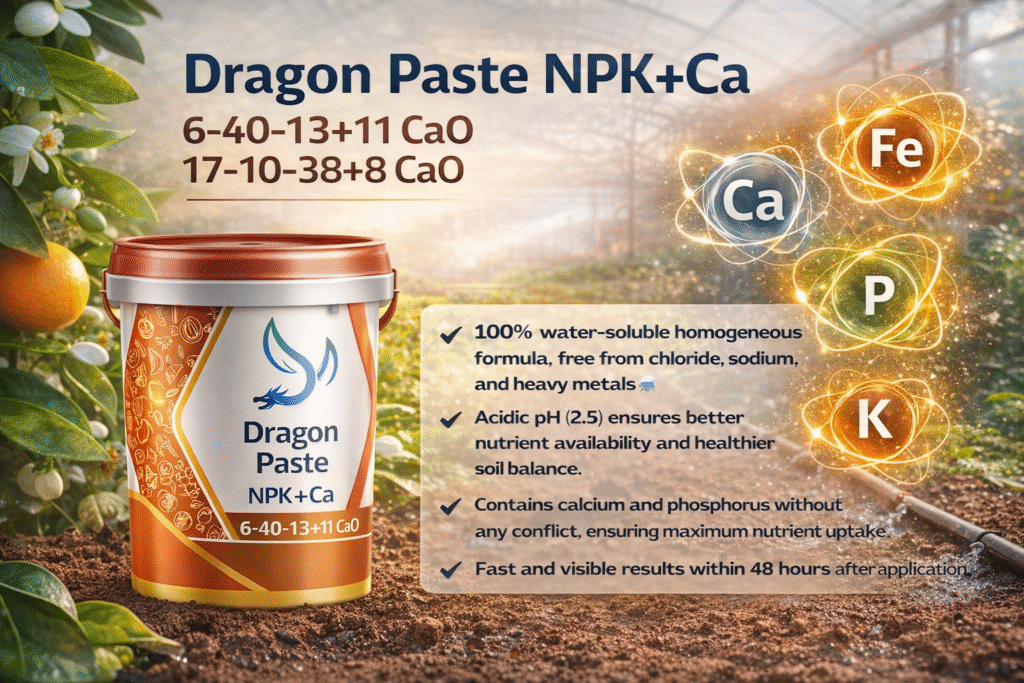
A paste fertilizer is a semi-solid colloidal suspension in which the macronutrients (nitrogen, phosphorus and potassium) and trace elements are evenly dispersed in a concentrated matrix. Unlike dry powders that need dissolving first, or granules that depend on soil moisture, a paste turns into a fully homogeneous solution almost immediately in water. The result combines the concentration of a solid with the immediate availability of a liquid.
The Dragon Paste range is 100% water soluble, leaving no undissolved particles in the nutrient solution. That matters in modern fertigation, where even microscopic residue builds up in drip emitters, micro-sprinklers and filters, causing blockages and uneven distribution.
Why the acidity matters
One of the most important features of Dragon Paste is its strongly acidic pH of 1–2. It is an engineered property with several agronomic benefits.
Better nutrient availability
Nutrient availability depends heavily on pH. Phosphorus, for example, becomes increasingly locked up in calcareous soils above pH 7.5, a condition very common in Morocco, Algeria, Tunisia and across the Mediterranean basin. When the acidic solution enters the soil, it temporarily lowers the pH around the roots, releasing bound phosphorus and making it available to the plant. The same effect improves the availability of iron, zinc, manganese and other micronutrients that become less accessible in alkaline conditions.
Irrigation water conditioning
Many arid farming regions irrigate with alkaline water (pH 7.5–8.5). In fertigation, that water can cause nutrients to precipitate inside the lines, especially calcium and magnesium carbonates that form scale. Dragon Paste's acidity acts as a built-in water conditioner, lowering the solution pH and helping prevent scale, often without separate acid injection.
Bicarbonate neutralisation
High bicarbonate in irrigation water is a persistent problem in North African and Middle Eastern agriculture. Over time it raises soil pH, reduces nutrient availability and encourages salt build-up. Dragon Paste neutralises bicarbonate as it mixes, delivering a cleaner solution to the root zone. The guide to salinity and alkaline water explains how to read these values in a water test.
The Dragon Paste range for every growth stage
Dragon Paste formulations cover each major crop stage, each with its own NPK balance and trace element package:
| Product | NPK focus | Main use |
|---|---|---|
| High Nitrogen | N-led | Vegetative growth, canopy development, leafy crops |
| High Phosphorus | P-led | Root development, transplant establishment, early growth |
| High Potassium | K-led | Fruit size, colour, sugar accumulation, shelf life |
| High-PK | P + K | Flower induction, fruit set, reproductive stages |
| Balanced | Equal NPK (30-30-30) | General maintenance, transition periods |
| NPK+CaO | NPK + calcium | Calcium-demanding crops, cell wall strength, blossom-end rot prevention |
Dragon Paste is packed in 1, 5, 10 and 20 kg units.
Purity: free of chloride, sodium and heavy metals
A fertilizer's quality is defined as much by what it leaves out as by what it contains. Many commercial fertilizers, especially those made from low-grade raw materials, carry chloride, sodium salts and traces of heavy metals such as cadmium, lead and arsenic. With repeated use, these accumulate in the soil, harm soil biology, restrict root growth and can enter the food chain.
Dragon works with raw materials from Jordan's potash and phosphate reserves, and every Dragon Paste product is free of chloride, sodium and heavy metals. That purity matters most for:
- Chloride-sensitive crops: strawberries, lettuce, peppers, avocados, citrus and grapevines lose yield and quality with excess chloride.
- Salt-affected soils: large areas of irrigated land in Morocco suffer secondary salinisation, and chloride-free NPK avoids adding to it.
- Protected cultivation: greenhouses and tunnels accumulate salts easily because no rain leaches them. See the greenhouse fertigation guide.
- Export produce: markets such as the EU, UK and Gulf states set strict limits on heavy metals in fresh produce, and contaminant-free fertilizers help growers stay compliant.
Paste compared with conventional formats
| Property | Granular | Crystal powder | Liquid | Dragon Paste |
|---|---|---|---|---|
| Dissolution speed | Slow (hours to days) | Moderate (minutes) | Instant | Near-instant |
| Residue risk | High | Moderate | None | None |
| Nutrient concentration | Medium | High | Low (diluted) | Very high |
| Transport efficiency | Good | Good | Poor (water weight) | Excellent |
| pH correction | None | Minimal | Variable | Strong (pH 1–2) |
| Storage stability | Good | Caking risk in humidity | Good | Excellent |
The comparison shows why paste is gaining ground with professional growers: it combines the strengths of solids and liquids while avoiding their main drawbacks. Each format still has its place, and the guide to choosing between paste, powder and liquid explains when each one fits.
How to apply paste fertilizers
Fertigation (drip and micro-sprinkler)
The most common method is to dissolve Dragon Paste in the fertilizer tank of a drip or micro-sprinkler system. It disperses quickly into a uniform solution that passes through filters, mainlines and emitters without clogging, and the acidic solution helps keep lines clean by dissolving mineral deposits. That makes it well suited to the drip-irrigated citrus, olive, vegetable and berry farms that dominate Moroccan agriculture. The fertigation best practices guide covers tank set-up and scheduling.
Foliar spray
For fast correction of deficiencies, or to support root nutrition at critical stages, Dragon Paste can be dissolved and applied as a foliar spray. Full solubility gives a clear spray solution that does not block nozzles, and the trace element package supplies micronutrients through the leaf. Foliar use is especially effective at flowering (High-PK or Balanced) and during fruit development (High Potassium). See the foliar fertilization guide for mixing order and timing.
Field evidence
Dragon backs its technology with field results. Documented trials and grower testimonials show Dragon Paste performing under varied and often demanding conditions. In Algeria, Dragon Paste 20-10-60+TE produced measurable gains in watermelon fruit weight, diameter and total harvest, and Dragon Paste has supported viable crops even under harsh desert conditions.
Conclusion
NPK paste combines colloid chemistry, an engineered acidic pH, pure raw materials and complete water solubility in one format. It solves several limitations of granular, powder and liquid fertilizers, particularly where irrigation water is alkaline and drip systems cannot tolerate residue. Explore the Dragon Paste range, browse the full catalogue, or contact the technical team through the contact page to request technical data sheets and trial samples.
Frequently asked questions
What is the advantage of paste fertilizer over soluble powder?
Paste dissolves almost instantly and completely, without dust or caking, and its acidic pH helps correct alkaline irrigation water. Soluble powder remains very useful for large areas and foliar programmes.
Can paste fertilizer be used in drip irrigation?
Yes, it is designed mainly for that. Being 100% water soluble, it leaves no residue to block emitters, and its acidity helps prevent carbonate scale in the lines.
Why does an acidic pH help in calcareous soils?
It temporarily lowers the pH around the roots, which releases phosphorus and micronutrients such as iron, zinc and manganese that are poorly available in alkaline soils.


Looking for a reliable specialty fertilizer partner?
We work with importers and distributors who want products that set their portfolio apart.