
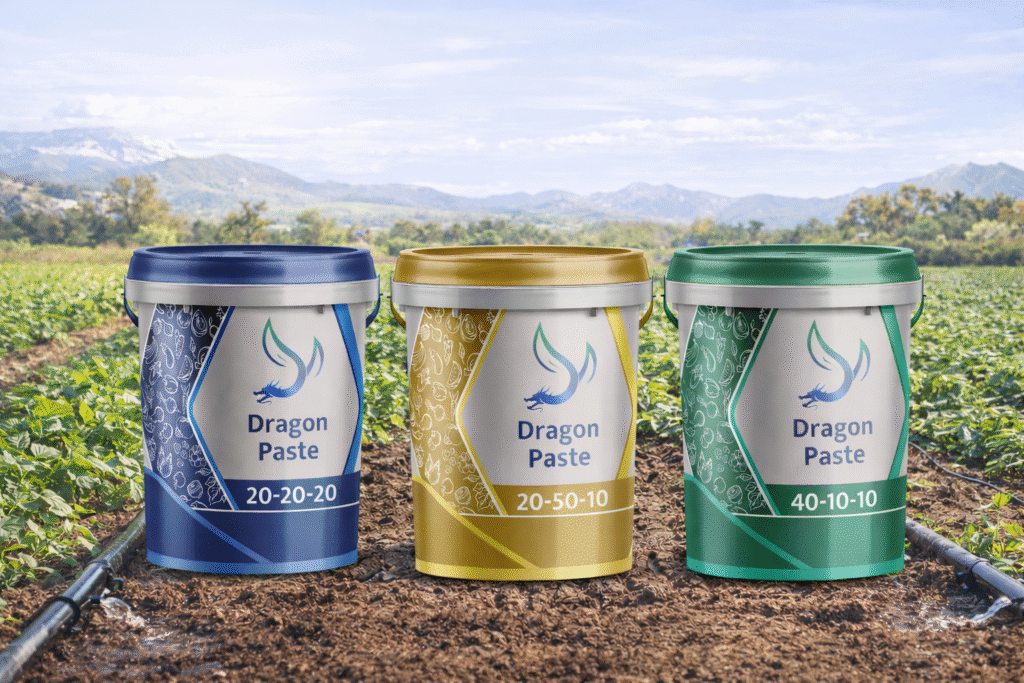
Fertigation, the practice of delivering dissolved fertilizer through the irrigation system, has changed modern agriculture. By placing nutrients directly in the root zone, it can raise nutrient use efficiency substantially compared with broadcasting, while saving water and labour. Across Morocco, the wider Mediterranean and arid regions worldwide, fertigation through drip has become the standard for high-value crops. Yet many growers lose much of that advantage through incompatible products, poor injection practice or the wrong schedule.
Dragon Ferti, a Jordanian producer of water-soluble fertilizers, designs its range, from NPK grades to specialty and micronutrient products, for clean fertigation. This guide shares the practical knowledge its team has built over more than 15 years of work across 50+ countries to help you get the most from every fertigation cycle.
Setting up the system
The three-tank method
Professional fertigation uses separate stock tanks (A, B and C) to avoid chemical incompatibility between concentrated solutions. Calcium fertilizers must never be mixed in concentrated form with phosphate or sulphate fertilizers: they form insoluble precipitates that block injectors and drip lines. A typical layout with Dragon products:
- Tank A, NPK base: Dragon Paste or Dragon Soluble Powder, choosing the NPK ratio that matches the crop's current stage.
- Tank B, calcium: Dragon PureCal (calcium) or Dragon MagiCal (calcium and magnesium), dissolved on their own.
- Tank C, micronutrients and specialty: Dragon Minor Elements (iron, zinc, manganese, copper or Mix) and specialty products such as Dragon Boost or Dragon Sea.
Where a single product is formulated to supply NPK and calcium together, such as Dragon Paste NPK+CaO, follow the label and dissolve it on its own rather than combining it with other concentrates.
Injection equipment and placement
Inject downstream of the main filter and upstream of the secondary (field) filters, so that any undissolved particles, including impurities from the water source, are caught before they reach the emitters. Dragon Paste dissolves completely and is strongly acidic in solution (pH 1–2), which helps dissolve mineral scale in pipes and emitters during each fertigation cycle.
The fertigation cycle, step by step
Phase 1: pre-flush (10–15% of irrigation time)
Start every session with clean water. This brings the system to uniform pressure and wets the soil around each emitter, so that when injection begins the solution reaches moist soil where roots are active. Injecting into dry soil wastes nutrients and risks root burn.
Phase 2: injection (60–70% of irrigation time)
Run the injection pumps and monitor the EC of the outgoing solution to confirm the dose. Because Dragon products are free of chloride and sodium, the EC you measure reflects nutrients rather than unwanted salts.
Alternate between tanks according to the programme: for example Tank A (NPK base), then a short clean-water gap, then Tank B (calcium), then Tank C (micronutrients or specialty products).
Phase 3: post-flush (15–20% of irrigation time)
Finish every session with clean water. This pushes the remaining solution out of the mainlines, sub-mains and laterals into the soil, so all injected nutrient reaches the root zone, and it prevents salts crystallising inside emitters between irrigations, a common cause of blockage.
Scheduling: matching products to crop demand
Products and frequency should change as the crop moves through its cycle. A general framework to adapt to your crop and conditions:
| Growth stage | Main Dragon product | Supporting products | Frequency |
|---|---|---|---|
| Transplant / establishment | Dragon Paste or Soluble Powder High Phosphorus | Dragon Rooty + Dragon Iron | Every 2–3 days |
| Vegetative growth | Dragon Paste or Soluble Powder High Nitrogen | Dragon Triple N + Dragon Mix Plus | Every 1–2 days |
| Flowering | Dragon Paste High-PK or Balanced | Dragon Flowering + Dragon BorCal | Every 2–3 days |
| Fruit development | Dragon Paste or Soluble Powder High Potassium | Dragon Fruity + Dragon PureCal | Every 1–2 days |
| Maturation / harvest | Dragon Paste High Potassium | Dragon PotaMax + Dragon Calibo | Reducing |
The guide to NPK by crop stage explains the logic behind each ratio.
Managing water quality
Water quality is the most overlooked factor in fertigation. In Morocco and across North Africa, common problems include high pH (above 7.5), high bicarbonate, excess calcium that forms scale, and variable salinity. Each one reduces nutrient availability and system performance.
Dragon Paste's acidity lowers the pH of the fertigation solution, neutralises bicarbonate and reduces scale, often without separate acid injection. Dragon Corrector adds pH and EC correction where water is particularly difficult, and Dragon Thio (potassium thiosulphate) supplies sulphur while helping to acidify the root zone in alkaline soils. The guide to salinity and alkaline water covers how to read a water analysis.
Complementing fertigation with foliar sprays
Root-zone fertigation is the backbone of the programme, and foliar sprays are a useful complement for fast micronutrient correction, stress recovery and critical stages. Most Dragon soluble products can be used both ways; check the label for each product.
For foliar work, Dragon Stick improves spray adhesion and reduces run-off, while Dragon Elixir and Dragon Spark are designed to be tank-mixed with foliar nutrients during critical growth windows. The foliar fertilization guide covers mixing order and timing.
Five common fertigation mistakes
- Mixing incompatible concentrates. Never combine calcium products with phosphate or sulphate fertilizers in the same stock tank. Keep Dragon PureCal or MagiCal in a separate tank from Dragon Paste or Soluble Powder.
- Skipping the pre-flush. Injecting into a dry system wastes product and risks salt damage to roots. Run 10–15% of the irrigation volume as clean water first.
- Using partly soluble fertilizers. Granular or poorly made powders leave residue that blocks emitters over time. Fully water-soluble paste, powder and liquid products greatly reduce that risk.
- Ignoring water pH. High-pH water reduces availability and causes scale. Monitor pH and use an acidic product like Dragon Paste, or Dragon Corrector, to bring the solution into the 5.5–6.5 range.
- Using one NPK ratio all year. Demand changes sharply across growth stages. Move from High Phosphorus at establishment to High Potassium at fruit fill to match supply with what the plant needs.
Build your fertigation programme
Good fertigation is where sound irrigation engineering meets the right fertilizer chemistry. Dragon Ferti supplies the chemistry side with a complete range of water-soluble products made for fertigation. Browse the full product range, or contact the technical team through the contact page to design a programme for your crops.
Frequently asked questions
Why use separate tanks for fertigation?
Because calcium reacts with phosphates and sulphates in concentrated form and forms insoluble solids that block injectors and emitters. Keeping NPK, calcium and micronutrients in separate tanks avoids that.
How long should the flush be before and after fertigation?
As a guide, run clean water for 10–15% of the irrigation time before injection and 15–20% after it. The pre-flush wets the root zone; the post-flush clears the lines and pushes all nutrient into the soil.
What pH should the fertigation solution have?
Generally 5.5 to 6.5. In that range nutrients stay available and scale is less likely to form. With alkaline water, an acidic fertilizer such as Dragon Paste or a corrector helps bring the solution into range.


Looking for a reliable specialty fertilizer partner?
We work with importers and distributors who want products that set their portfolio apart.