
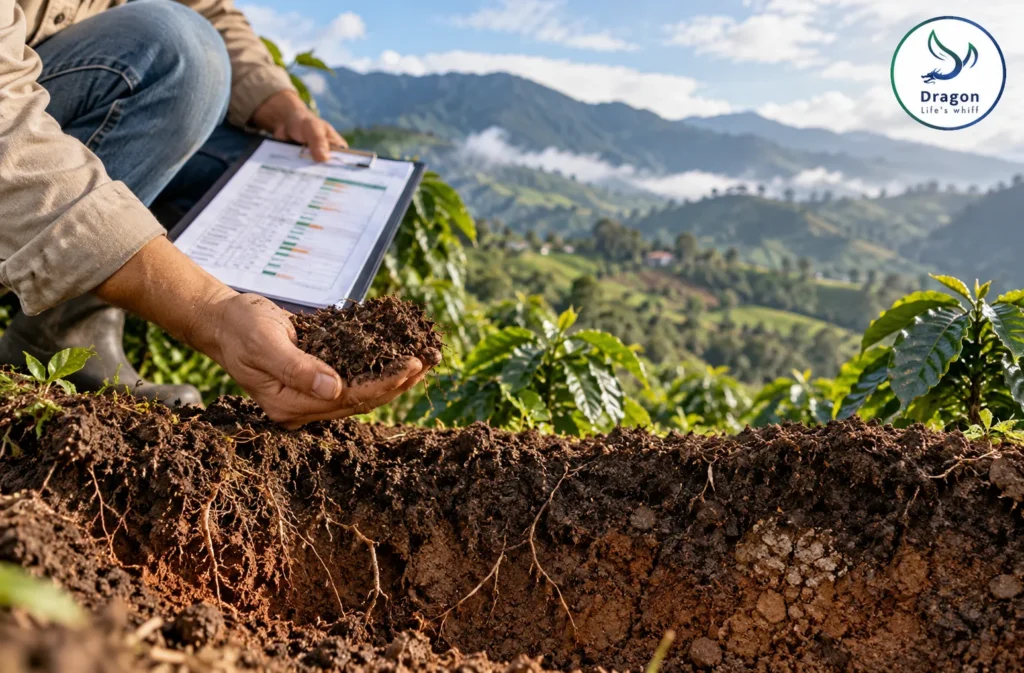
A soil analysis from the Colombian Andes, the Orinoquia or the Amazon arrives as a page of numbers. Most growers look at one of them, the pH, and decide whether to lime.
That single number hides most of what matters. Two soils at the same pH can need completely different treatment, and liming by pH alone is one of the most common ways Colombian farms either waste lime or create new problems with it.
This guide walks through the report the way an agronomist reads it.
Why acidity is the default in Colombia
According to IGAC, Colombia's soils break down roughly as follows by soil order: about 31 per cent andisols, 24 per cent inceptisols, 20 per cent entisols, 10 per cent oxisols and under 5 per cent ultisols. Most of the inceptisols and entisols are nutrient-poor and predominantly acidic, and the majority of soils in the Andean zone, the Amazon and the Orinoquia have low pH.
High rainfall is the underlying driver. Over long periods, rain leaches calcium, magnesium and potassium out of the soil and leaves acidic elements behind, above all aluminium. Acidity is not a defect peculiar to one farm. It is the natural end point of tropical weathering.
Line 1: pH
pH tells you the soil is acidic. It does not tell you how much of a problem that is.
Its real value is as a signal. Below about 5.5, aluminium starts to dissolve into the soil solution in forms that damage roots, and that dissolved aluminium is usually the actual reason the crop is struggling. Raising the pH toward that level causes the aluminium to precipitate out of solution, which is why 5.5 is a common working target in Colombian liming.
| pH range | What it usually means |
|---|---|
| Below 5.0 | Strong acidity, aluminium likely active, root damage probable in sensitive crops |
| 5.0 to 5.5 | Moderate acidity, aluminium may still be a factor depending on the other lines |
| Above 5.5 | Aluminium largely out of solution; attention shifts to calcium, magnesium and other nutrients |
Line 2: exchangeable aluminium
This is the number that should drive the liming decision far more than pH does.
Exchangeable aluminium is the aluminium held on the soil particles and able to move into solution. A soil with a high reading has a lot of acidity that lime has to neutralise before anything improves. A soil with a low reading at the same pH may need very little.
The widely used approach in tropical soils calculates the lime requirement from exchangeable aluminium rather than from pH, with a multiplying factor adjusted for the soil and crop. Research reviewing liming in the Colombian Amazon notes that calculating lime from pH and aluminium alone can still underestimate the true requirement, which is why the rest of the report matters too.
Line 3: aluminium saturation
Aluminium saturation expresses aluminium as a share of all the exchangeable cations: aluminium, calcium, magnesium, potassium and sodium together. It is the best single indicator of how hostile the soil is to roots.
A soil can have a moderate aluminium figure but still a high saturation if calcium and magnesium are very low, which means the roots are surrounded mostly by aluminium. Crops differ widely in how much saturation they tolerate. Coffee and many pastures cope with more than most vegetables and fruit trees, so the same number can be acceptable for one crop and damaging for another.
Lines 4 and 5: calcium and magnesium
These tell you what the lime needs to supply, not only what it needs to remove.
Agricultural lime supplies calcium. Dolomitic lime supplies calcium and magnesium together. If the report shows magnesium low relative to calcium, dolomitic lime corrects both problems in one pass. If magnesium is already adequate, calcitic lime avoids pushing it higher than needed.
For Hass avocado in Colombia, Agrosavia gives tentative targets from productive orchards of about 4.0 to 6.0 cmol(+)/kg for calcium and 1.5 to 2.5 cmol(+)/kg for magnesium. The guide to Hass avocado fertilization in Colombia covers those in context.
Line 6: organic matter and soil type
On andisols, the volcanic soils that dominate much of Colombia's coffee and fruit country, the rules change.
Andisols contain allophane and other active minerals that hold phosphorus very tightly and buffer strongly against pH change. That means lime moves the pH more slowly than on other soils, and applied phosphorus is fixed rapidly. The guide to coffee fertilization on Colombian volcanic soils covers this in detail.
Organic matter also matters in its own right. It can bind aluminium into less harmful forms, which is one reason high-organic-matter soils sometimes tolerate a lower pH better than their numbers suggest.
What aluminium actually does to the crop
Dissolved aluminium attacks the root tip, where growth happens. Roots become short, thickened and stubby, and the root system that should explore the soil stays small.
The consequences show up as problems that look like something else. A small root system takes up less phosphorus, calcium and magnesium, so the crop can appear deficient in those nutrients even when the soil holds them. It also takes up less water, so aluminium-affected crops wilt sooner in dry spells. Growers who add more fertilizer to fix the apparent deficiency often see little improvement, because the root that would absorb it is the thing that is damaged.
Liming properly
Once the report has been read, a few principles follow.
Base the rate on aluminium, calcium and magnesium together, not on pH alone.
Choose the material to match the report. Calcitic lime, dolomitic lime, quicklime and hydrated lime all raise pH, but they differ in speed, magnesium content and handling. Dolomite where magnesium is short, calcitic where it is not.
Incorporate where possible. Lime moves slowly downward. Surface application on its own mostly corrects the top few centimetres.
Consider gypsum for the subsoil. Gypsum does not raise pH much, but it moves calcium downward more readily than lime and can reduce aluminium toxicity deeper in the profile, where lime rarely reaches. It is often used alongside lime rather than instead of it.
Do not overshoot. Over-liming raises pH beyond what the crop needs and can induce deficiencies of zinc, manganese, boron and iron. Agrosavia's guidance on avocado specifically warns against excess lime. Retest after liming before adding more.
Where fertilizer choice fits
Lime corrects the soil. Fertilizer choice then decides whether the correction holds.
Watch the nitrogen source. Ammonium-based nitrogen and urea acidify soil as they are converted in the soil, which works against liming. On strongly acidic ground, a greater share of nitrate nitrogen avoids undoing the lime.
Supply calcium and magnesium in the crop programme. Dragon PureCal provides calcium at a neutral pH, Dragon MagiCal supplies magnesium with calcium, and Dragon Calibo adds boron alongside calcium. These do not replace lime, but they keep the crop supplied while the soil correction takes effect.
Use organic matter. Humic products such as Dragon HV15 and Dragon PK Humic support the root environment on soils where organic matter is low.
Correct micronutrients after liming. Because liming can reduce zinc, manganese and boron availability, check them on the follow-up test. Dragon Mix Plus covers the group, and foliar application bypasses soil chemistry entirely. The foliar fertilization guide covers method.
Dragon Ferti does not sell lime, and this guide is not a case for replacing it with fertilizer. The honest sequence is lime to fix the soil, then a well-chosen programme to feed the crop on the corrected ground. The same logic applies across the Andes and East Africa, as the guide to acidic soils in the Kenyan highlands shows.
Beyond Colombia
The same soils extend into Ecuador and Peru's highland and Amazon zones, and soil acidity is also linked to cadmium uptake in Andean cacao. Raising pH on acidic cacao soils is one of the better-supported ways to reduce it, covered in cadmium in cacao and the EU limits.
Conclusion
Acidity is the normal condition of most Colombian farmland, and pH is only the first line of the report. Exchangeable aluminium and aluminium saturation show how hostile the soil really is, calcium and magnesium show what the lime should supply, and soil type shows how the soil will respond. Lime on the full picture, retest before adding more, and choose fertilizers that support the correction rather than undo it. For specifications or distribution enquiries, see the Dragon Ferti range or contact the export team through the contact page.
Frequently asked questions
Why are so many Colombian soils acidic?
High rainfall over long periods leaches calcium, magnesium and potassium out of the soil and leaves acidic elements, especially aluminium, behind. IGAC data show most soils in the Andean zone, the Amazon and the Orinoquia have low pH, making acidity the normal condition rather than an exception.
At what pH does aluminium become a problem?
Aluminium begins dissolving into harmful forms below about pH 5.5. Raising the pH toward that level causes it to precipitate out of solution, which is why around 5.5 is a common working target when liming acidic Colombian soils.
Should lime rate be based on pH?
Not on pH alone. Exchangeable aluminium, aluminium saturation, calcium and magnesium give a far better basis. Two soils at the same pH can need very different amounts of lime, and liming by pH alone risks either wasting lime or over-liming.
What is the difference between lime and gypsum?
Lime raises soil pH and neutralises acidity. Gypsum raises pH very little but moves calcium into the subsoil more readily, reducing aluminium toxicity deeper in the profile where lime rarely reaches. They are often used together.
Can too much lime harm crops?
Yes. Over-liming can raise pH beyond what the crop needs and reduce the availability of zinc, manganese, boron and iron, creating new deficiencies. Retesting after liming and basing further applications on the results avoids this.
More from Blog.

Looking for a reliable specialty fertilizer partner?
We work with importers and distributors who want products that set their portfolio apart.