
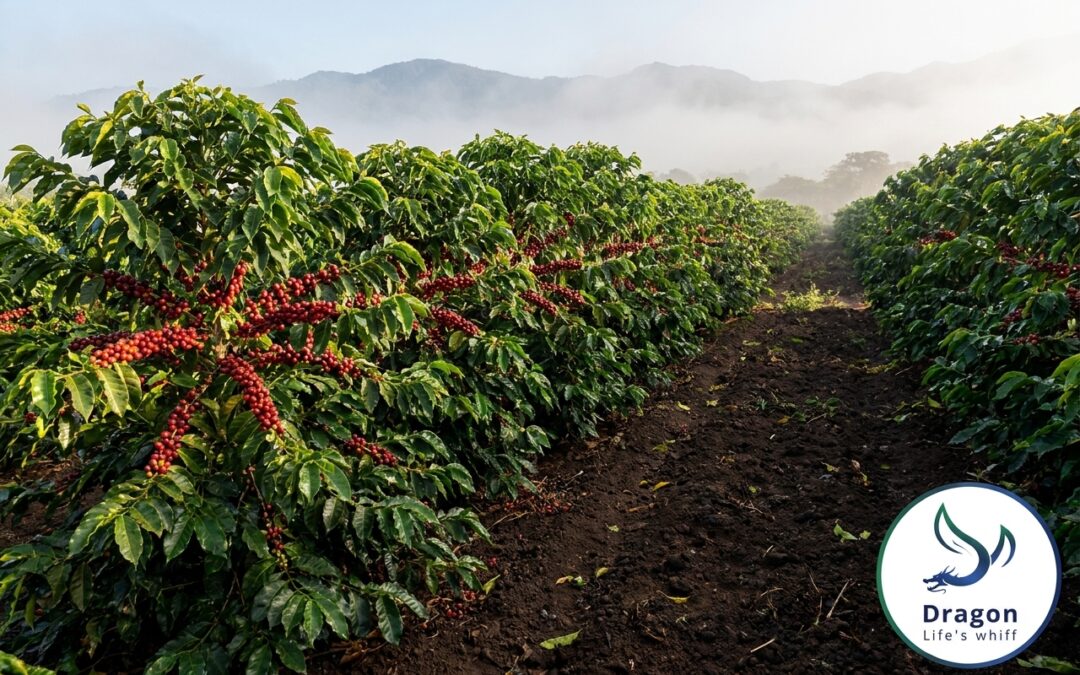
The soils of Colombia’s Eje Cafetero are some of the strangest agricultural soils on earth. They’re young, formed from volcanic ash less than ten thousand years ago. They’re high in organic matter, often 8 to 12 percent in the topsoil, two to three times richer than most agricultural soils worldwide. And they have a phosphorus problem specific to volcanic geology: amorphous aluminum and iron minerals in the clay fraction bind incoming phosphate so tightly that 80 percent or more of an applied P fertilizer becomes plant-unavailable within weeks.
These are Andisols, the technical name for volcanic-ash-derived soils. Colombia, Costa Rica, parts of Ethiopia, and a slice of Indonesia have them. They produce some of the finest specialty coffee in the world, partly because of the high organic matter and partly because of the cool altitude where they typically occur. They also break most standard fertilization protocols, because what works on a mineral soil at sea level doesn’t work on a young volcanic soil at 1,500 meters elevation.
This article walks through what a coffee fertilization program actually needs to do on Colombian Andisols, why specialty fertilizers with humic-acid chelation outperform conventional NPK on these soils, and how Dragon’s paste, soluble powder, and specialty lines apply across Caldas, Quindío, Risaralda, Antioquia, Huila, and Nariño.
The Andisol P-fixation problem
Here’s the chemistry. Colombian Andisols have what soil scientists call “allophane” and “imogolite” in the clay fraction. These are short-range-order alumino-silicate minerals with massive surface areas and high reactivity. When phosphate fertilizer hits these surfaces, it adsorbs so strongly that root acids and soil microbes can’t liberate it back into solution within the timeframe coffee roots can use it.
The practical effect: a Colombian coffee farm applying 100 kg of P₂O₅ per hectare might be making 15 to 25 kg of that phosphorus available to the plant. The rest stays bound to allophane and imogolite. Across many seasons, this fixed phosphorus accumulates in the soil but never reaches the roots.
The fix isn’t more phosphorus, which just fixes more deeply. The fix is phosphorus chemistry that works around the lockup. Two approaches:
- Humic acid chelation. Humic substances complex with phosphate and hold it in plant-available forms, bypassing the allophane lockup. Dragon PK Humic is engineered for exactly this. The humic acids in the formulation bind phosphate before it reaches the soil minerals, then release it slowly to the root zone.
- Foliar P application during high-demand windows. Bypass the soil entirely. A foliar Dragon Paste High Phosphorus spray during early flowering and bean development reaches the plant directly.
Combined, these two approaches can double or triple effective P use efficiency on Andisol soils, without applying more total phosphorus.
Coffee’s actual nutritional demand
A productive Arabica coffee plant in Colombia, yielding 1,200 to 1,800 kg of green coffee per hectare, removes roughly:
| Nutrient | Removal per ton green coffee | Annual rate at 1,500 kg/ha |
|---|---|---|
| Nitrogen (N) | 35 kg | 52 kg |
| Potassium (K₂O) | 50 kg | 75 kg |
| Phosphorus (P₂O₅) | 8 kg | 12 kg |
| Calcium (CaO) | 4 kg | 6 kg |
| Magnesium (MgO) | 4 kg | 6 kg |
| Sulfur (S) | 3 kg | 4.5 kg |
K is the heaviest demand, then N, then everything else. Cenicafé’s research over decades has confirmed K and N as the primary yield drivers on Colombian coffee, with P, Zn, and B critical at specific reproductive stages.
The other important point: coffee’s nutritional demand is highly seasonal. The vegetative phase (which sets the next year’s productivity) wants N. The flowering and fruit-set phase wants P, B, and Zn. The cherry development and fill phase wants K. Applying balanced NPK year-round wastes nutrients at every stage.
Zinc and boron deficiencies on Andisols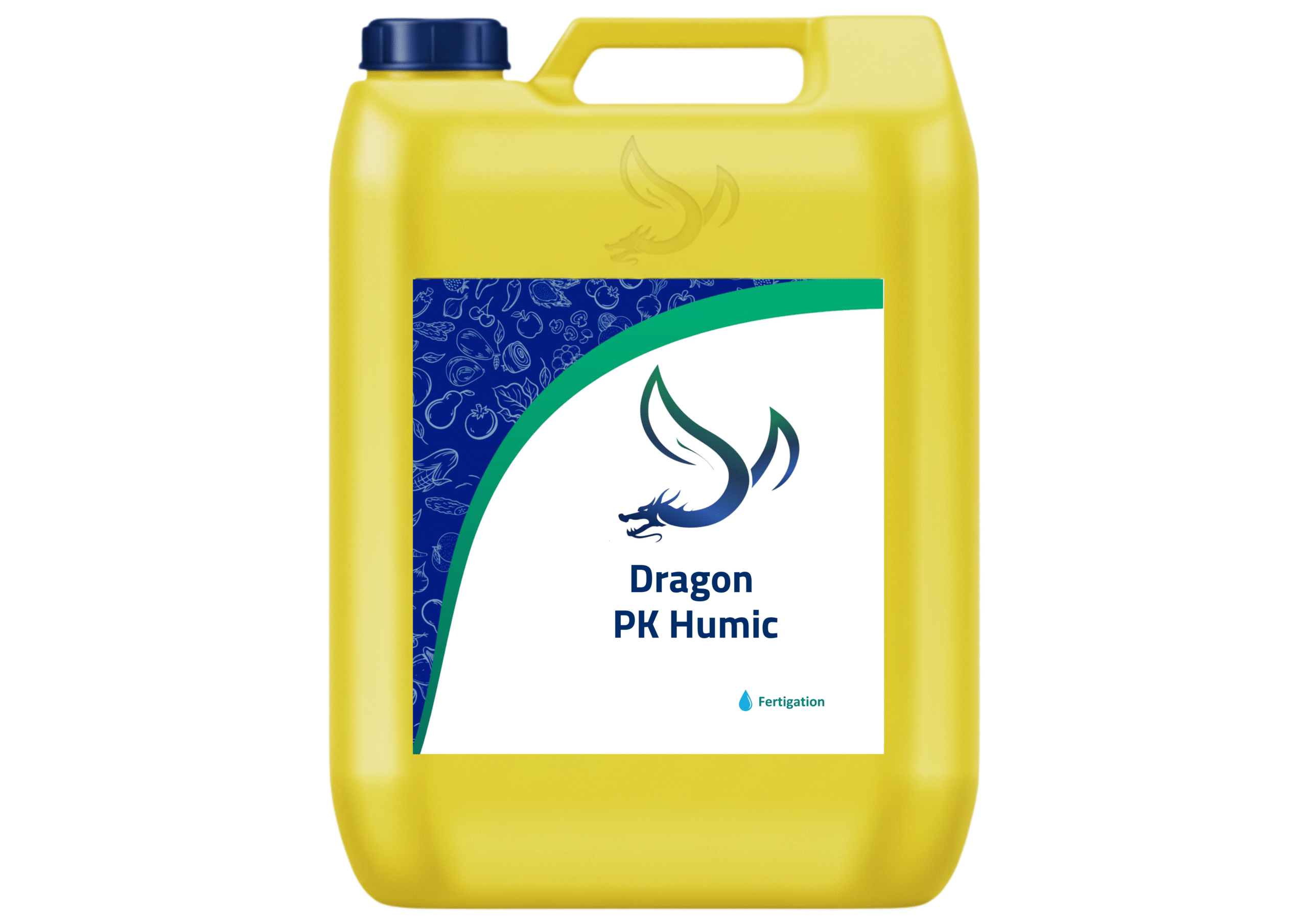
Zinc deficiency shows up on Colombian coffee as “little leaf” syndrome: small, narrow leaves at branch tips, with internodes shortened and growth visibly stunted. It’s common across Andisol soils because the same allophane that fixes phosphate also fixes zinc, and because high organic matter binds zinc into unavailable organic complexes.
Boron deficiency shows up at flowering as poor pollen viability and reduced fruit set, then later as small, malformed cherries that drop prematurely. It’s a major yield limitation in older Colombian coffee farms, especially those with intensive long-term cropping that depleted the trace soil reserves.
The corrections:
- Zinc: Dragon Zinc 13% as a foliar application twice a year minimum, once during pre-flowering and once at active vegetative growth.
- Boron: Dragon BorCal at flowering onset, with a follow-up during early cherry development.
- Multi-element maintenance: Dragon Mix Plus covers Zn, B, Mn, Cu, and Fe in a single application.
For organic-certified coffee farms, which Colombia has a growing number of, Dragon Mix is the organic-compatible alternative covering the same elements.
Building a seasonal program for Colombian coffee
Colombian coffee has two main flowering windows per year (the principal “cosecha” and the secondary “mitaca”), which means the nutrition program runs on two reproductive cycles rather than one. A generalized framework:
- Pre-flowering of each cycle: Dragon Paste High-PK plus Dragon BorCal foliar. Supports pollen viability and fruit set.
- Cherry development: Dragon Paste High Potassium drives bean fill and cup quality. K is the single most yield-correlated nutrient for coffee on Andisols.
- Vegetative phase between flowerings: Dragon Paste High Nitrogen or Dragon Fert High Nitrogen for canopy and shoot development. This is what sets the following cycle’s productivity.
- Stress recovery (drought, “veranillo”): Dragon Sea or Dragon Boost biostimulant.
- Phosphorus efficiency: Dragon PK Humic routinely, alongside the seasonal NPK program. This is the workaround for Andisol P-fixation.
- Micronutrient maintenance: Dragon Mix Plus twice per year.
The program above is for a productive Arabica farm targeting specialty cup grades (84+ points on the SCA scale). For commodity-grade farms, the same nutrients matter but at lower application intensity. For Cup of Excellence or other premium-segment producers, where green coffee can fetch $4 to $8 per pound versus $2 for commodity, the math on specialty fertilizer becomes extremely favorable.
Climate adaptation: the coffee belt is moving up
The optimal elevation for Colombian Arabica has shifted up by roughly 200 meters since the 1990s. Farms that were prime production at 1,400 m are now marginal, while new plantings at 1,800 to 2,100 m are establishing where coffee couldn’t grow before. The combination of warming temperatures and shifting rainfall is forcing farms to either invest in shade canopy and irrigation, or to relocate.
For farms managing climate stress on existing plantings, biostimulants and trace-element nutrition are increasingly important. Dragon Sea (a seaweed-based product) supports drought tolerance and stress recovery. Dragon HV15 combines humic acids with micronutrients in a single application, useful where the soil’s natural humic content is being depleted by intensified cropping.
The foliar program details and the broader specialty fertilizer ROI breakdown cover the cross-crop logic. For Colombian coffee farms, distributors serving the Eje Cafetero, or members of the Federación Nacional de Cafeteros’ commercial supply chain, the contact page is the way in.
Frequently asked questions
Why does phosphorus fertilizer work so poorly on Colombian coffee farms?
The volcanic ash that formed Colombian Andisols produces clay minerals (allophane and imogolite) with massive surface areas that bind phosphate extremely tightly. Roughly 75 to 85 percent of applied conventional phosphorus becomes plant-unavailable within weeks. The fix is phosphorus chemistry that works around the lockup: humic-chelated forms like Dragon PK Humic, or foliar P applications that bypass the soil entirely.
What’s the role of Cenicafé recommendations in fertilizer selection?
Cenicafé (the national coffee research center) provides the agronomic baseline for most Colombian coffee farms. Their fertilization recommendations are sound for commodity-grade production. For specialty-grade and premium-segment farms, the agronomic principles translate but the input quality matters more: chloride-free K sources, humic-chelated P, chelated micronutrients. Dragon products fit this premium-segment positioning.
How does fertilization affect coffee cup quality?
Cup quality is influenced by genetics, processing, and growing conditions, with nutrition playing a meaningful supporting role. Adequate K nutrition during cherry fill correlates with better sugar accumulation and cleaner cup profiles. Zinc and boron deficiency during flowering reduces yield without significantly affecting cup quality, but severe nutritional stress can produce defects (uneven ripening, small beans) that lower grades. For specialty-grade farms targeting 84+ point cups, the precision NPK programs offered by Dragon’s specialty lines protect quality at the margins.
Are Dragon products available through Colombian agricultural distributors?
Dragon ships to South America through established Caribbean and Pacific port routes. The current focus in Colombia is on building distributor relationships with input chains serving the Eje Cafetero and with cooperatives affiliated with the Federación Nacional de Cafeteros. For distributor inquiries, contact the export team via the contact page.
Which Dragon products specifically address Andisol soil chemistry?
Three products in particular: Dragon PK Humic (humic-chelated phosphorus that works around Andisol P-fixation), Dragon Mix Plus (multi-element correction for Zn and B deficiencies common on these soils), and Dragon HV15 (humic acid plus micronutrients for combined soil-health and nutrition correction). Combined with the Dragon Paste line for the seasonal NPK program, these cover the agronomic specifics of Colombian volcanic soils.