
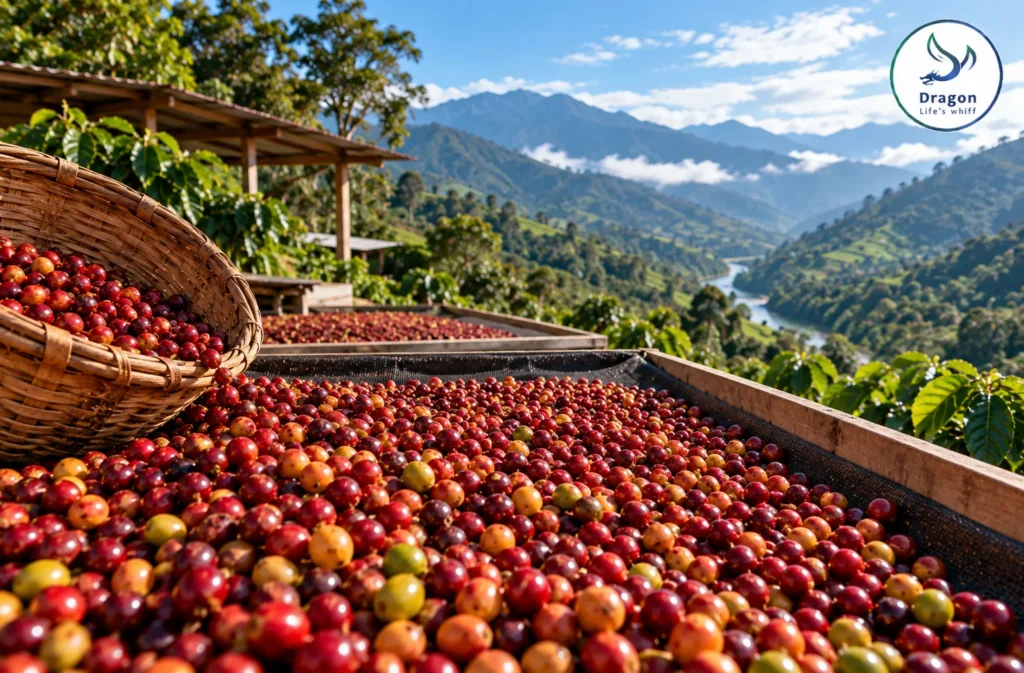
Three numbers describe Peruvian coffee better than any paragraph can.
Around 90,000 hectares under organic certification, making Peru the world's leading exporter of organic coffee.
721 kilograms per hectare, the national average yield in the 2024/25 season according to USDA estimates.
Nearly 40 per cent of the crop still affected by coffee leaf rust, the disease that swept through Peru from 2012 and 2013 onward.
Put those together and the shape of the problem is clear. Peru has built a premium market position on certification, but a large share of its farms produce too little per hectare, and a disease that arrived more than a decade ago is still taking its cut. More than 90 per cent of Peruvian coffee comes from smallholders on plots under 5 hectares, spread across Cajamarca, San Martin, Junin and Amazonas on the eastern slopes of the Andes. For most of those families, yield is income.
Why organic farms were hit hardest
When leaf rust arrived, organic producers were particularly exposed. They had fewer tools available to control the disease than conventional farms, and many were already running trees on thin nutrition.
That second point matters more than it is usually given credit for. Coffee researchers have long observed that rust does the most damage on trees that are carrying a heavy crop without the nutrition to support it. A tree that pours its reserves into a large crop and gets little back drops leaves, and a tree losing leaves to rust has less capacity to recover and less to fill the next crop with. Leaf rust is a fungal disease and needs to be managed as one, through resistant varieties, shade management and appropriate control measures. But a starved tree and a well-fed tree do not experience the same outbreak in the same way. The same line between supporting plant health and controlling a disease runs through the guide to Fusarium TR4 in Ecuadorian banana.
The economics make this harder. Labour accounts for about 58 per cent of production costs on Peruvian coffee farms and fertilizer for about 24 per cent. When budgets are tight, fertilizer is the line that gets cut. USDA noted that the recent production recovery was driven partly by higher prices allowing more fertilizer use, which is the same relationship seen in reverse.
What the tree is actually short of
Coffee on Peru's eastern slopes grows mainly between 1,000 and 1,800 metres, typically under shade, often on acidic soils with high rainfall. That combination produces a familiar set of shortfalls.
Potassium is removed heavily in the harvested cherry and drives bean fill. A tree short of potassium produces lighter beans and more defects at the cupping table.
Nitrogen builds the leaf area that the crop depends on. Under shade the demand is lower than in full sun, but it does not disappear.
Magnesium is often short on acidic, leached soils, and shows as yellowing between the veins of older leaves. It is regularly mistaken for nitrogen deficiency and treated with the wrong product.
Boron and zinc affect flowering, fruit set and the development of new growth. Both are commonly low on acidic tropical soils.
Calcium is frequently low where soils are strongly acidic, and acidity also raises aluminium, which damages roots. Where a soil test shows high aluminium, lime or another soil correction comes first. The guide to acid soils and aluminium in the Andes covers how to read those figures.
Feeding an organic coffee farm
Organic certification rules out synthetic NPK and many conventional inputs, which is where most of Peru's organic farms find themselves stuck. The options are narrower, and compost and manure alone rarely supply enough potassium and micronutrients for a productive crop on depleted soil.
The Dragon Organic line is built for that gap, with organic-compatible products covering calcium, humic nutrition and soil correction. Dragon Calibo supplies calcium with boron ahead of flowering, Dragon PureCal provides calcium on its own, and Dragon HV15 and Dragon PK Humic support the root environment on soils where organic matter has been run down. Dragon Sea supports trees recovering from stress, including defoliation.
Certification standards differ between certifiers and destination markets. Before using any input on a certified farm, confirm with your certifier that it is permitted under the standard you are certified to. That is a rule for every supplier, not only this one.
Feeding a conventional coffee farm
Conventional farms have more room to move and a clearer route to yield.
A balanced base such as Dragon Fert soluble powder supports vegetative growth after harvest and through the early season. As the crop develops, the balance should move toward potassium, with Dragon Paste High Potassium or Dragon PotaMax carrying bean fill. Dragon MagiCal covers magnesium with calcium, and Dragon Zinc or Dragon Mix Plus address micronutrients.
Most Peruvian coffee farms have no irrigation, so foliar application is the practical way to deliver micronutrients and correct a shortfall quickly. The foliar fertilization guide covers mixing order, timing and coverage.
Timing on a smallholding
With a harvest running roughly from April through September, the most useful windows for a smallholder with a limited budget are:
- After harvest, when the tree needs to rebuild leaf and reserves. This is the application most often skipped and the one that most affects next year's crop.
- Before flowering, when boron and zinc support set.
- During fruit development, when potassium drives bean fill.
If a farm can afford only one intervention, a soil test comes before any fertilizer. Spending on the wrong nutrient is the most expensive mistake a small coffee farm can make.
The regulation arriving from Europe
The EU Deforestation Regulation requires coffee sold into Europe to be traced to plots that were not deforested. Peru's National Coffee Board has warned that many small producers lack the land documentation this requires.
That is not a fertilizer question, but it points in the same direction. Producing more from existing land is the only route to growth for farms that cannot expand. Yield per hectare on current plots matters more now than it did when new land could simply be planted.
Lessons from next door
Colombia faced leaf rust at about the same time and responded with a large replanting programme using resistant varieties, alongside a more deliberate approach to fertilization. The guide to coffee fertilization on Colombia's volcanic soils covers the soil chemistry that Peru's northern coffee regions partly share.
What this means for a distributor
Peruvian coffee is sold largely through cooperatives, and cooperatives are where input decisions increasingly get made. They offer technical support, organise certification, and buy for their members.
A supplier who can serve both halves of the market, with organic-compatible products for certified members and a conventional range for the rest, is more useful to a cooperative than one who serves only one. Many highland families also grow potato further up the slope, covered in the guide to potato fertilization in the Peruvian highlands. Dragon Ferti supplies Certificates of Analysis, Technical Data Sheets, Safety Data Sheets and Free Sale Certificates, and manufactures under ISO 9001, ISO 14001 and ISO 45001 certified management systems. Every product is free of chloride, sodium and heavy metals.
Conclusion
Peru leads the world in organic coffee exports on farms that average little over 700 kilograms per hectare, with leaf rust still affecting a large part of the crop. Nutrition does not cure rust, but a well-fed tree carries its crop and recovers from defoliation far better than a starved one. Test the soil, correct acidity first, feed after harvest as well as during the crop, and on certified farms use inputs your certifier accepts. For specifications or distribution enquiries, see the Dragon Ferti range, review field trial results, or contact the export team through the contact page.
Frequently asked questions
What is the average coffee yield in Peru?
USDA estimated the national average at about 721 kilograms per hectare in the 2024/25 season, with wide variation depending on farm management. More than 90 per cent of Peruvian coffee is grown by smallholders on plots under 5 hectares, mostly shade-grown and without irrigation.
Can fertilizer prevent coffee leaf rust?
No. Leaf rust is a fungal disease managed through resistant varieties, shade management and disease control measures. Good nutrition helps trees carry their crop and recover from defoliation, and researchers have long observed that rust damage is worst on heavily cropping trees with poor nutrition, but fertilizer is not a substitute for disease management.
Which nutrients are most often short on Peruvian coffee farms?
Potassium, which drives bean fill, and magnesium, zinc and boron are commonly short on the acidic, heavily leached soils of the eastern Andean slopes. Strongly acidic soils may also carry high aluminium, which should be corrected before fertilizer can work well.
Can organic coffee farms use mineral fertilizers?
Only those permitted by their certification standard. Standards vary between certifiers and markets, so any input should be confirmed with the certifier before use. Organic-compatible calcium, humic and soil correction products can help fill the gaps that compost alone often leaves.
When should Peruvian coffee be fertilized?
The most important windows are after harvest, when the tree rebuilds leaf and reserves, before flowering for boron and zinc, and during fruit development for potassium. The post-harvest application is the one most often skipped and the one with the largest effect on the following crop.


Looking for a reliable specialty fertilizer partner?
We work with importers and distributors who want products that set their portfolio apart.