
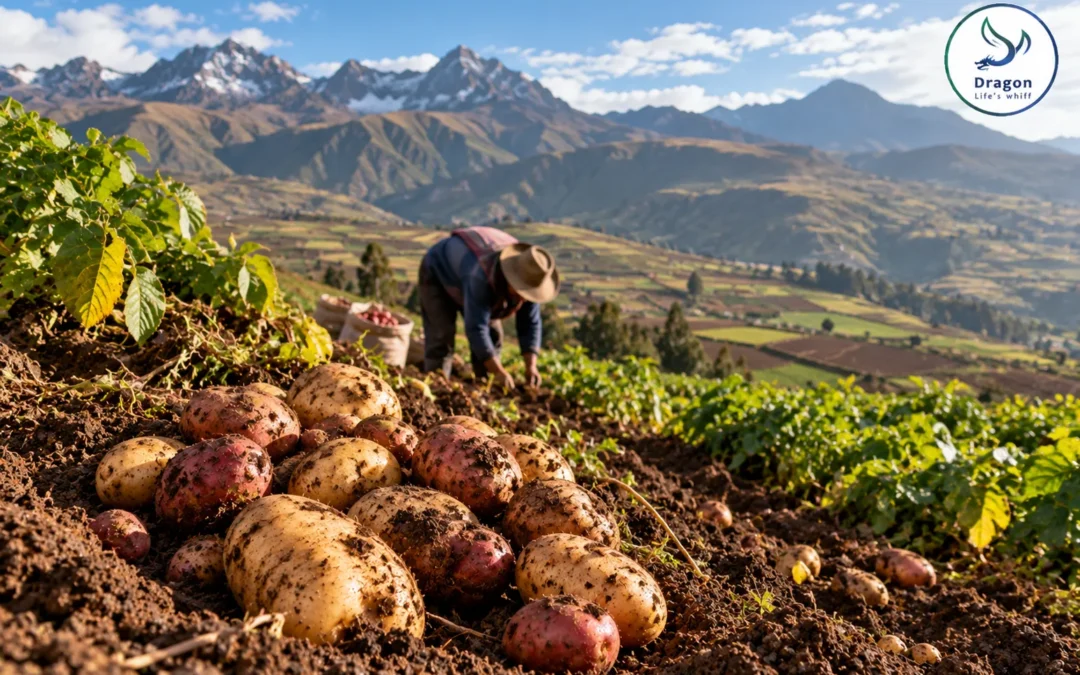
Peru grows more potatoes than any other country in Latin America. National production reached about 6 million tonnes in 2022 on some 341,000 hectares, and around 90 per cent of it comes from the Andean highlands, much of it between 2,000 and 4,500 metres.
The national average yield was about 17.6 tonnes per hectare. The International Potato Center has compared Peru’s yields with around 20 tonnes in Colombia and 60 to 80 tonnes in the Netherlands and Canada. Native potato plots in regions such as Huanuco often average closer to 12 or 13 tonnes.
The obvious response is to sell more fertilizer. The honest one is to ask where the missing yield actually goes, because fertilizer is not at the top of the list.
The yield ladder, in order
Think of the gap between a typical highland plot and a well-run one as a ladder. Each rung has to be in place before the one above it pays off.
Rung 1: seed. This is the biggest single constraint, and it has nothing to do with fertilizer. Most highland farmers replant tubers saved from their own harvest, year after year, and viruses accumulate in that seed with each generation. A virus-infected seed tuber produces a weaker plant that no amount of fertilizer can fully rescue. This is why regional programmes such as Huanuco’s native potato project focus on distributing clean, high-quality seed first, with a target of lifting yields toward 16 tonnes per hectare.
Rung 2: soil acidity. Much highland ground is acidic. Below about pH 5.5, aluminium becomes toxic to roots and phosphorus becomes locked up. Fertilizer applied to an uncorrected acid soil is partly wasted.
Rung 3: phosphorus at planting. Cold soils at altitude slow root activity and phosphorus uptake. A crop that starts short of phosphorus sets fewer tubers, and tuber number is largely decided early.
Rung 4: potassium and the rest of the programme. Potassium drives tuber bulking and quality. Magnesium, calcium and micronutrients fill in behind.
Rung 5: protecting what you have grown. Frost, late blight and pests can take a well-fed crop down in a night.
Fertilizer matters from rung two upward. But a farmer who spends heavily on rung four while planting degenerated seed on an acid soil is buying the top of a ladder with no bottom.
Why altitude changes the nutrition
Potato at 3,500 metres is not the same crop as potato at sea level, even when the variety is identical.
Cold soil works slowly. Soil microbes that release nitrogen from organic matter are much less active in cold ground. Highland soils can hold a lot of organic matter and still supply little nitrogen early in the season, when the crop needs it to build leaf.
Phosphorus moves poorly in the cold. Root uptake of phosphorus falls as soil temperature drops. That makes a well-placed starter application at planting more valuable at altitude than in warm lowland soils. Dragon Fert High Phosphorus supplies phosphorus in a fully soluble form, and Dragon Rooty supports early root development.
The season is short and weather is unforgiving. At high altitude a crop may have little margin between planting and the first hard frost. Nutrition that pushes growth late, particularly excess nitrogen, can leave the crop immature and exposed when the cold arrives.
Rain drives the calendar. Most highland potato is rainfed and planted with the rains. That means fertilizer goes in by hand at planting and hilling rather than through a drip line, and foliar sprays are the practical route for anything applied later.
Building the programme
At planting: phosphorus and a moderate nitrogen dose, placed near the seed tuber rather than broadcast. On acid soils, correct pH beforehand where possible. The guide to acid soils and aluminium in the Andes explains how to read the soil test.
At hilling: the second nitrogen application and the start of the potassium programme, as the plant moves toward tuber initiation.
During bulking: potassium carries the crop. Dragon Fert High Potassium and Dragon PotaMax support tuber fill. Calcium matters for skin quality and resistance to bruising, and Dragon PureCal supplies it. Magnesium is often short on leached highland soils, and Dragon MagiCal covers magnesium with calcium.
Micronutrients: zinc and boron are commonly low on acidic Andean soils. Dragon Zinc corrects a confirmed shortfall, and Dragon Mix Plus covers the group as a foliar spray.
After a frost or hail event: a damaged crop has to rebuild leaf quickly to keep filling tubers. Dragon Boost supports that recovery. Nothing restores leaf that has been killed outright, and it should not be sold as if it could.
Native potatoes and the quality premium
Peru holds a unique genetic inheritance, with thousands of cultivated potato varieties, many of them native to the Andes. Native potatoes increasingly reach urban markets, restaurants and snack manufacturers at a premium, and some grower organisations now sell directly to agro-industrial buyers.
That premium depends on quality as much as quantity. A snack processor cares about dry matter and frying quality, and dry matter is influenced by the potassium source. Chloride-based potash tends to lower tuber dry matter, which is covered in detail in the guide to potassium and dry matter in processing potato. Every Dragon Ferti product is free of chloride, sodium and heavy metals, which matters when a buyer is testing tubers for frying quality.
What a small grower should do first
For a family farming a hectare or two in the highlands, with little cash for inputs, the order of spending matters more than the amount:
- Clean seed, even for part of the plot, to start breaking the cycle of virus build-up.
- A soil test, to find out whether the soil is acidic and what it lacks.
- Phosphorus at planting, placed close to the seed.
- Potassium during bulking, especially where the crop is sold on quality.
Spending in that order will usually produce more than spending twice as much on fertilizer alone.
What this means for a distributor
Highland potato is a smallholder market sold through local agro-dealers, cooperatives and regional programmes, often in small quantities and at low prices. It is not a market won by bulk.
It is won by credibility. A dealer who tells a farmer that seed comes before fertilizer, and that a soil test should come before either, will sell less in the first season and more over the following five. Dragon Ferti supplies Certificates of Analysis, Technical Data Sheets, Safety Data Sheets and Free Sale Certificates, and manufactures under ISO 9001, ISO 14001 and ISO 45001 certified management systems. Soluble powder in 10 and 25 kilogram sacks suits the small quantities highland farms buy. The same honest approach is applied to the coast in the guide to fertigation on Peru’s desert coast, and to the eastern slopes in the guide to coffee fertilization in Peru.
Conclusion
Peru’s highland potato yields sit well below their potential, but fertilizer is not the first reason why. Degenerated seed, acid soil and cold-limited phosphorus uptake all come before the fertilizer programme, and each has to be addressed for the next to pay. Once they are, phosphorus at planting and potassium through bulking make the largest difference, with chloride-free potassium protecting tuber quality for premium buyers. For specifications or distribution enquiries, see the Dragon Ferti range, review field trial results, or contact the export team through the contact page.
Frequently asked questions
What is the average potato yield in Peru?
National production was about 6 million tonnes in 2022 on roughly 341,000 hectares, giving an average of about 17.6 tonnes per hectare. Native potato plots in highland regions often yield less, around 12 to 13 tonnes, while the International Potato Center has cited yields of 60 to 80 tonnes in countries such as the Netherlands and Canada.
What limits potato yields most in the Peruvian highlands?
Seed quality is generally the largest single factor. Farmers who replant their own tubers year after year accumulate viruses that weaken each new crop. Soil acidity, cold-limited phosphorus uptake, frost and late blight follow.
Why is phosphorus so important for highland potato?
Cold soils at altitude reduce root activity and phosphorus uptake, and phosphorus strongly influences early tuber set. A soluble phosphorus application placed close to the seed at planting gives the crop the start it needs when soil conditions work against it.
When should potassium be applied to potato?
Mainly from hilling through tuber bulking, when the plant is filling tubers. Potassium drives bulking and influences tuber quality, and chloride-free sources help protect dry matter where potatoes are sold for frying or processing.
Can fertilizer protect potatoes from frost?
No. Fertilizer cannot prevent frost damage. Good nutrition helps a crop rebuild leaf after partial damage, and avoiding excess late nitrogen helps the crop mature before the cold season, but frost risk is managed mainly through planting date, site choice and frost-tolerant varieties.