
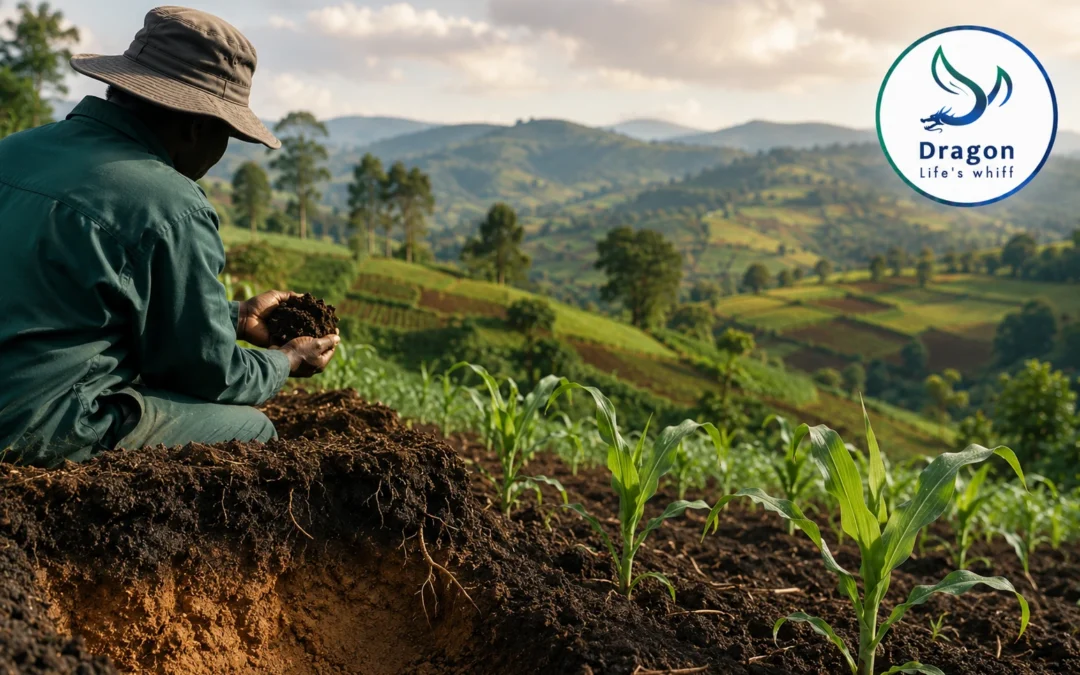
A farmer in Embu applies the same phosphorus he applied last year, and the year before. The maize still stunts. He assumes he needs more fertilizer. He almost certainly does not, because on strongly acidic ground most of the phosphorus he buys never reaches the crop at all.
Around thirteen percent of Kenya’s land is acidic, concentrated in the counties that grow the most food: Meru, Embu, Kirinyaga, Nyeri, Kiambu, Nyandarua, Tharaka-Nithi, and across the west through Siaya, Busia, Kakamega and Uasin Gishu. Study sites there have measured below pH 5, some closer to 4.
Three problems, not one
Acidity does not damage a crop in one way. It does three separate things at once, which is why partial fixes disappoint.
| What you see | What is happening | What actually helps |
|---|---|---|
| Stunted roots, poor establishment | Aluminium becomes soluble below about pH 5.2 and is directly toxic to root tips | Raise pH with lime; protect early root growth |
| No response to phosphorus | Iron and aluminium oxides bind phosphate into forms roots cannot take up | Humic-complexed P, and foliar P to bypass the soil |
| Nutrients wash straight through | Cation exchange capacity collapses, so the soil holds very little | Build organic matter; feed little and often |
The second row is the expensive one. Research in the Kenyan highlands has found the yield response to phosphorus falls as acidity saturation rises. The more acidic the soil, the less each bag does. Buying more is the wrong reflex.
This is the mirror image of the problem across North Africa and the Gulf, where high pH locks up iron and zinc. Same mechanism, opposite direction. If your soils run alkaline instead, our guide to salinity and alkaline water covers that side.
Be honest about lime
Dragon Ferti does not sell agricultural lime, so treat this as advice rather than a pitch: on strongly acidic soil, lime is part of the answer and no fertilizer replaces it. Kenyan trials at around four tonnes per hectare have lifted pH, cut exchangeable aluminium sharply and raised available phosphorus. Kenya’s own subsidy list leaves DAP out over concerns it pushes acidity further.
What fertilizer choice decides is how much of your spend survives the soil.
Getting phosphorus past the lockup
Two approaches work, and they combine well.
The first is to protect the phosphate before the soil can grab it. Dragon PK Humic holds phosphorus in humic complexes that keep it available to roots for longer instead of surrendering it to iron and aluminium oxides on contact.
The second is to skip the root zone. Foliar phosphorus applied at the stages that matter most, using a fully soluble source such as Dragon Fert High Phosphorus, delivers straight to the leaf and ignores the soil entirely.
Alongside those, Dragon Rooty supports root development through the establishment window when aluminium damage does most harm, and Dragon Corrector manages the pH of the solution in your tank so that what you mix stays available.
One caution worth stating clearly: on strongly acid soils manganese is more often present in excess than in shortage. Dragon Manganese is for a deficiency confirmed by tissue or soil analysis, not a routine addition here.
Organic matter is doing real work
Humic inputs on acid soil are not only a certification convenience. Organic matter raises cation exchange capacity, the property these soils lack most, and it buffers aluminium. That makes the Dragon Organic line useful here whether or not you are certified, with HV and PK Humic as organic-compatible versions.
A short checklist
- Test pH, exchangeable acidity, aluminium saturation and available phosphorus, not pH alone
- Lime according to the test, not by habit
- Switch to humic-complexed phosphorus rather than raising your rate
- Add a foliar phosphorus pass at establishment and at the reproductive stage
- Feed little and often, since these soils hold almost nothing in reserve
- Retest after two seasons to see whether the acidity is moving
Conclusion
The instinct to buy more phosphorus when phosphorus stops working is understandable and it is expensive. On acidic highland soil, the useful moves are correcting the acidity itself, choosing a phosphorus form the soil cannot immediately lock away, and using foliar feeding to bypass a hostile root zone. Start with a soil test. To match a programme to your results, see the Dragon Ferti range or contact the team through the contact page.
Frequently asked questions
How do I know if soil acidity is my real problem?
A soil test reporting pH, exchangeable acidity and aluminium saturation will tell you. pH alone is not enough, because two soils at the same pH can hold very different amounts of exchangeable aluminium. Above roughly twenty percent aluminium saturation, most maize varieties grown in Kenya suffer visibly.
Will fertilizer alone fix an acidic soil?
No, and any supplier who says otherwise is overselling. Lime corrects the acidity. Fertilizer choice determines how much of your spend survives contact with the soil while pH is still low, and how much you can deliver by other routes such as foliar. The two work together.
Why is DAP a concern on these soils?
Diammonium phosphate acidifies over time, which is why Kenya left it off the national subsidy list. On soil that is already strongly acidic, repeatedly adding an acidifying phosphorus source works against you even though the label promises phosphorus the crop needs.
Does foliar phosphorus really work, or is it a stopgap?
It works for targeted correction and is the fastest way to reach a crop whose roots are struggling. It is not a full substitute across a season, because the quantity a leaf absorbs is limited. Treat it as a precision tool for critical stages while you fix the soil underneath.