
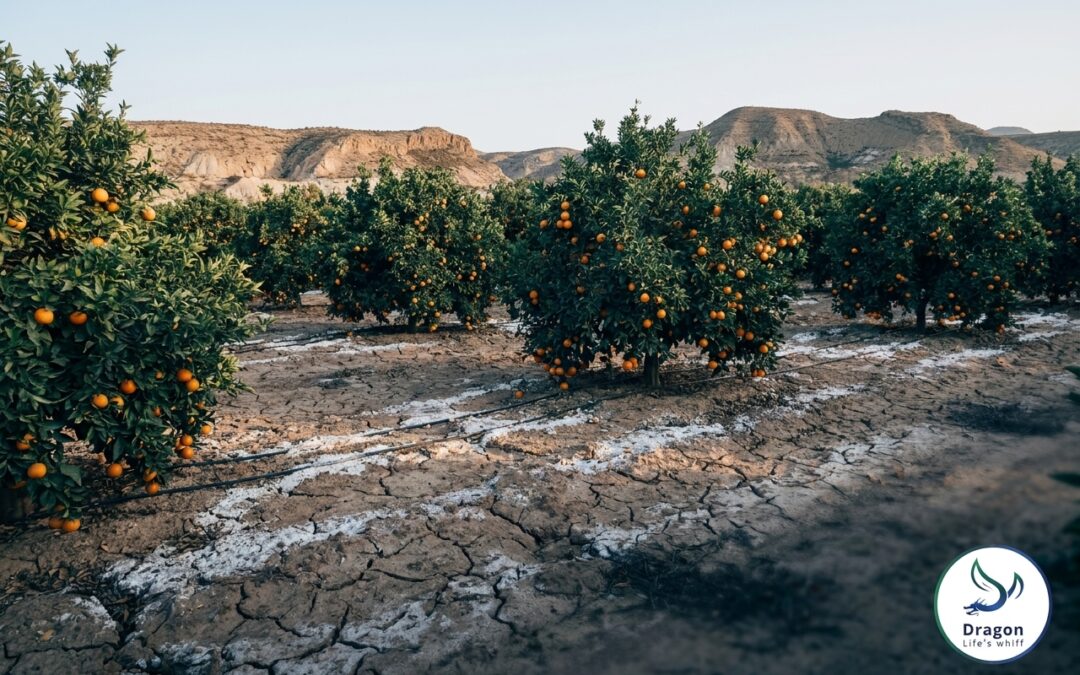
Across much of the Middle East, North Africa, and the world’s irrigated drylands, the water that keeps farms alive is also slowly working against them. It carries salt. It runs alkaline. It is loaded with bicarbonate. And it quietly wrecks fertilizer programs that were designed for clean, neutral water.
If your irrigation water reads above pH 7.5, if your soil shows white crusting, or if your drip emitters clog with scale by mid-season, this is your problem. The good news is that it is manageable. The fix is part water chemistry, part product selection, and part program design.
Two different problems, often confused
Salinity and sodicity get lumped together, but they are not the same thing and they do not have the same solution.
| Problem | What it is | Main effect | Core fix |
|---|---|---|---|
| Salinity (high EC) | Total dissolved salts in soil or water | Plant cannot draw water, “physiological drought” | Leaching, salt-tolerant program, chloride-free inputs |
| Sodicity (high SAR) | Sodium dominating the soil exchange sites | Soil structure collapses, water will not infiltrate | Calcium to displace sodium, then leach it away |
A field can have one, the other, or both. Treating a sodium problem with more leaching alone will not fix the structural collapse, and treating a salinity problem with calcium alone will not lower the salt load. Knowing which one you have is the first step, and it comes from a soil and water test, not a guess.
Why alkaline water sabotages fertilizer
High-bicarbonate, high-pH water causes three failures at once.
- Nutrient lockup. Iron, zinc, manganese, and phosphorus precipitate into forms roots cannot absorb. A soil test can read “adequate iron” while the crop shows clear chlorosis, because the iron is present but unavailable.
- Tank and line scaling. Calcium and bicarbonate react to form carbonate scale that builds up inside drip lines and blocks emitters. Water distribution across the field turns uneven, and yield follows.
- Reduced fertilizer efficiency. Phosphate applied through alkaline water can precipitate before it ever reaches the root.
The single most useful chemical tool against this is an acidifying fertilizer. Dragon Paste is formulated at pH 2.5, so when it is injected into alkaline irrigation water it pulls the solution pH down into a usable range and dissolves the bicarbonate scale that would otherwise build up at the emitters. For growers on deep-well water above 200 ppm bicarbonate, that property alone changes how a season runs.
The role of calcium against sodium
When sodium dominates a soil, it breaks down soil structure: clay particles disperse, pores seal, and water stops infiltrating. The remedy is to flood the exchange sites with calcium, which displaces the sodium so it can be leached away below the root zone.
Dragon PureCal and Dragon Calibo supply soluble calcium that does this work while also feeding the crop. Applied through fertigation, calcium serves double duty: it protects soil structure and it strengthens fruit cell walls for better quality and shelf life.
Why chloride-free matters double here
On a field that is already fighting salt, every input that adds more salt makes the problem worse. Most cheap potassium fertilizer is potassium chloride, which loads both chloride and a salinity burden into soil that cannot afford either. Chloride-sensitive crops like citrus, grape, avocado, and stone fruit suffer first.
Dragon’s lines are free of chloride and sodium across every formulation, so they feed the crop without adding to the salt load. On saline ground, that is not a marketing nicety, it is a basic requirement.
A practical program for difficult water
Pulling it together, a working approach on saline or alkaline ground looks like this:
- Test first. Water EC, pH, bicarbonate, and SAR; soil EC and exchangeable sodium. Repeat seasonally.
- Acidify the solution. Use pH 2.5 paste or a tank corrector to bring fertigation water into the 5.5 to 6.5 range.
- Feed little and often. Frequent light fertigation beats heavy weekly doses, which spike salinity in the root zone.
- Build in a leaching fraction. Apply slightly more water than the crop needs so salts move below the roots rather than concentrating around them.
- Use chloride-free, sodium-free inputs. Stop adding to the problem.
- Supply calcium continuously to manage sodium and protect soil structure.
This is the same logic that runs through the country programs for Iraq, the Jordan Valley, Egyptian citrus, and Saudi desert agriculture, where salt and alkaline water are the defining challenge. Reading the product spec sheets correctly helps you confirm an input is genuinely chloride-free before you buy it.
To match a program to your specific water analysis, the team is reachable through the contact page, and the full product catalog lists the relevant lines.
Frequently asked questions
How do I know if my problem is salinity or sodicity?
A soil and water test tells you. Salinity shows up as high EC (total salts). Sodicity shows up as a high SAR or high exchangeable sodium percentage, usually alongside poor water infiltration and crusting soil. Many drylands have both at once, which is why testing beats guessing.
Can an acidifying fertilizer really fix alkaline irrigation water?
It can correct the fertigation solution pH and prevent bicarbonate scaling in the lines, which solves a large part of the problem. Dragon Paste at pH 2.5 lowers solution pH on injection. For very high bicarbonate water, a dedicated tank corrector adds further control. It does not change the underlying water source, but it makes that water usable for an effective program.
Why is chloride-free fertilizer important on saline soil?
Saline soil already carries more salt than the crop can comfortably handle. Potassium chloride, the most common cheap potassium source, adds both chloride and additional salinity. Chloride-free inputs feed the crop without worsening the salt load, which matters most for chloride-sensitive crops like citrus, grape, and avocado.
How does calcium help with sodium-affected soils?
Sodium breaks down soil structure by dispersing clay and sealing pores. Calcium displaces sodium from the soil exchange sites, allowing the sodium to be leached below the root zone and letting soil structure recover. Soluble calcium products like Dragon PureCal deliver this through fertigation while also feeding the crop.