
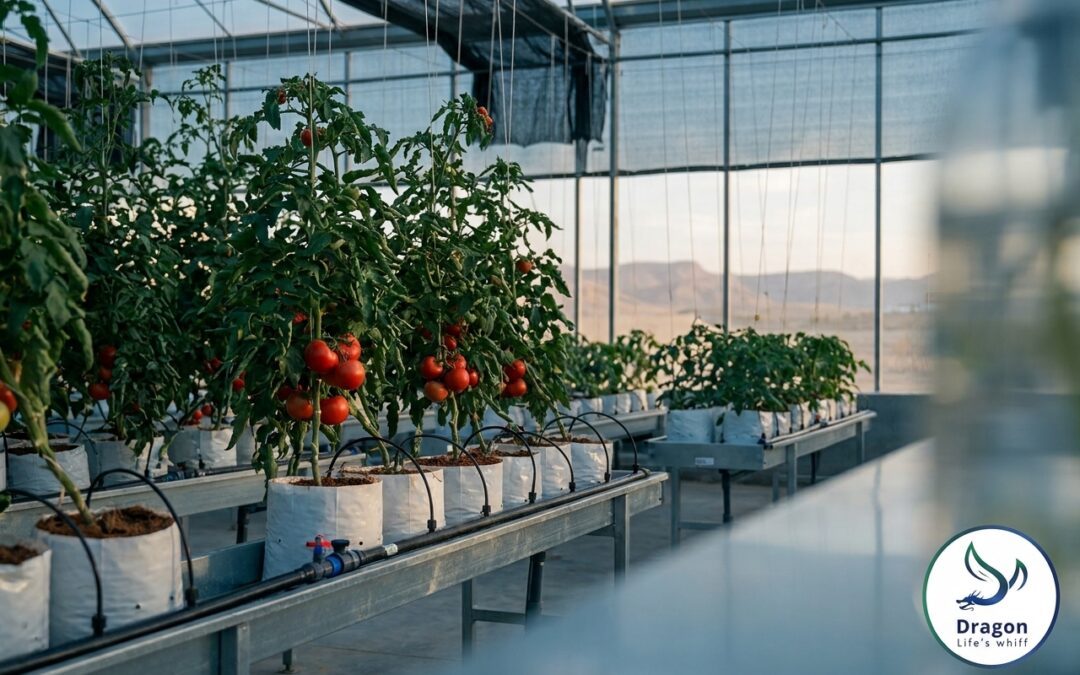
In an open field, the soil forgives mistakes. It buffers pH swings, holds a reserve of nutrients, and releases them slowly through microbial activity. Inside a greenhouse, especially a soilless one, none of that safety net exists. Every nutrient the plant receives comes from the fertigation tank, and every error in that tank reaches the roots within hours.
That is the core fact of protected cultivation. It is also why greenhouse growing delivers the highest yields in agriculture, and why it demands the most precise fertilizer program of any production system.
Why protected cultivation is different
A greenhouse or net-house removes the variables that limit open-field yield: weather, pests, evaporation, and inconsistent water. In exchange, it hands the grower total responsibility for nutrition. There is no soil reservoir to fall back on. In rockwool, coir, or perlite systems, the substrate is essentially inert, holding water and roots but contributing almost no nutrients of its own.
This is why commodity granular fertilizer has no place in protected cultivation. The program has to be built on fully water-soluble inputs that dissolve completely, leave no residue to clog emitters, and can be dialed to an exact recipe. Dragon’s soluble powder and liquid lines are built for exactly this kind of total-control feeding.
The base nutrient solution
Every greenhouse program starts with a target nutrient solution defined by two numbers: EC and pH.
EC (electrical conductivity) measures the total concentration of dissolved nutrients. Too low and the crop starves; too high and it suffers salt stress and stops drinking. pH governs whether those nutrients stay available for the roots to take up.
| Crop / stage | Target EC (mS/cm) | Target pH |
|---|---|---|
| Young transplants | 1.5 – 2.0 | 5.5 – 6.0 |
| Vegetative growth | 2.0 – 2.5 | 5.5 – 6.2 |
| Flowering / fruit set | 2.5 – 3.0 | 5.8 – 6.2 |
| Fruit fill (tomato, pepper) | 3.0 – 3.5 | 5.8 – 6.2 |
These are starting points, not absolutes. Saline source water, high light, or a salt-sensitive variety all shift the targets. The discipline is to set a target, then measure and correct against it continuously.
Stage-based feeding for fruiting vegetables
Greenhouse tomato, pepper, and cucumber follow the same broad nutritional arc, with potassium taking the lead as fruit develops.
- Establishment: higher phosphorus to drive rooting, modest nitrogen. A high-phosphorus or balanced soluble feed works here.
- Vegetative growth: nitrogen-led feeding for canopy and structure.
- Flowering and fruit set: balanced N-P-K with added calcium and boron. Dragon BorCal supports set and reduces blossom-end disorders.
- Fruit fill: potassium-led feeding for size, color, and flavor, with calcium running continuously for firmness and shelf life through Dragon PureCal.
The calcium thread runs through the whole fruiting phase. Blossom-end rot in tomato and pepper is a calcium-transport failure, not always a calcium-shortage one, so continuous low-dose calcium through fertigation outperforms occasional heavy applications.
Micronutrients in soilless systems
Because the substrate contributes nothing, micronutrients have to be supplied and kept available in the tank. Iron is the one to watch. It deficiency-flags fast as interveinal chlorosis on young leaves, and it precipitates easily if pH or EC drifts. A stable chelated iron such as Dragon Iron 10% holds up across the working range, and Dragon Mix Plus covers the full micronutrient set in one addition. Magnesium often needs separate supplementation in coir, which is naturally low in it.
Controlling drift
A greenhouse program is never “set and forget.” Three things drift and need active management:
- EC creep: salts accumulate in the substrate over time. Monitor run-off EC and flush when it climbs.
- pH swing: the crop’s own nutrient uptake shifts solution pH. A tank corrector keeps it in range.
- Nutrient antagonism: too much of one nutrient blocks another. Excess potassium suppresses calcium and magnesium uptake, a common cause of fruit-quality problems.
The foundation under all of it is water quality. If your source water is alkaline or saline, the greenhouse program has to start there, which is covered in detail in the guide to managing salinity and alkaline water.
Where this applies
Protected cultivation is expanding fastest in exactly the markets where open-field conditions are hardest: Saudi Arabia’s Vision 2030 greenhouse projects, the Jordan Valley, the developing protected sector in Kurdistan, and substrate fruit systems like Peruvian blueberry and Kenyan cut flowers. The agronomy is the same everywhere: total control, soluble inputs, constant measurement.
To design a greenhouse program around your crop, substrate, and water, the team is reachable through the contact page, and the full product catalog lists every soluble and specialty line.
Frequently asked questions
What EC and pH should I target in a greenhouse nutrient solution?
It depends on crop and stage, but most fruiting vegetables run between EC 1.5 and 3.5 mS/cm, rising as the plant moves from transplant to fruit fill, with pH held between 5.5 and 6.2. Saline source water or salt-sensitive varieties lower the EC target. Set a target for your situation, then measure and correct against it rather than assuming it holds steady.
Why can’t I use granular fertilizer in a greenhouse?
Protected and soilless systems deliver every nutrient through the irrigation water, so the fertilizer must be fully water-soluble. Granular product does not dissolve cleanly, leaves residue that clogs emitters, and cannot be dosed to a precise recipe. Soluble powders and liquids are the only practical option for fertigation.
How do I prevent blossom-end rot in greenhouse tomato and pepper?
Blossom-end rot is usually a calcium-transport failure rather than a simple shortage, so the fix is continuous calcium supply during fruit development rather than a single large dose. Run soluble calcium such as Dragon PureCal through fertigation throughout the fruiting phase, and avoid excess potassium, which suppresses calcium uptake.
What is EC creep and how do I manage it?
EC creep is the gradual build-up of salts in the substrate as the crop takes up water faster than nutrients. Monitor the EC of the run-off (drainage) solution. When it rises above your target, flush the substrate with lower-EC solution to bring it back down. Left unmanaged, it causes salt stress and stalls growth.