
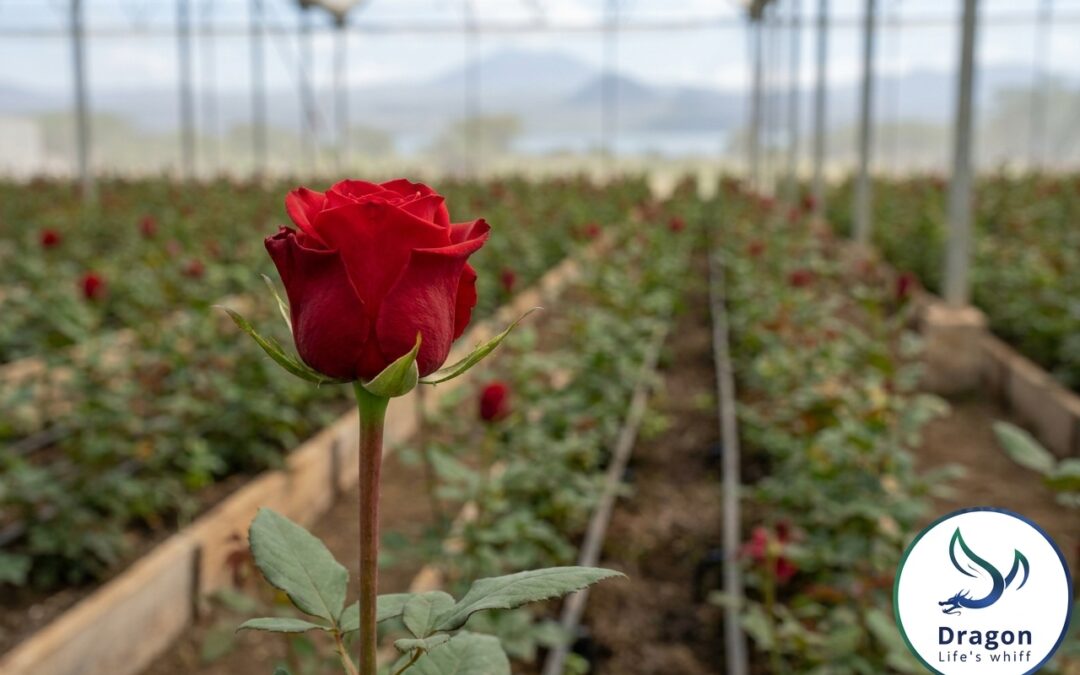
A Kenyan rose grower’s job isn’t to grow roses. It’s to land a flower at the Royal FloraHolland auction in Aalsmeer, or at a Tesco distribution center in Reading, that meets a specific set of measurable quality criteria – stem length, stem strength, head size, color uniformity, vase life – and that passes residue testing on the way there.
The economic gap between a flower that grades up and a flower that gets rejected can be 4x to 6x the price per stem. That gap is what Kenyan flower production is actually optimized around, and most of the optimization runs through nutrition.
This article covers what a serious fertilization program looks like for Kenyan cut-flower operations exporting to European markets, with specific focus on roses (the dominant crop) but applicable to hypericum, summer flowers, and statice. The agronomic principles apply across the Naivasha cluster, Kiambu, Nakuru, and the Mt. Kenya region.
What European buyers actually measure
Kenyan flower exports – roughly $700 million annually – flow primarily to the Dutch auction system and direct contracts with European supermarket chains. Both channels grade flowers on the same physical criteria, plus regulatory compliance.
| Criterion | What it measures | Nutrition’s role |
|---|---|---|
| Stem length | 60, 70, 80, 90+ cm grades | N and K drive vegetative growth |
| Stem strength | Resistance to bending | K, Ca, Si for cell wall integrity |
| Head/bud size | Diameter at packing | P at bud initiation, B and Ca during development |
| Color uniformity | Saturation and consistency | Fe, Mn, micronutrient balance |
| Vase life | Days from packing to wilt at consumer | Ca-mediated cell wall durability |
| Residue compliance | EU MRL (maximum residue limits) | Input traceability and certification |
| Chemical traceability | Documented input chain | Supplier certification |
Stem length sets the base price. Stem strength and head size move the flower between grades. Vase life sets the customer’s willingness to come back next week. Residue compliance and traceability determine whether the buyer accepts the flower at all.
Of those criteria, vase life is the one that surprises growers most often. Two roses of identical size and color can have wildly different vase performance based on calcium nutrition during the last three weeks before harvest. The calcium that ends up in petal cell walls during late development is what holds the flower together for ten days on a consumer’s counter – and that calcium has to be delivered through fertigation in continuous low doses, not a single high dose.
The chloride-free argument
Roses are chloride-sensitive. Chloride accumulation in leaf tissue shows up as scorched leaf margins by year two of cultivation, and as reduced flower size and dulled color by year three. Many growers fertilize with commodity potassium chloride for years before noticing the cumulative effect – and once it’s in the soil or substrate, getting it back out is slow and expensive.
Dragon Paste, Dragon Fert soluble powder, and Dragon Liquid are free of chloride, sodium, and heavy metals across every formulation. For Kenyan rose operations – especially those running year three or older on the same beds – this is the single most important spec to match. Switching from a chloride-bearing K source to chloride-free Dragon products usually shows up as improved leaf color and flower quality within one production cycle.
Iron chelation in Naivasha volcanic soils
Naivasha’s volcanic soils are mineral-rich. They’re also often alkaline at depth, with calcareous patches that lock up iron and manganese exactly the way calcareous soils in Egypt or Algeria do. Roses on volcanic Naivasha land routinely show interveinal chlorosis on young leaves, which growers correct with iron sulfate sprays that work for two weeks and then need to be repeated.
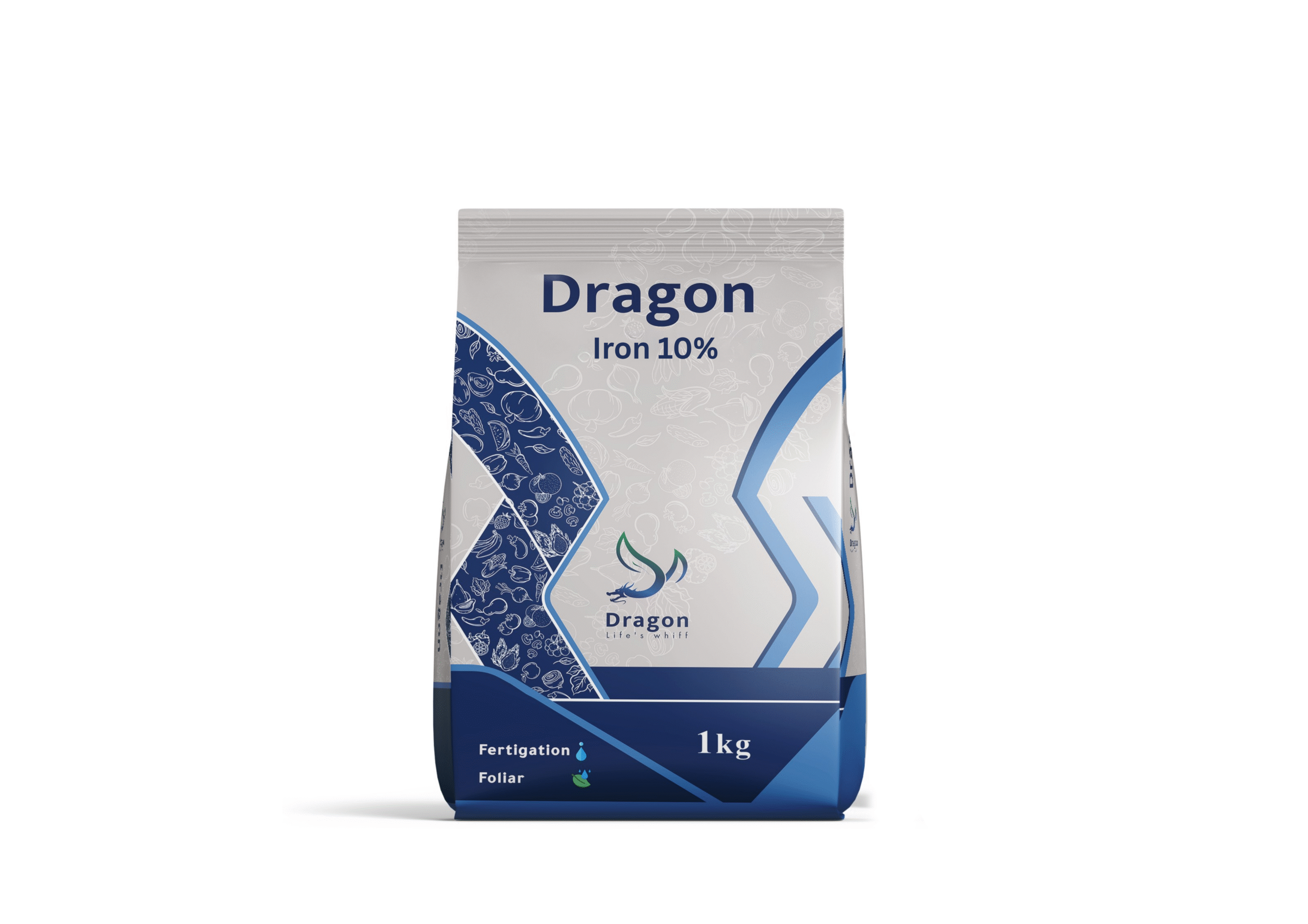
The fix is chelated iron, not iron sulfate. Dragon Iron 10% is a stable chelate that stays plant-available across the pH range Naivasha soils actually produce in the root zone. Applied through fertigation, it loads into developing leaves and stays there. Corrections last weeks rather than days, and the visible chlorosis pattern shifts permanently.
The same principle applies to Mn deficiency, addressed with Dragon Manganese 13%, and to the multi-element corrections that show up across most Naivasha greenhouse operations after the second production cycle – handled with Dragon Mix Plus as a routine maintenance application every 2-3 weeks.
Building a year-round program
Kenyan rose production runs continuously – there’s no off-season. The fertigation program adjusts weekly based on flush status across the beds. A generalized weekly framework:
- Vegetative drive between flushes: Dragon Fert High Nitrogen or Dragon Paste High Nitrogen at moderate dose. Drives stem elongation.
- Bud initiation: Dragon Paste High-PK plus foliar Dragon BorCal. B and Ca support bud development.
- Bud development through harvest: Dragon PureCal continuous through drip – the vase-life-determining window. Two to three small doses per week.
- Post-harvest recovery: Dragon Sea or Dragon Boost – biostimulant support after a flush.
- Routine micronutrient maintenance: Dragon Mix Plus every 2-3 weeks. Dragon Iron 10% as needed for chlorosis.
- Foliar adhesion: Dragon Stick added to foliar sprays. Improves droplet retention on rose leaves, which are waxy and shed water-based sprays easily.
The foliar fertilization guide covers the spray side in detail. For greenhouse roses specifically, foliar adds rapid correction capacity on top of the fertigation backbone – not as a replacement.
Compliance and supplier certification
EU buyers – especially the supermarket direct-contract channel – increasingly require documented chemical input traceability across the supply chain. Dragon’s positioning as a Jordanian manufacturer with contamination-free production gives Kenyan flower operations a clean traceability story for their European buyer audits.
The specialty fertilizer ROI case for export-oriented agriculture applies to Kenyan floriculture directly: the value isn’t in raw yield, it’s in moving the grade-up fraction from 70% to 85% on flowers that command 4x the price at the top grade. For Kenyan flower farms, distributors serving the Naivasha and Mt. Kenya clusters, or members of the Kenya Flower Council, the contact page is the way in. The full product catalog covers all six lines.
Frequently asked questions
What chloride level is safe for rose production?
Cumulative chloride in the substrate or root-zone soil above 50-70 ppm starts to show visible quality effects in chloride-sensitive rose varieties – earlier in some cultivars. The practical answer is to use chloride-free fertilizers from day one, especially for K sources. Switching off potassium chloride to chloride-free K (as in Dragon Paste High Potassium or Dragon Fert High Potassium) is the single biggest input change for long-term rose quality.
How does fertilization affect rose vase life?
Vase life is largely determined by calcium loading in petal cell walls during the last three weeks before harvest. Continuous low-dose calcium through fertigation (Dragon PureCal or Dragon Calibo) outperforms single high-dose applications. Boron supports the same cell-wall mechanism. A rose with adequate Ca-B nutrition during bud development can hold 10-14 days of vase life; the same variety with calcium deficiency typically wilts at 5-7 days.
What’s the best foliar program for greenhouse roses in Naivasha?
Routine maintenance with Dragon Mix Plus every 2-3 weeks covers most micronutrient needs. Add Dragon Iron 10% during early flush stages on plants with chlorosis history. BorCal foliar at bud initiation supports head development. Dragon Stick in every spray improves droplet adhesion on waxy rose foliage. Spray during the cooler hours (early morning or evening) to maximize uptake without leaf damage.
Are Dragon fertilizers compliant with EU MRL standards?
Dragon products are produced free of chloride, sodium, and heavy metals, with traceable sourcing from Jordanian Potash and Phosphate reserves. For EU MRL compliance, the relevant factors are heavy-metal trace content (Dragon products test free) and chemical-input documentation, which Dragon provides on request for export-channel buyers. For specific certification documentation, contact the export team via the contact page.
Which Dragon products work best for Kenyan floriculture’s volcanic alkaline soils?
Chelated micronutrients are the key – Dragon Iron 10%, Dragon Mix Plus, Dragon Manganese 13% – because alkaline patches in Naivasha volcanic soils lock up these elements just as MENA calcareous soils do. For the NPK base, Dragon Paste’s pH 2.5 actively counteracts the alkaline-water bicarbonate problem. Dragon PureCal handles the calcium nutrition that drives stem strength and vase life. A complete program rotates these through fertigation week by week.