
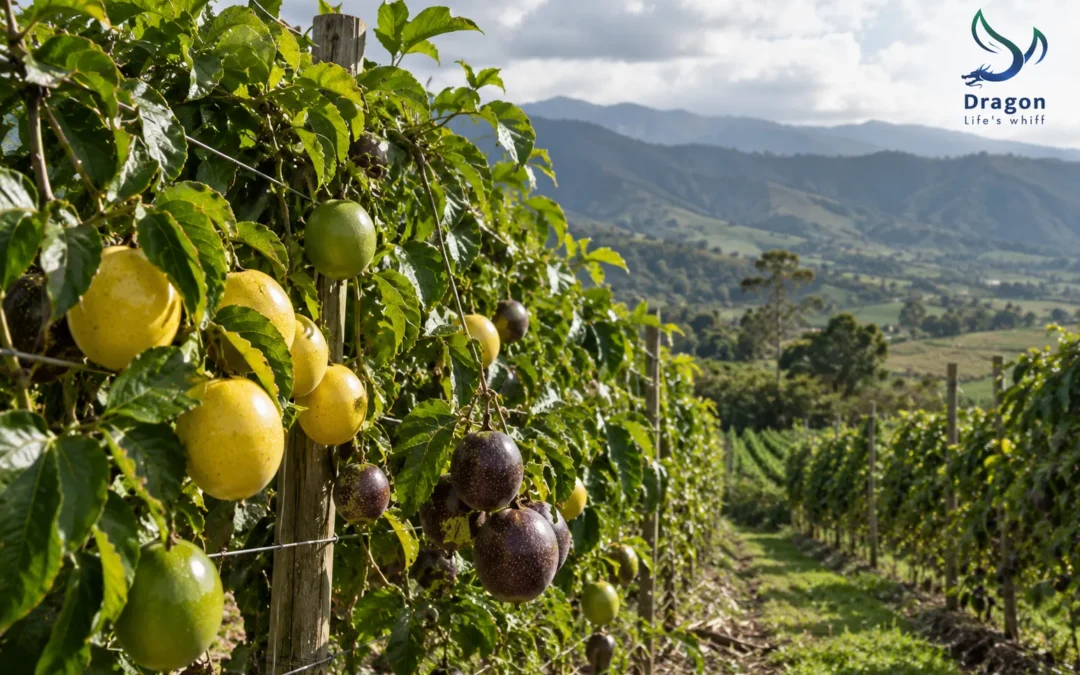
Colombia grows passion fruit in almost every corner of the country. Agrosavia counts around 24,000 hectares of passifloras spread across 24 departments and more than 400 municipalities, concentrated in Huila, Antioquia, Meta and Tolima.
Two of those fruits matter most commercially, and they could hardly be run more differently. Yellow maracuya is grown mainly for the domestic juice and pulp market. Purple gulupa is grown in the highlands and shipped to Europe. According to Analdex figures based on DIAN data, gulupa accounts for about 91 per cent of Colombia’s passion fruit exports, with 43.4 million dollars shipped in the first nine months of 2024 alone, mostly to the Netherlands, the United Kingdom, Germany, Belgium and Canada. Maracuya exports over the same period were under one million dollars.
Same genus, very different businesses. The nutrition has to follow the business. Passion fruit also sits alongside other exotic fruits Colombia and its neighbours now ship abroad, such as the pitahaya grown across Ecuador.
Two fruits side by side
| Maracuya (yellow) | Gulupa (purple) | |
|---|---|---|
| Main market | Domestic juice and pulp | Fresh export, mainly Europe |
| Growing zone | Warm lowlands and mid-slopes | Highlands, roughly 1,800 to 2,200 metres |
| What the buyer pays for | Juice volume and pulp yield | Appearance, skin condition and shelf life after a long journey |
| Main quality risk | Low juice content, poor fruit fill | Wrinkled or damaged skin, short shelf life |
| Pollination | Highly self-incompatible, depends on large bees | Less dependent on specific pollinators |
The table shows why a single passion fruit programme does not work. A maracuya grower wants every fruit full of juice. A gulupa grower wants every fruit to look perfect in a Dutch supermarket two or three weeks after picking.
The problem nutrition cannot solve
Before discussing fertilizer, the biggest constraint on maracuya yield deserves to be stated plainly, because it has nothing to do with fertilizer.
Maracuya is strongly self-incompatible. Its flowers need pollen from a different plant, carried mainly by large carpenter bees of the genus Xylocopa. Research on Colombian maracuya describes cross-pollination by these bees as the main natural mechanism, and many growers resort to assisted or hand pollination where bees are scarce.
Where pollinators are missing, flowers do not set fruit, and no quantity of fertilizer will change that. Protecting bee habitat near the crop, avoiding insecticide sprays during flowering hours, and assisted pollination where needed do more for maracuya yield than any nutrient. A supplier who tells a grower otherwise is not being honest.
Nutrition matters once pollination is working, because it decides how many of the pollinated flowers go on to become full, heavy fruit.
Feeding maracuya for juice
Maracuya is a vigorous vine that flowers and fruits over a long period, so it needs steady feeding rather than a few large doses.
Potassium is the nutrient of juice. It drives fruit fill, juice content and sugar, which is exactly what a juice buyer pays for. Dragon Paste High Potassium and Dragon PotaMax carry the fruiting period.
Nitrogen builds the vine, but not too much. A strong vine is needed to carry the crop, but excess nitrogen produces leaf and shoot at the expense of flowers and fruit, and a dense canopy invites disease.
Boron and calcium support flowering and set. Boron is needed for pollen tube growth and fertilization, so it helps a pollinated flower actually become a fruit. Dragon Calibo supplies calcium with boron ahead of flowering, and Dragon Flowering supports the set.
Feeding gulupa for Europe
Gulupa grows at altitude, where temperatures are cooler and more even, and it is judged by a far stricter standard. The skin has to arrive in good condition, and the fruit has to last.
Calcium for skin and shelf life. Calcium strengthens cell walls, which supports firm tissue and sound skin through transport and storage. It has to be supplied while the fruit is developing, because it is not moved into the fruit later. Dragon PureCal supplies calcium through fruit development.
Potassium balanced against calcium. Potassium supports fruit fill and flavour, but pushed too hard it competes with calcium uptake and can weaken the very skin quality the export buyer checks. The two need balancing rather than each being maximised.
Restrained nitrogen late in the season. Excess nitrogen as fruit matures produces softer fruit with a shorter shelf life, a costly result for a fruit that spends weeks in transit.
Magnesium and micronutrients. Highland soils are often acidic and leached, so magnesium and micronutrients can run short. Dragon MagiCal covers magnesium with calcium, and Dragon Mix Plus covers the micronutrient group.
A crop that never stops
Both fruits flower and fruit more or less continuously under Colombia’s equatorial conditions, so a single plant can carry flowers, young fruit and ripening fruit at the same time. That is the same challenge faced by Colombian Hass avocado, and the answer is similar: a steady base feed through the year with targeted adjustments, rather than a calendar of separate phases. The logic is set out in the guide to Hass avocado fertilization in Colombia.
For vines on drip, the Dragon Paste and Dragon Fert soluble powder lines deliver that steady feeding through the irrigation. For the many smaller plots without drip, foliar application is the practical route for calcium and micronutrients, as covered in the foliar fertilization guide.
Soil comes first
Much of Colombia’s passion fruit grows on acidic soil, particularly in the highlands where gulupa is grown. Acidity limits calcium and magnesium availability and can release aluminium that damages roots, which undermines everything else. A soil test for pH, aluminium, calcium and magnesium should come before a fertilizer programme, and the guide to acid soils and aluminium in Colombia explains how to act on it.
When fertilizer is expensive
With fertilizer prices high, passion fruit growers face the same pressure as everyone else. Spending on the nutrient that actually limits the crop, and on the stage when it matters, is worth more than spending more overall. The guide to the price of urea and nitrogen efficiency covers how to get more from every kilogram.
What this means for a distributor
Colombia’s passion fruit growers include small maracuya producers supplying juice processors and specialised gulupa exporters meeting European standards. They need different products and different advice.
A dealer who understands that maracuya is limited first by pollination and then by potassium, while gulupa is limited by skin quality and shelf life, can serve both. Gulupa exporters answering to European buyers need paperwork as much as product, and Dragon Ferti provides a Certificate of Analysis, Technical Data Sheet, Safety Data Sheet and Free Sale Certificate for each item, manufactured under ISO 9001, ISO 14001 and ISO 45001 certified management systems. None of the range contains chloride, sodium or heavy metals, a point worth confirming for any fruit that faces residue testing on arrival in Europe.
Conclusion
Maracuya and gulupa share a genus but not a business. Maracuya is sold on juice, depends on bees to set fruit, and responds to potassium once pollination works. Gulupa is sold on how it looks and lasts in Europe, and depends on calcium supplied during fruit development, balanced against potassium, with nitrogen held back late. Test and correct acidic soil first, feed steadily through a year-round cycle, and remember that no fertilizer replaces a missing pollinator. Maracuya and gulupa growers can review the Dragon Ferti range, compare results in the field trial results, or send questions to the export team through the contact page.
Frequently asked questions
What is the difference between maracuya and gulupa?
Maracuya is the yellow passion fruit, grown mainly in warmer zones for the domestic juice and pulp market. Gulupa is the purple passion fruit, grown in the highlands at roughly 1,800 to 2,200 metres and exported fresh, mainly to Europe, where it accounts for about 91 per cent of Colombia’s passion fruit exports.
Why is my maracuya not setting fruit?
Most often because of poor pollination. Maracuya is strongly self-incompatible and depends on large carpenter bees to carry pollen between plants. Where bees are scarce, flowers fail to set regardless of fertilizer. Protecting pollinators and using assisted pollination address this.
Which nutrient increases maracuya juice content?
Potassium. It drives fruit fill, juice content and sugar, which is what juice buyers pay for. It should be supplied through the fruiting period once pollination is working well.
How can gulupa shelf life be improved?
Supply calcium during fruit development to strengthen cell walls and skin, keep potassium balanced against calcium rather than pushed to excess, and avoid heavy nitrogen as fruit matures. Harvest handling and the cold chain also matter.
Does passion fruit need steady feeding?
Yes. Under Colombia’s equatorial conditions the vines flower and fruit almost continuously, so a steady base feed through the year with targeted adjustments serves them better than a few large doses.