
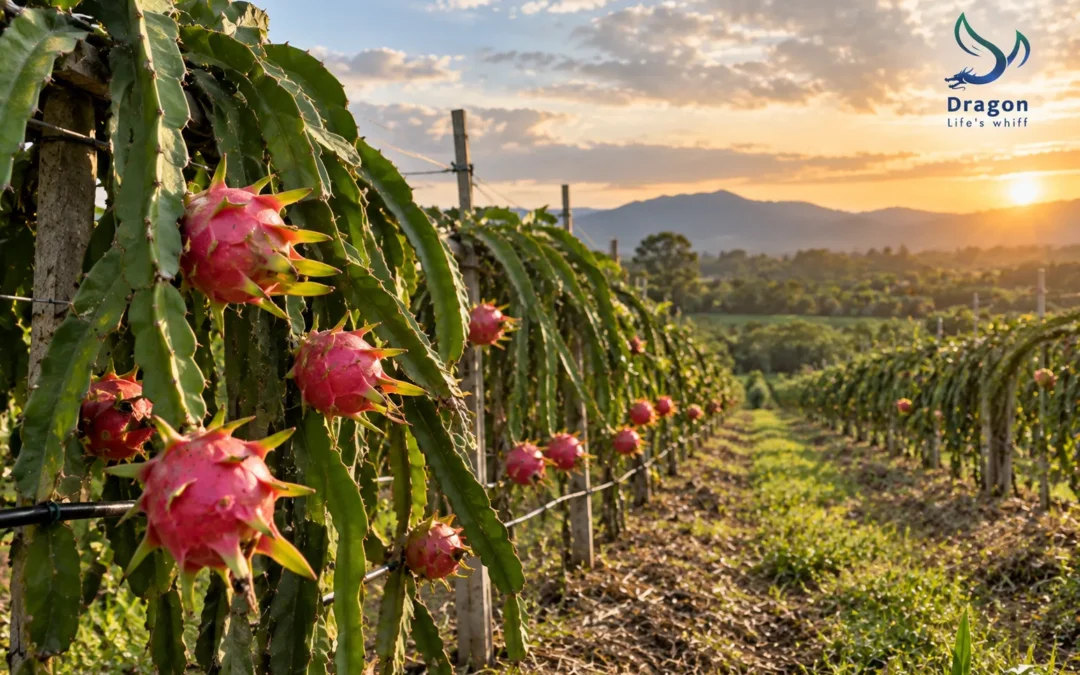
Ecuador’s pitahaya exports reached about 273 million dollars in 2025, up 32 per cent, according to the exporters’ federation Fedexpor, with around 64,000 tonnes shipped. Planted area grew from roughly 1,500 hectares in 2021 to more than 8,100 hectares a few years later. The fruit now reaches around 60 countries, with the United States taking about three-quarters of the value and the European Union most of the rest.
Few crops anywhere have grown that quickly. And that speed has left a gap.
| Country and variety | Approximate yield |
|---|---|
| China, red pitahaya | 36.8 tonnes per hectare |
| Vietnam, red pitahaya | 27.5 tonnes per hectare |
| Ecuador, red pitahaya | 15.1 tonnes per hectare |
| Ecuador, yellow pitahaya | 12.3 tonnes per hectare |
Those figures, cited by Forbes Ecuador, are not an exact like-for-like comparison. Asian producers work mainly with red varieties under intensive systems, and Ecuador’s yellow pitahaya commands a price premium that partly offsets lower yields. But the direction is clear. Much of Ecuador’s area was planted in a hurry by growers learning a new crop, and the knowledge of how to manage it has lagged behind the hectares.
Nutrition is one of the places where that gap can be narrowed.
Two pitahayas, two very different places
Ecuador grows two distinct crops under one name, in two very different environments.
Yellow pitahaya is concentrated in Morona Santiago, which accounts for about two-thirds of the yellow crop, with Palora at its heart. The yellow fruit from the area carries a denomination of origin, Pitahaya Amazonica de Palora. It grows in the Amazon foothills, with high rainfall and soils that are typically acidic and heavily leached.
Red pitahaya is concentrated on the coast, with Manabi producing about three-quarters of it, followed by Guayas and Esmeraldas. Conditions there are warmer and drier, with a pronounced dry season and, in places, irrigation.
The same fertilizer programme cannot serve both. The Amazon’s problem is nutrients washing out of acidic soil in heavy rain. The coast’s problem is supplying water and nutrients through the dry season.
A cactus that does not behave like one
Pitahaya is a climbing cactus, and growers new to it often manage it like a desert plant. It is not one. In cultivation it responds strongly to nutrition and water, and it has specific sensitivities.
Its roots are shallow and sensitive to waterlogging. Saturated soil starves the roots of oxygen and invites stem and root rots. In high-rainfall Amazon plantings, drainage and raised beds matter as much as anything applied.
Excess nitrogen causes problems. Heavy nitrogen produces soft, succulent stem growth that is more susceptible to fungal stem diseases, which Forbes Ecuador lists among the sector’s main challenges. It also pushes vegetative growth at the expense of flowering.
Flowering comes in waves. Pitahaya flowers in flushes through the productive season, and each flush needs the nutrients for flowering and fruit set available at the time.
Feeding for fruit, not just for stem
The aim is a plant with enough stem to carry a heavy crop, then a programme that shifts toward flowering and fruit.
Establishment and stem growth. Young plants need nitrogen and phosphorus to build the stem framework. Dragon Rooty supports root development after planting, and a balanced base such as Dragon Paste Balanced builds the frame.
Before and during flowering. Boron and calcium support flowering and fruit set. Dragon Calibo supplies calcium with boron, and Dragon Flowering supports the set itself.
Fruit fill. Potassium drives fruit size, sugar content and weight, which is what the grower is paid for. Dragon Paste High Potassium and Dragon PotaMax carry fruit development, and nitrogen should be held back as fruit fills.
Skin and shelf life. Export fruit travels a long way, and calcium supports firm tissue and sound skin. Dragon PureCal supplies calcium through fruit development.
The Amazon: acid soil and heavy rain
In Palora and the surrounding Amazon, soils are commonly acidic, low in calcium and magnesium, and high in aluminium in places. Heavy rain leaches nutrients quickly.
Two consequences follow. Soil acidity should be tested and corrected before large fertilizer investments, since aluminium damages roots and acidic soil locks up phosphorus. The guide to acid soils and aluminium explains how to read the figures. And fertilizer should go on in smaller, more frequent doses rather than large ones that the next storm will carry away. Dragon MagiCal covers magnesium with calcium, both commonly short on these soils.
The coast: getting through the dry season
On the coast, where red pitahaya dominates, the constraint shifts to water. Where irrigation exists, fertigation lets the grower keep feeding through the dry months. The Dragon Paste and Dragon Fert soluble powder lines dissolve completely for drip systems. Where irrigation is limited, foliar sprays deliver micronutrients and calcium when root uptake is restricted, as covered in the foliar fertilization guide.
Quality problems that fertilizer cannot fix
It would be misleading to present nutrition as the answer to everything holding back Ecuadorian pitahaya.
Fruit fly is a quarantine pest, and access to the United States depends on farms meeting phytosanitary requirements. That is managed through monitoring, orchard hygiene and certification with Agrocalidad, not through fertilizer.
Stem diseases need drainage, sanitation and disease management. Balanced nutrition, and avoiding excess nitrogen in particular, helps, but it does not replace them.
Artificial ripening has caused problems. Growers chasing early prices have used ripening chemicals to excess, and shipments have been rejected as a result. Quality has to be grown, not forced.
A note on the name
There is an obvious coincidence in a company called Dragon Ferti writing about dragon fruit. It is only a coincidence. The advice above would be the same under any name, and every product in the Dragon Ferti range is free of chloride, sodium and heavy metals, which matters on a crop whose export buyers are increasingly strict about residues and traceability.
What this means for a distributor
Ecuador’s pitahaya sector is young, fast-growing and made up mostly of small and medium growers, around 2,260 producers according to the agriculture ministry. Many are still learning the crop. That makes technical advice unusually valuable, and it rewards a supplier who can explain why the Amazon and the coast need different programmes rather than selling one bag to both.
Because pitahaya buyers increasingly ask for traceability, Dragon Ferti backs every product with a Certificate of Analysis, a Technical Data Sheet, a Safety Data Sheet and Free Sale Certificates, all produced under ISO 9001, ISO 14001 and ISO 45001 certified management systems. Ecuador’s other export crops are covered in the guides to cacao fertilization in Ecuador and banana after Fusarium TR4.
Conclusion
Ecuadorian pitahaya has grown faster than almost any crop in the region, and its yields still trail the intensive systems of Asia. Yellow pitahaya in the Amazon and red pitahaya on the coast face different problems, heavy rain on acid soil in one and dry-season supply in the other. A programme that builds the stem, supplies calcium and boron for flowering, shifts to potassium for fruit fill and avoids excess nitrogen can help close the gap. Growers and exporters in Palora, Manabi and beyond can explore the Dragon Ferti range, read the published field trial results, or talk to the export team through the contact page.
Frequently asked questions
How much pitahaya does Ecuador export?
About 64,000 tonnes worth around 273 million dollars in 2025, according to Fedexpor, a 32 per cent increase in value. The United States takes about three-quarters of the value, with the European Union the second market.
Where is pitahaya grown in Ecuador?
Yellow pitahaya is concentrated in Morona Santiago, especially around Palora in the Amazon foothills, which carries a denomination of origin. Red pitahaya is grown mainly on the coast, with Manabi producing most of it, followed by Guayas and Esmeraldas.
Why are pitahaya yields in Ecuador lower than in Asia?
Asian producers mostly grow red varieties under intensive management, while much of Ecuador’s area was planted quickly by growers new to the crop. Yellow pitahaya also yields less but sells at a premium. Better nutrition, drainage and crop management can narrow the gap.
Does too much nitrogen harm pitahaya?
Yes. Excess nitrogen produces soft stem growth more prone to fungal stem diseases and favours vegetative growth over flowering. Nitrogen should support stem development early, then be reduced as the plant moves into flowering and fruit fill.
Which nutrients improve pitahaya fruit quality?
Potassium drives fruit size, sugar and weight, while calcium supports firm tissue and sound skin for export. Boron and calcium before and during flowering support fruit set.