
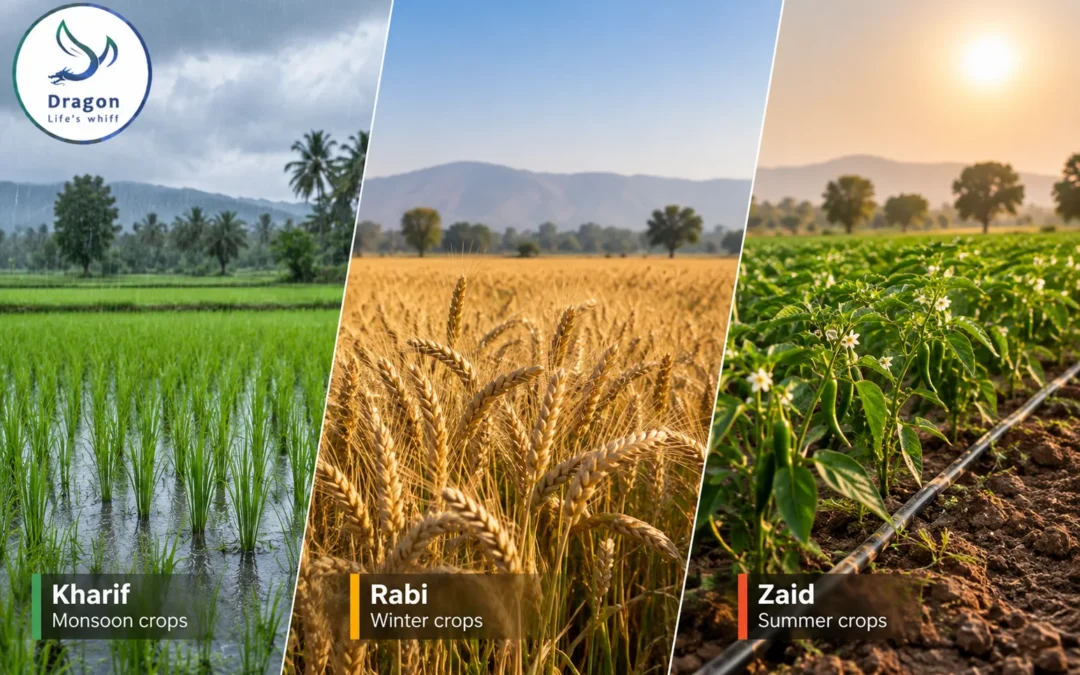
Indian agriculture runs on three cropping seasons, and most nutrition programmes are written as if there were one.
Kharif is the monsoon crop, sown with the rains from around June and harvested from September. Rabi is the winter crop, sown from October and harvested in spring. Zaid is the short summer crop between them, dependent entirely on irrigation.
The same field, the same soil test and the same fertilizer behave differently in each. Not slightly differently. The dominant loss mechanism changes completely, and a programme that is correct in January is wrong in July.
Kharif: everything you apply is trying to leave
The monsoon season problem is loss, not supply.
Nitrogen as nitrate is mobile in water, and heavy rain moves it below the root zone. Sulphate behaves the same way. In waterlogged soil, a second mechanism removes nitrogen as gas. Potassium leaches on light soils. A single application made before the rains can be substantially gone before the crop is large enough to use it.
Zinc behaves differently and worse. Flooded soil chemistry converts zinc into forms roots cannot reach, which is why the rice belt was where Indian zinc deficiency was first identified and why the national survey data on zinc and boron keeps returning the results it does.
What follows practically: split applications rather than basal dressings, and foliar correction for micronutrients rather than soil application, because soil application into saturated ground is money spent on chemistry that will not release it.
Kharif also carries a diagnostic trap. Yellow crops in the monsoon get treated with urea by reflex. If the yellowing is on new growth at the top rather than old leaves at the bottom, it is sulphur rather than nitrogen, and urea will not fix it.
Rabi: the season you can actually control
Rabi is irrigated, predictable and cooler, which makes it the season where a precise nutrition programme earns the most.
Losses are lower because water is applied rather than delivered by weather. Root systems develop well in moderate temperatures. The crop has a long, stable window in which to respond to what you give it.
This is where fertigation pays for itself. A grower who can change the nutrient ratio week by week through the drip line, rather than committing at sowing, can follow the crop through its stages instead of guessing in advance. The logic of which grade belongs to which stage is set out in what the numbers on a water-soluble fertilizer sack mean.
Most of India’s high-value rabi horticulture sits here. Onion held for storage, where sulphur and potassium build the keeping quality that determines the season’s income. Potato on a processing contract, where the potash source moves the dry matter the buyer tests. Tomato, where calcium delivery in the weeks after fruit set decides how much fruit reaches the mandi in marketable condition.
The rabi mistake is almost always the same one: nitrogen carried too far into the season. It looks like a healthy crop and it costs storage life in onion, dry matter in potato, firmness in tomato and shelf life in everything.
Zaid: heat and water are the whole story
The short summer crop between rabi harvest and the monsoon is grown entirely on irrigation, under rising temperatures, on soil that is often carrying salt left over from the rabi season.
Three things dominate.
Evaporation concentrates salts. With no rain to leach and high evaporative demand, salinity climbs in the root zone, particularly under drip where the wetted volume is small. Removing avoidable salt from the programme is the cheapest response available, and chloride-based potassium is the usual source of it.
Water quality is at its worst. Borewell chemistry deteriorates as the water table drops through summer, so the bicarbonate and salinity readings that looked acceptable in November may not be acceptable in April. That interaction is covered in the guide to fertigation water quality in India.
Heat suppresses calcium movement. High temperatures combined with high transpiration demand produce exactly the conditions where fruit outgrows its calcium supply, which is why calcium disorders cluster in summer crops.
Crops that mature into the heat carry a further problem. Chilli across Guntur and Warangal ripens and is field dried into rising temperatures, so the most valuable part of its cycle happens under the most stress, and a programme that tapers off at that point gives away the colour value the crop is graded on.
Zaid is also the season where protected cultivation changes the arithmetic most, because a polyhouse can moderate the temperature the crop experiences while making the salt accumulation worse. Both sides of that trade are covered in the polyhouse nutrition guide.
Perennials do not get a season off
Orchard and plantation crops run across all three, and their nutrition is organised around the crop cycle rather than the calendar.
Banana in Jalgaon builds potassium demand toward shooting and bunch fill regardless of which season that falls in. Table grapes in Nashik work to a double pruning cycle with a short export window from December to April. Pomegranate is managed through bahar treatments that let the grower choose the harvest period. Apple in Himachal and Kashmir has one window after petal fall that decides what survives storage nine months later.
The common thread across all of them is that the decisive nutrient application happens weeks or months before the consequence is visible. That is what makes perennial nutrition hard to sell and expensive to get wrong.
What carries across every season
Four things do not change with the calendar.
Test the irrigation water, not just the soil. Soil is tested once and moves slowly. Water passes through the root zone daily, and high bicarbonate will neutralise a correct application before the plant sees it.
Stop nitrogen earlier than instinct suggests. This is the most expensive habit in Indian horticulture, and it produces a better-looking field and a worse-paying crop in almost every crop covered here.
Supply calcium during cell division, not near harvest. Calcium is fixed permanently where it lands and does not move again. Applying it late is the most commonly wasted input on the list.
Stop paying to add chloride. Muriate of potash is roughly half chloride by weight, and grape, potato, onion, citrus and tomato all respond poorly to its accumulation under drip. Every product in the Dragon Ferti range is free of chloride, sodium and heavy metals, which means the salt you build in the root zone is nutrient rather than ballast.
What this means for a dealer
Seasonality is a stocking problem before it is an agronomic one.
Kharif sells volume nitrogen and foliar micronutrients. Rabi sells the full staged fertigation programme and is where specialty margin concentrates. Zaid is short, small and dominated by stress and water correction products. A dealer buying the same mix in every quarter is carrying dead stock for part of the year and running out in another.
It is also a planning conversation worth having with growers in advance rather than at the counter. A farmer who agrees a season programme in September buys across four months. One who walks in with a yellow leaf buys once. The commercial case for stocking water-soluble fertilizer in India and the comparison of paste, powder and liquid formats cover how to build that range.
Dragon Ferti supplies importers and distributors with Certificates of Analysis, Technical Data Sheets, Safety Data Sheets, full composition labels and Free Sale Certificates, and manufactures under ISO 9001, ISO 14001 and ISO 45001 certified management systems. The import and registration process sets out what a distributor needs to plan for.
Conclusion
Kharif is a season of loss, rabi is a season of control, and zaid is a season of heat and salt. The soil test does not change between them but the correct programme does. Split and go foliar in the monsoon, run a full staged programme in winter, and manage water chemistry and salinity in summer. For specifications, registration support or distribution enquiries, see the Dragon Ferti range, read grower reports on the testimonials page, or contact the export team through the contact page.
Frequently asked questions
What are the kharif, rabi and zaid seasons?
Kharif is the monsoon crop, sown with the onset of the rains around June and harvested from September. Rabi is the winter crop, sown from October and harvested in spring. Zaid is the short summer crop grown between rabi harvest and the next monsoon, entirely dependent on irrigation.
Why do fertilizers perform differently in kharif and rabi?
Because the dominant loss mechanism changes. In kharif, heavy rain leaches mobile nutrients below the root zone and waterlogging removes nitrogen as gas and locks up zinc. In rabi, water is applied rather than delivered by weather, so losses are lower and a precise staged programme can be followed.
Should micronutrients be applied to soil or leaf during the monsoon?
Foliar is generally more reliable in kharif. Saturated soil chemistry converts zinc and other micronutrients into unavailable forms, so a soil application may never reach the crop. Foliar spraying bypasses soil chemistry entirely.
Why is salinity worse in the zaid season?
High evaporation with no rain to leach concentrates dissolved salts in the root zone, and borewell water quality often deteriorates as the water table falls through summer. Under drip the wetted volume is small, so salts concentrate exactly where the feeder roots sit.
What single change improves results across all three seasons?
Testing the irrigation water. It passes through the root zone every day, high bicarbonate raises pH around the root and blocks micronutrient uptake regardless of what the soil test said, and the test costs very little against a season’s inputs.