
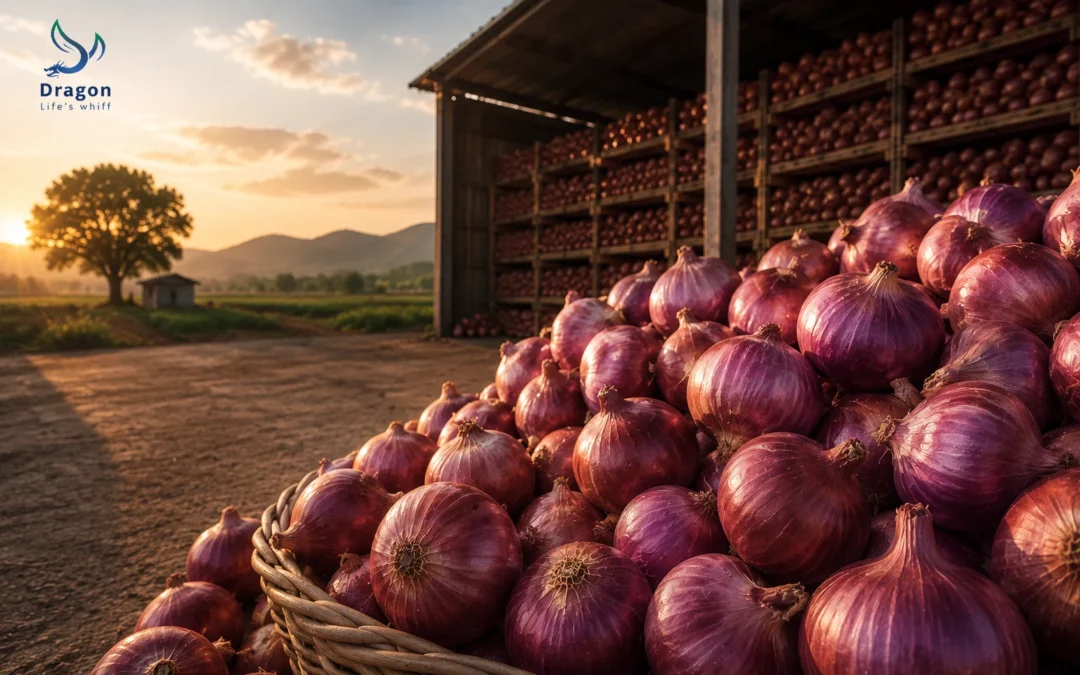
Most crops are sold soon after they come off the field. Rabi onion is not. It goes into a chawl and sits there while the grower waits for the price to move, and what comes out months later decides what the season was worth.
Storage losses on stored onion in India are large enough that they, rather than yield, often determine whether a block made money. Bulbs rot, sprout, shrink and lose skin. A grower who harvested well and stored badly ends up selling less than they grew.
Much of that outcome is set before harvest, by nutrition.
Where the crop sits
Maharashtra is the largest producing state, with Nashik at the centre of it and Lasalgaon operating as the reference market for the whole country. The crop runs in three cycles: kharif, late kharif, and the rabi summer crop that is the one actually stored and the one that carries export volume.
Export destinations are mostly regional, and export policy has been volatile, with bans, minimum prices and duties arriving at short notice. That volatility is itself an argument for storage quality. A grower who can hold sound bulbs for four or five months has options when the policy or the price changes. A grower whose stock is deteriorating has to sell into whatever the market is that week.
Sulphur is the nutrient this crop is built on
Onion is a sulphur crop in a way that few others are. The compounds that give it pungency are sulphur based, and pungency correlates with storage life. A low-sulphur bulb is milder, softer and does not keep.
That is the connection most programmes miss. Sulphur is not a flavour detail, it is a storage input applied months before storage begins.
Potassium is the other half of the pair. It drives bulb size, firmness and skin development, and firm bulbs with intact skins are what survive a chawl.
Dragon Thio supplies potassium and sulphur together, which is exactly the combination this crop wants, and Dragon Fruity does the same through a different chemistry. Where potassium is the specific constraint, Dragon PotaMax and Dragon Fert High Potassium carry the bulbing phase.
Muriate of potash is the default potassium in the market and it brings chloride with it. On a shallow-rooted crop under drip, in soil that is often already alkaline, that is the wrong salt to be adding season after season. The same problem affects table grapes in the same district, which are outright chloride sensitive, and banana in Jalgaon, where it accumulates across ratoons. The Dragon range is free of chloride, sodium and heavy metals.
Late nitrogen is what ruins a stored onion
This is the single most common and most expensive mistake in the crop.
Nitrogen applied late produces thick necks. A thick neck does not cure properly, and a bulb that does not cure properly is an open door for rot in storage. Late nitrogen also encourages doubles and delays maturity, and it produces a soft bulb that looks fine at harvest and fails at month three.
Nitrogen belongs early, through leaf development, because leaf number before bulbing sets how large a bulb the plant can make. Dragon Triple N and Dragon Paste High Nitrogen suit that stage. Once bulbing starts, the programme should be moving toward potassium and sulphur, not holding nitrogen.
A grower selling into storage should be told this plainly, because the field looks better with late nitrogen and the loss arrives long after the decision. Chilli growers in Guntur and Warangal pay for the same mistake in colour value rather than storage life.
Calcium and boron decide the rest
Calcium builds cell wall strength, and cell wall strength is what resists the rots that develop in storage. It has to go on during bulb development, while cells are dividing, because calcium does not redistribute once deposited. Applying it near harvest achieves very little.
Dragon PureCal and Dragon Calibo cover that window, and Dragon NPK+CaO delivers calcium alongside the base programme.
Boron affects bulb quality and skin retention, and Dragon BorCal handles it with calcium in one pass ahead of bulbing.
Zinc is worth checking on any Maharashtra block given how much of the state reads below threshold. Dragon Zinc corrects a confirmed shortage and Dragon Mix Plus covers the group where several read low.
Why fertigation suits onion particularly well
Onion has a shallow, sparse root system with limited ability to forage. It cannot go looking for nutrients the way a deeper-rooted crop can, so placement matters more than it does elsewhere.
Drip fertigation puts nutrients in the small volume the roots actually occupy, in doses timed to the stage. On a crop where the difference between early nitrogen and late nitrogen decides storage outcome, being able to change the ratio week to week rather than at two fixed applications is worth more than the product itself.
The Dragon Fert soluble powder and Dragon Paste lines are made for that delivery, and dissolve without residue that would threaten emitters.
What a Nashik dealer is selling
Not fertilizer. Reduced storage loss and the ability to hold stock until the price is right.
That is a far easier conversation than a price comparison, because every onion grower in the district has watched a chawl go bad and can put a number on it. A dealer who explains why the sulphur applied in February determines what comes out of storage in August is offering something the shop across the road is not, and the broader case for stocking water-soluble fertilizer in India follows the same logic across other crops.
Dragon Ferti supplies the documentation registration requires: Certificate of Analysis, Technical Data Sheet, Safety Data Sheet, labels with full composition and Free Sale Certificates. Manufacturing runs under ISO 9001, ISO 14001 and ISO 45001 certified management systems. The import and registration process covers what an importer needs to plan for, and registration status for specific products in India is a question for the export team.
Conclusion
Onion is graded and paid on what survives storage, and storage performance is built in the field by sulphur, potassium and calcium, and destroyed by nitrogen applied too late. Get the sequence right and the same crop is worth more months later. For specifications, registration support or distribution enquiries, see the Dragon Ferti range, read grower reports on the testimonials page, or contact the export team through the contact page.
Frequently asked questions
Why does sulphur matter so much in onion?
The compounds responsible for onion pungency are sulphur based, and pungency tracks with storage life. A sulphur-short crop produces milder, softer bulbs that deteriorate faster in the chawl, which means sulphur applied during the crop is effectively a storage input.
What causes thick necks and poor curing?
Usually nitrogen applied too late. Late nitrogen keeps the plant vegetative, produces thick necks that do not cure properly, and leaves a soft bulb that looks acceptable at harvest and fails weeks into storage. Nitrogen belongs in the leaf development phase, before bulbing begins.
Should I use muriate of potash on onion?
It is the cheapest potassium but it is potassium chloride, and it adds chloride to a shallow root zone under drip on soil that is often already alkaline. A potassium source that also supplies sulphur serves this crop considerably better, since onion needs both.
When should calcium be applied?
During bulb development, while cells are dividing. Calcium moves in the transpiration stream and does not relocate once deposited, so applications close to harvest have limited effect on the cell wall strength that resists storage rots.
Do these products work without drip?
Yes. The soluble powders can be applied as foliar sprays, which is the practical route for micronutrient and stage correction on a flood-irrigated block. Fertigation gets more from the same product because onion roots are shallow and placement matters on this crop more than most.