
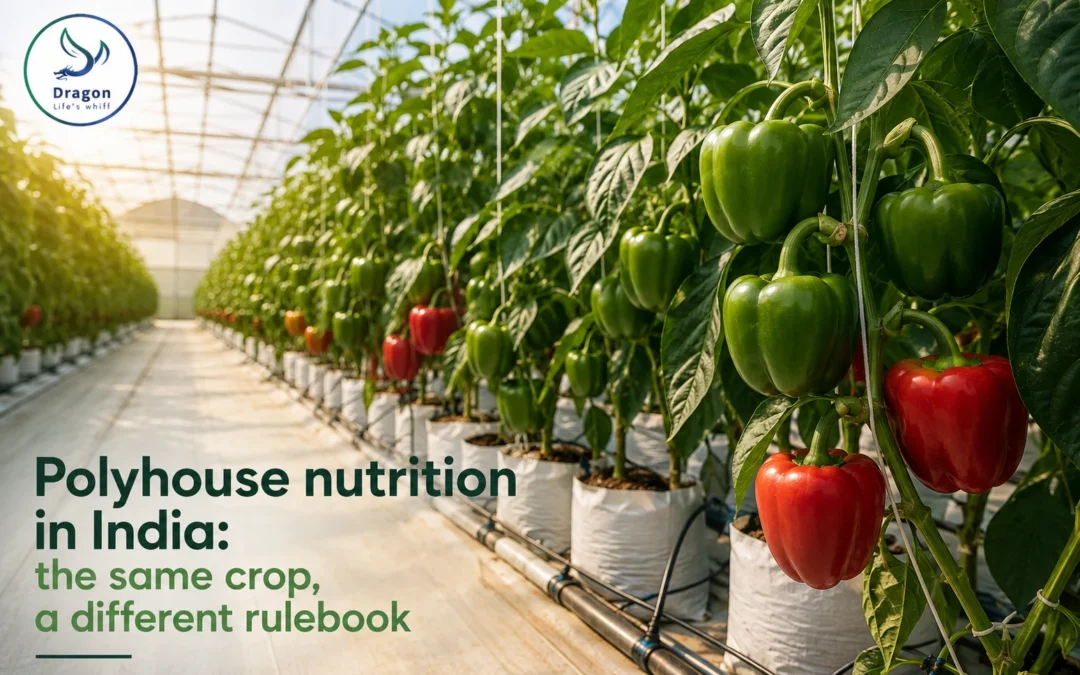
A capsicum plant under a polyhouse in Pune is not the same commercial proposition as a capsicum plant in an open field forty kilometres away. It yields several times more, it runs for eight or nine months instead of three, and it is sold into a market that grades on uniformity rather than weight.
It also fails differently. Under cover, there is no rain to flush accumulated salts out of the root zone, no wind to move humidity, and no margin for a nutrition programme that was designed for an open field.
Most polyhouse problems in India that get blamed on pest pressure or seed quality start as a nutrition or water chemistry problem that had nowhere to drain.
What changes when you put a roof over the crop
Four things change at once, and they compound.
Salts accumulate. Every irrigation leaves behind whatever the plant did not take up. Outdoors, monsoon rain leaches that away each year. Under a polyhouse it stays, and root zone EC climbs season after season until growth slows for reasons the grower cannot see.
Transpiration drives calcium, and humidity suppresses transpiration. Calcium moves only in the water the plant pulls through itself. On a humid afternoon under plastic, that flow slows, and calcium stops arriving at the fruit even when there is plenty in the soil. This is why blossom end rot appears in polyhouses that have never had a calcium shortage on paper.
The crop cycle is long. An open field capsicum crop is a sprint. A polyhouse crop runs most of the year and carries flowering, fruit set and harvest simultaneously for months. Nutrient demand never returns to zero, and a programme built around three or four fixed applications does not fit.
Fertigation is the only realistic delivery route. There is no practical way to broadcast fertilizer through a standing crop under cover, so everything goes through the drip line. That makes product solubility a hard requirement rather than a preference.
Root zone EC is the number most growers are not watching
Indian polyhouse growers commonly monitor soil pH and skip EC, which is the wrong way round for protected cultivation.
Electrical conductivity measures total dissolved salts, and it is the single best early warning of the accumulation problem. A rising EC explains stunted growth, reduced water uptake, tip burn and a crop that stops responding to feed. By the time symptoms are obvious, correcting it takes a leaching cycle the grower rarely has time for.
Two habits prevent most of it. Measure EC in the root zone rather than in the tank, because the tank tells you what you added and the root zone tells you what stayed. And stop adding unnecessary salt.
That second point is where product choice does real work. Muriate of potash is roughly half chloride by weight, and chloride is a salt the plant largely does not need. Under a roof, with no rain to remove it, that chloride has nowhere to go. Every product in the Dragon Ferti range is free of chloride, sodium and heavy metals, which means the EC you build is nutrient rather than ballast.
The same argument applies outdoors on table grapes in Nashik and on onion under drip in Maharashtra. Under cover it simply arrives faster.
Calcium is a transport problem, not a supply problem
The most common polyhouse complaint in India is blossom end rot in capsicum and tomato, and the most common response is to add more calcium.
That usually fails, because the calcium was already there. What failed was delivery. Calcium travels in the transpiration stream and is deposited once, permanently, in the tissue that was growing at the time. It does not move again. High humidity slows transpiration, fast-growing fruit outruns the supply, and the tissue at the end of the fruit gets nothing.
What actually helps: keeping calcium continuously available in the root zone rather than in periodic large doses, managing humidity and venting so the plant transpires, and avoiding the ammonium-heavy and potassium-heavy feeds that compete with calcium uptake at exactly the wrong moment.
Dragon PureCal supplies calcium through fruit development. Dragon Calibo and Dragon BorCal pair calcium with boron, which matters because boron supports the cell wall structure calcium is being deposited into, and a crop short of both responds poorly to either alone. Dragon NPK+CaO carries calcium alongside the base feed instead of as a separate injection.
Feeding a crop that never stops
A polyhouse crop needs a different nutrient ratio at every stage, and it needs several stages running at once.
Through establishment, root development sets the ceiling for everything that follows. Dragon Rooty and a phosphorus-weighted feed such as Dragon Paste High Phosphorus suit that window.
Through vegetative build, nitrogen drives the leaf area that will carry the crop for months. Dragon Triple N and Dragon Paste High Nitrogen fit here, and this is the only stage where pushing nitrogen is straightforwardly useful.
From flowering onward the programme becomes a balancing act, because the plant is setting new fruit while filling old fruit. Dragon Flowering supports set, while Dragon Paste High Potassium and Dragon PotaMax carry fill. A balanced paste grade is often the sensible background feed with the specialty products layered on top.
Micronutrients need continuous low-level supply rather than rescue doses. Dragon Mix Plus covers the group, and Dragon Iron matters wherever the water runs alkaline, which is most of Maharashtra, Gujarat and Karnataka. The survey data on zinc and boron across Indian soils explains why so many blocks start from a deficit.
Water chemistry decides whether any of this works
Under a polyhouse the irrigation water is the whole water supply. There is no rain diluting it.
Borewell water across much of the Indian polyhouse belt carries high bicarbonate, and bicarbonate raises pH around the root regardless of what is in the tank. Iron and zinc precipitate, phosphorus availability drops, and emitters begin to scale.
The Dragon Paste line runs acidic in solution, which pushes against that rather than adding to it. Where the water needs correcting on its own terms, Dragon Corrector is built for it. Test the water before designing a programme, not after the first problem appears.
What this means for a dealer
Protected cultivation growers are the easiest specialty customers in India to serve well and the easiest to lose.
They are technically literate, they measure things, and they are spending enough per hectare that a product decision is worth arguing about. They also talk to each other, and a cluster of polyhouses in one taluka will adopt or reject a product together.
The dealer who wins that cluster is usually the one who explained EC accumulation before it became a problem, not the one with the lowest price. The commercial case for stocking water-soluble fertilizer in India applies here with the numbers turned up.
Dragon Ferti supplies importers and distributors with the documentation registration requires: Certificate of Analysis, Technical Data Sheet, Safety Data Sheet, labels carrying full composition and Free Sale Certificates. Manufacturing runs under ISO 9001, ISO 14001 and ISO 45001 certified management systems, and the import and registration process sets out what a distributor needs to plan for.
Conclusion
Protected cultivation removes the rain, and removing the rain removes the forgiveness. Salts accumulate, calcium delivery depends on humidity rather than on supply, and the crop demands feeding for most of the year. A programme that works outdoors is not automatically a polyhouse programme. For specifications, registration support or distribution enquiries, see the Dragon Ferti range, read grower reports on the testimonials page, or contact the export team through the contact page.
Frequently asked questions
Why does blossom end rot appear in polyhouses with adequate soil calcium?
Because calcium reaches the fruit through the transpiration stream and is fixed permanently where it lands. High humidity under cover slows transpiration, so fast-growing fruit outruns the supply even when soil calcium is sufficient. Continuous availability through fertigation and better venting help more than a larger dose.
What root zone EC should a polyhouse grower aim for?
The target depends on crop and stage, so the useful discipline is trend rather than an absolute figure. Measure the root zone rather than the tank, record it through the season, and treat a steady climb as a signal to leach and to reduce unnecessary salt in the feed. Chloride-based potassium is the usual source of avoidable salt.
Can conventional fertilizers be used through polyhouse drip lines?
Only partly. Products that leave residue or precipitate will block emitters, and under a standing crop that is difficult to fix. Fully water-soluble grades without chloride, sodium or heavy metals avoid that risk, which is why fertigation and specialty fertilizer adoption move together.
How often should micronutrients be applied under cover?
As continuous low-level supply through the fertigation programme rather than as occasional corrective doses. A long crop cycle means demand never stops, and rescue applications after visible symptoms cost yield that has already been lost.
Does Dragon Ferti supply protected cultivation growers in India?
Dragon Ferti exports to more than 50 countries and works with importers and distributors across Asia, Africa and the Middle East. Paste ships in 5, 10 and 20 kilogram formats, soluble powder in 10 and 25 kilogram sacks, and liquid in 1, 5 and 20 litre containers. Registration and distribution status for India is best confirmed with the export team.