
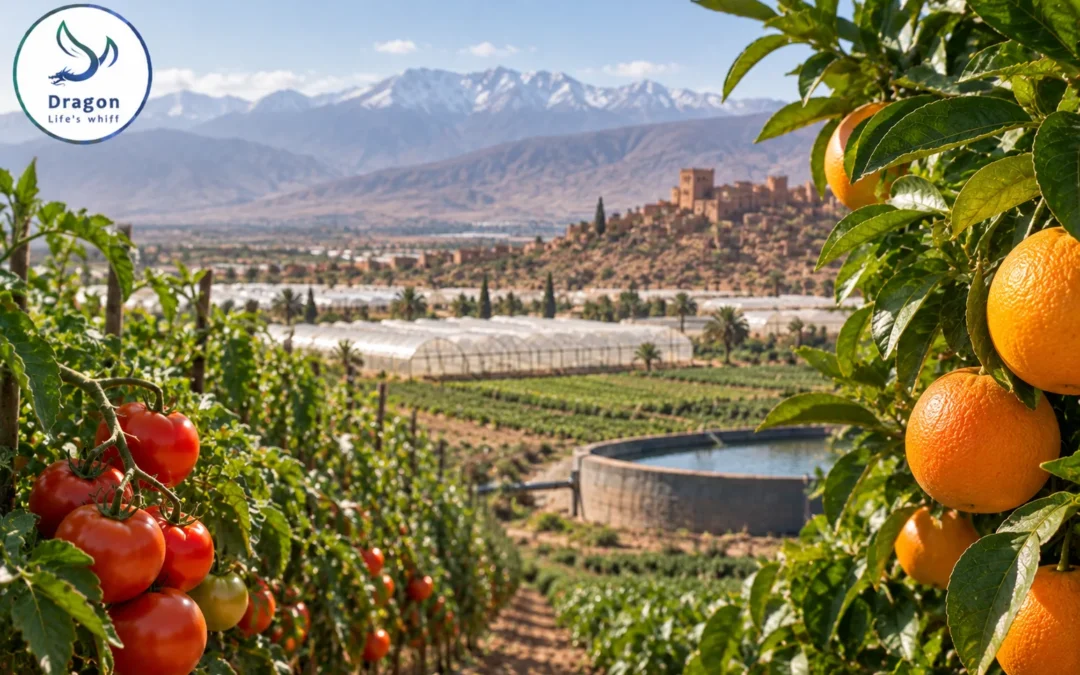
Morocco holds the largest phosphate rock reserves on earth. OCP is one of the world’s biggest fertilizer exporters. Ask why a Moroccan farm would import fertilizer at all and the question answers itself before you finish asking it.
Then look at what actually goes into a drip line in Souss-Massa in February.
Phosphate rock is not plant nutrition. It is a raw material. What a greenhouse tomato grower in Agadir or a clementine block in Berkane needs is a fully water-soluble NPK that dissolves without residue, carries no chloride into already-saline ground, and can be shifted stage by stage through a crop that is being graded by a European buyer. Morocco exports the commodity and imports the specialty, and that is not a contradiction. It is how the fertilizer industry works everywhere.
Supplying specialized NPK fertilizers to the Moroccan market means solving the problems Moroccan soil, Moroccan water and Moroccan buyers actually create. This is what those problems are.
The three constraints that define Moroccan crop nutrition
Water is scarce and increasingly saline. Successive drought years have drawn down reservoirs and pushed farms onto groundwater. In the Souss-Massa the aquifer has been over-drawn for decades, and seawater intrusion along the coastal strip raises chloride in exactly the areas growing the highest-value export crops. Every irrigation adds salt that no rainfall is arriving to leach out.
The soils are calcareous and alkaline. Free lime is widespread across Moroccan agricultural land, and above roughly pH 7.5 iron, zinc and manganese convert into forms roots cannot take up while phosphorus binds with calcium and drops out of availability. A soil test can show adequate zinc and the crop can still be short of it. The micronutrient picture across North African soils covers why correction so often fails here.
The buyer is European. Morocco supplies the EU with tomatoes, citrus, melons, beans, berries and early vegetables, and those markets audit. Residue compliance, traceability and consistent grade are conditions of access rather than selling points.
Those three together explain why a fertilizer that performs well in a temperate European field can underperform badly in Morocco, and why the specification matters more than the analysis on the front of the bag.
Chloride is the wrong salt for Moroccan agriculture
Muriate of potash is the cheapest potassium available anywhere, and roughly half of it by weight is chloride.
On ground that is already accumulating salt, under drip irrigation where the wetted volume is small and salts concentrate at its edge, that chloride has nowhere to go. Citrus is among the most chloride-sensitive crops grown commercially, and citrus is a Moroccan mainstay from the Gharb to the Oriental. Tomato, melon and soft fruit all suffer measurable quality loss as chloride builds.
The damage is slow, which is what makes it dangerous. Vigour drifts down, fruit size drops, and by the time anyone connects it to the fertilizer programme the grower has usually blamed the rootstock, the season or the water.
Every product Dragon Ferti manufactures is free of chloride, sodium and heavy metals. On salt-affected Moroccan ground that is not a marketing distinction, it is the difference between adding to the problem and not.
There is a second benefit specific to this market. The Dragon Paste line runs acidic in solution, which works against the bicarbonate in alkaline Moroccan irrigation water rather than compounding it. Where the water itself needs correcting, Dragon Corrector is built for that job.
What “specialized” actually means here
A specialized NPK fertilizer is not a better version of a general one. It is a different product solving a different problem.
Conventional granular fertilizer is designed to be broadcast onto soil and released slowly as it breaks down. A specialized water-soluble NPK is designed to dissolve completely and become available immediately, so the grower controls the timing rather than the soil chemistry controlling it. That immediacy is the feature. It is what allows a programme to shift from phosphorus at establishment to nitrogen through vegetative growth to potassium through fruit fill, following the crop instead of guessing in advance.
The Dragon Paste range delivers that as a fully water-soluble paste, including the NPK+CaO grade that supplies calcium alongside the base feed, which matters on any crop where firmness and shelf life decide the grade. Dragon Fert soluble powder covers the same nutritional logic in crystal form for larger areas and foliar programmes, and Dragon Liquid suits precise dosing in smaller quantities.
Alongside those sit the specialty products that no NPK grade can replace, including Dragon PotaMax where potassium alone is the constraint, Dragon Thio for potassium with sulphur, and Dragon BorCal and Dragon PureCal for the calcium and boron that determine fruit set and firmness. The chelated micronutrient range addresses the iron and zinc that calcareous soil locks away, and the organic-compatible line serves growers working toward certified production.
The full stage-by-stage logic is set out in the guide to specialized NPK fertilizers for every crop stage, and the format question is covered in why water-soluble fertilizer performs the way it does.
Why a Jordanian producer is relevant to a Moroccan farm
The honest answer is not distance. Jordan and Morocco sit at opposite ends of the Arab world, and shipping runs from Aqaba through the Suez Canal and across the Mediterranean.
The relevant answer is that Jordan’s own growing conditions look remarkably like Morocco’s. Jordanian agriculture runs on calcareous alkaline soils, saline and bicarbonate-heavy irrigation water, severe water scarcity and near-total dependence on drip. A fertilizer developed to perform in the Jordan Valley and the Amman highlands was engineered against the same constraints a Souss-Massa grower faces every season. It is not a temperate-climate product being adapted for North Africa. It was built for these conditions from the start.
Jordan is also a source country for the raw material. Jordanian potash and phosphate reserves are among the highest-grade in the world, and Dragon Ferti sources directly from them, which is what makes chloride-free, sodium-free and heavy-metal-free output achievable at the raw material stage rather than as a later purification step. The science behind the paste technology explains that in detail, and the route from Jordan to Morocco covers the logistics.
Dragon Ferti is a Jordanian fertilizer company based in Amman, exporting to more than 50 countries, manufacturing under ISO 9001, ISO 14001 and ISO 45001 certified management systems, and recognised through the Queen Rania National Entrepreneurship Award 2024 to 2025. The growth from Amman to more than 50 markets sets out how that footprint was built.
Results a distributor can point at
Claims about quality are worth what the field data behind them is worth.
Dragon Ferti publishes its crop trials rather than describing them. A watermelon trial using Dragon Paste 20-10-60 + TE documents the effect on yield. Dragon Paste 15-20-50 on tomatoes and Dragon Paste 10-50-20 with Dragon Thio on grapes cover two crops central to Moroccan export horticulture. Dragon PotaMax on mangoes and a greenhouse cucumber trial in Kurdistan extend the record into protected cultivation.
Closer to home, Dragon Paste in Algeria documents performance in North African conditions specifically. The full set sits on the testimonials page.
For crop-level programmes rather than single trials, the guide to fertilization programmes for citrus, olives, tomatoes and watermelon covers the four crops that matter most across Moroccan growing regions.
What an importer should be evaluating
A Moroccan distributor assessing a new supplier is not really assessing the fertilizer. They are assessing whether it can be registered, whether it clears customs, whether the analysis holds consistently from one shipment to the next, and whether the manufacturer produces documentation on request rather than after three reminders.
Dragon Ferti supplies that as a set: Certificate of Analysis, Technical Data Sheet, Safety Data Sheet, labels carrying full composition, and Free Sale Certificates. Batch consistency is a clearance issue and not merely a quality one, because a shipment whose analysis drifts will eventually produce a sample that fails at the port.
The eight-point supplier evaluation guide sets out what to check and in what order. For growers moving toward certified production, the organic transition roadmap covers how to make that shift without giving up yield, and the sustainability commitments behind the range explain the production standards underneath it.
Fertigation practice is where most of the value is realised or lost, and the drip irrigation and soluble fertilizer guide covers injection, compatibility and scheduling in detail.
Conclusion
Morocco has no shortage of phosphate. What it has is saline irrigation water, calcareous soil that locks up micronutrients, a European buyer that audits, and a rapidly expanding drip-irrigated area that needs a fertilizer capable of going through an emitter without leaving anything behind.
Those are the problems a specialized NPK fertilizer exists to solve, and they are the same problems Jordanian agriculture has been solving for decades. For specifications, registration support or distributor enquiries across Morocco and North Africa, see the full Dragon Ferti range, review the field trial results, or contact the export team through the contact page.
Frequently asked questions
Why would Morocco import fertilizer when it has the world’s largest phosphate reserves?
Because phosphate rock is a raw material rather than a finished crop nutrition product. Morocco exports commodity phosphate and imports the water-soluble specialty NPK, micronutrient and calcium products that drip-irrigated export horticulture requires. The two serve entirely different purposes.
What makes a fertilizer suitable for Moroccan conditions?
Three things above all. Complete water solubility so it passes through a drip emitter without residue, absence of chloride and sodium so it does not add salt to ground that is already saline, and an acidic reaction in solution so it works against the bicarbonate in alkaline irrigation water rather than compounding it.
Why does chloride matter so much for Moroccan crops?
Citrus, tomato, melon and soft fruit are all chloride sensitive, and they are Morocco’s principal export crops. Under drip irrigation the wetted volume is small, so chloride concentrates where the feeder roots sit, and with little rainfall to leach it the accumulation builds season after season until yield and quality decline.
What documentation does Dragon Ferti provide to importers?
Certificates of Analysis, Technical Data Sheets, Safety Data Sheets, labels carrying full composition, and Free Sale Certificates. Manufacturing operates under ISO 9001, ISO 14001 and ISO 45001 certified management systems, which gives an assessing authority an independent reference rather than a supplier’s own assurance.
Which Dragon Ferti products suit Moroccan export horticulture?
The paste range for drip-irrigated high-value blocks, including the NPK+CaO grade where fruit firmness and shelf life matter, soluble powder for larger areas and foliar work, chelated micronutrients for calcareous soils that lock up iron and zinc, and the calcium and boron specialty products for fruit set and post-harvest quality.
Does Dragon Ferti supply distributors as well as farms?
Yes. Dragon Ferti works with importers and distributors across Africa, the Middle East and beyond, supplying registration documentation, technical support and a product range broad enough to serve smallholdings and large estates from the same stock.