
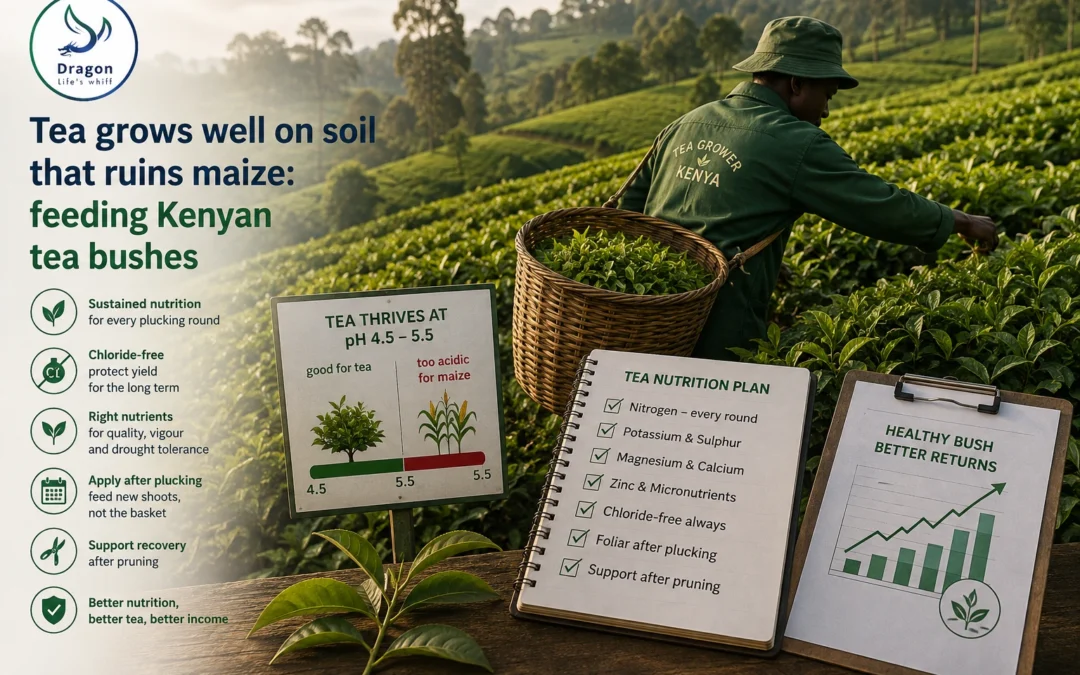
The acidity that stunts maize in Kericho and Nandi is the same acidity tea wants. A tea bush is happiest around pH 4.5 to 5.5, roughly where a maize crop starts failing.
So a smallholder with tea on one side of the road and maize on the other is farming two crops with opposite relationships to the same problem. The usual highland advice about correcting acidity does not apply to the tea.
Plucking is the whole story
Most crops are harvested once. Tea is harvested every seven to fourteen days, and what leaves the farm is young leaf and shoot, the most nutrient-dense tissue on the bush.
That changes the question. You are not feeding toward a harvest, you are replacing something continuously removed. Nitrogen goes out with every round and has to come back, or the bush thins and yield per bush falls quietly over several seasons.
Dragon Paste High Nitrogen covers the sustained nitrogen demand, and Dragon Triple N supports the shoot growth that becomes next round’s crop. Split applications work better than one heavy dose, for the same reason continuous removal needs continuous replacement.
The chloride problem nobody mentions
Tea is chloride-sensitive, and the damage is slow enough that most growers never connect it to the fertilizer sack.
Chloride accumulates in the bush over years, depressing yield and degrading made-tea quality in ways a factory grader notices before a farmer does. Cheap muriate of potash is potassium chloride, so a grower buying on price buys the problem along with the potassium.
Every Dragon Ferti product is free of chloride and sodium. On a crop that stays in the ground for decades that matters, because you cannot replant your way out of accumulated chloride.
What potassium and magnesium actually do here
Potassium drives shoot vigour and drought tolerance, which matters in a crop expected to produce year round. Magnesium and sulphur affect leaf colour and made-tea quality, and both are commonly short on long-cropped highland soils.
Dragon Thio supplies potassium with sulphur in one product. Dragon MagiCal covers magnesium alongside calcium.
Zinc symptoms are easy to misread. Short zinc gives shortened internodes and slow shoot extension, which looks like a tired bush rather than a deficiency. Dragon Zinc corrects it, usually visible by the next flush.
Feeding between plucking rounds
Fertigation is uncommon on smallholder tea, so foliar does most of the work. It suits a dense canopy where a spray reaches a lot of leaf quickly.
The window is right after a plucking round, when the bush is pushing new shoots. Nutrients applied then go into growth you harvest a week or two later. Applied just before plucking, much of what you paid for leaves in the basket.
After pruning
Pruning cuts the bush back hard, and recovery is when a tea field is most vulnerable and most responsive. Helping it rebuild frame and leaf quickly shortens the time before full plucking resumes.
Dragon Sea supports that phase. Nitrogen matters too, but aim for steady rebuilding rather than soft growth that will not survive the next dry season.
On growers switching to avocado
Some smallholders in the tea zones have been uprooting bushes for avocado, which pays better per acre at current prices. That is a real calculation and not one to argue with from outside.
Worth saying, though: a lot of Kenyan tea produces well below what the same bushes could with proper nutrition, and yield per bush is the lever a farmer controls without changing crop. Know what your existing field would do properly fed before deciding it cannot pay. For growers who do switch, our piece on avocado dry matter and export grade covers what buyers measure.
Organic and certified tea
Kenya has established organic-certified tea and the premium is real. The programme works the same way with approved inputs. The Dragon Organic line includes organic-compatible Sea and HV, so a certified field runs the same nitrogen-led logic.
Conclusion
Tea rewards consistency more than intervention. Replace the nitrogen you remove each round, avoid chloride on a crop that stays in the ground for thirty years, feed just after plucking, and support the bush after pruning. To match products to your field, see the Dragon Ferti range or contact the team through the contact page.
Frequently asked questions
What is the best fertilizer for tea in Kenya?
Tea needs sustained nitrogen above everything else, because plucking removes young leaf every week or two and that nitrogen has to be replaced. Potassium supports shoot vigour and drought tolerance, and magnesium affects leaf quality. The critical requirement is that the potassium source is chloride-free, since tea is chloride-sensitive and the damage accumulates over years.
Why does chloride harm tea bushes?
Chloride builds up in the bush over successive seasons and depresses both yield and made-tea quality. Because tea is a permanent crop that stays in the same ground for decades, there is no easy way to reverse the accumulation once it happens. Muriate of potash, the cheapest common potassium source, is potassium chloride, which is why buying on price alone costs more later.
When should I apply fertilizer relative to plucking?
Just after a plucking round, when the bush is pushing new shoots and demand is highest. Nutrients applied at that point go into the growth you will harvest in the following round. Applied shortly before plucking, a good share of what you paid for is removed from the field in the basket.
Does soil acidity need correcting in a tea field?
Usually not, and this is where tea differs from most highland crops. Tea grows well at around pH 4.5 to 5.5, which is acidic enough to damage maize. Liming a tea field to a neutral pH works against the crop. If you farm both, treat the fields separately rather than applying one soil management plan across the farm.