
Counterfeit and substandard fertilizer has been a documented problem in the Kenyan market. Bags have reached farmers containing sand and inert filler, regulators have confirmed substandard product in circulation, and consignments have been impounded.
Most fertilizer companies would rather not write about this. A farmer who loses a season to a fake bag loses far more than the price of the bag, and the checks that protect you are not complicated.
What you can tell by looking
Visual inspection catches crude counterfeits. It does not catch good ones, and that limit is worth stating first.
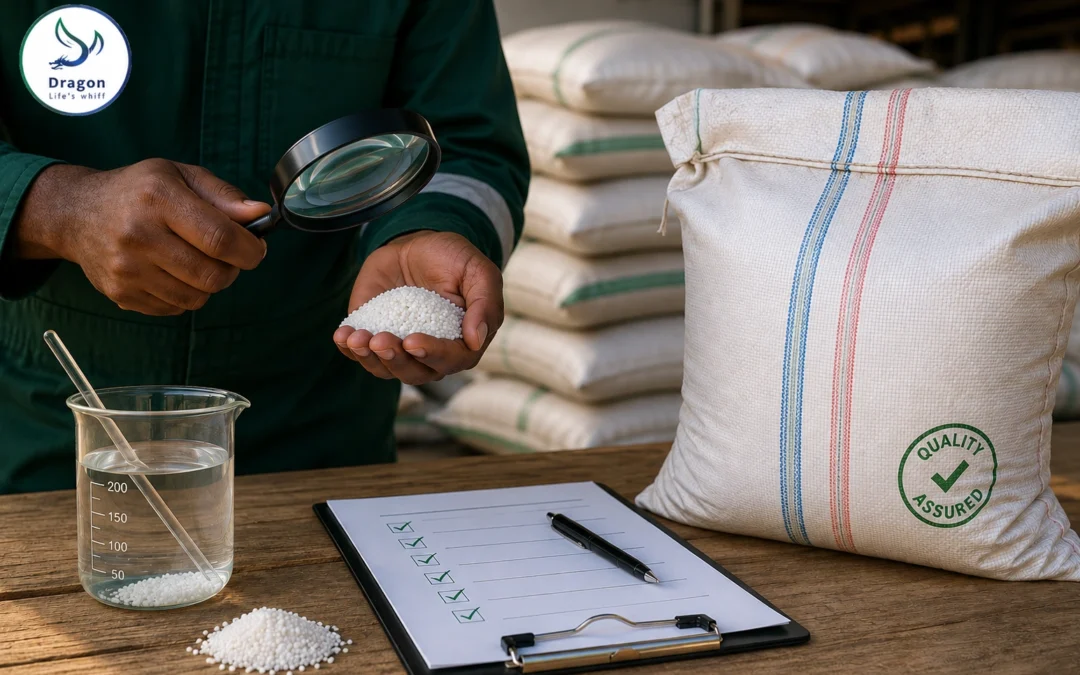
Check the seal and stitching, since a bag opened and restitched has been interfered with. Look for a batch number and manufacturing date, and be suspicious if either is missing, smudged, or identical across bags from supposedly different lots. Check the material for sand, stones, or granules of inconsistent size and colour. Dyed filler is common, and colour that rubs off on wet fingers is a warning.
What you cannot see is nutrient content. A bag can look normal and contain half the nitrogen on the label. The Fertilizer Association of Kenya’s position is that nutrient content is confirmed by laboratory analysis, not by eye.
The solubility test you can run yourself
One check works without a laboratory, for water-soluble products.
Stir a small measured amount into clean water at the label rate. A fully water-soluble fertilizer dissolves completely, leaving no sand, grit or sludge at the bottom. Insoluble residue in a product sold as soluble tells you something is in the bag that should not be.
This does not verify the NPK analysis. It does catch filler, which is what most crude adulteration relies on.
Ask for the documents
This separates a genuine supplier from an unverifiable one, and it costs nothing but a question.
A real manufacturer can produce a Certificate of Analysis for the specific batch you are buying, a Technical Data Sheet, a Safety Data Sheet, and a label showing full composition. Imported product should have a Free Sale Certificate. If a seller cannot produce a Certificate of Analysis for the batch in front of you, that is the most informative answer you will get all day.
Four questions worth asking before you pay:
- Who manufactured this, not who sold it to you?
- What is the batch number, and can I see the Certificate of Analysis for it?
- Is the product registered, and under whose name?
- Will you give me a receipt showing the batch?
A dealer who answers all four without hesitation is probably fine. One who becomes vague at question two is telling you something.
Why a quality system matters more than a promise
Any supplier will tell you their product is good. Under ISO 9001, batch consistency is an audited process rather than an assurance, checked by someone with no commercial interest in the answer.
Dragon Ferti manufactures under ISO 9001, ISO 14001 and ISO 45001 certified management systems and supplies the documentation above to distributors and importers. That is not a claim about how good the fertilizer is. It is a claim about whether anyone independent has checked how it is made.
Keep your own records
Buy from registered dealers and keep receipts showing batch numbers. If a product fails, a receipt and batch number are what let you pursue it. Without them you have no case.
If you export, the same records do double duty. Buyers and auditors ask what you applied, and a file of receipts with batch numbers and matching Certificates of Analysis is exactly the evidence they want, including for a GLOBALG.A.P audit on an export vegetable block.
A note on price
Counterfeit product competes on price, so an unusually cheap bag deserves more scrutiny, not less. That does not make expensive product automatically genuine. But if a price sits well below what everyone else charges for the same analysis, ask why before you buy, and ask for the Certificate of Analysis while you are asking.
Conclusion
Check the seal, batch number and material. Run a solubility test if the product should dissolve. Ask for the Certificate of Analysis for that batch and treat hesitation as the answer. Buy from registered dealers, keep receipts, and remember only a laboratory confirms nutrient content. For Dragon Ferti’s product range and quality documentation, use the contact page.
Frequently asked questions
Can I tell if fertilizer is fake just by looking at it?
You can catch crude counterfeits. Sand, stones, inconsistent granule size, dye that rubs off, tampered seals and missing batch numbers are all visible. What you cannot see is nutrient content, so a bag that looks correct may still be well below its label analysis. Confirming the actual NPK content requires laboratory testing.
What is the simplest test a farmer can do?
For a water-soluble product, dissolve a measured amount in clean water at the label rate. It should dissolve completely with no sand, grit or sludge left in the container. Insoluble residue in a product sold as fully soluble indicates filler. This catches adulteration but does not verify the nutrient analysis.
What documents should a fertilizer supplier be able to give me?
A Certificate of Analysis for the batch you are buying, a Technical Data Sheet, a Safety Data Sheet, and a label showing full composition. Imported product should also have a Free Sale Certificate. A supplier unable to produce a Certificate of Analysis for the specific batch is the clearest warning sign available to a buyer.
Does ISO certification mean the fertilizer is good?
It means the manufacturing process is audited independently, so batch-to-batch consistency is verified rather than promised. Whether the product suits your crop is a separate question that depends on your soil. What certification removes is the risk that what is in the bag varies from the label.