
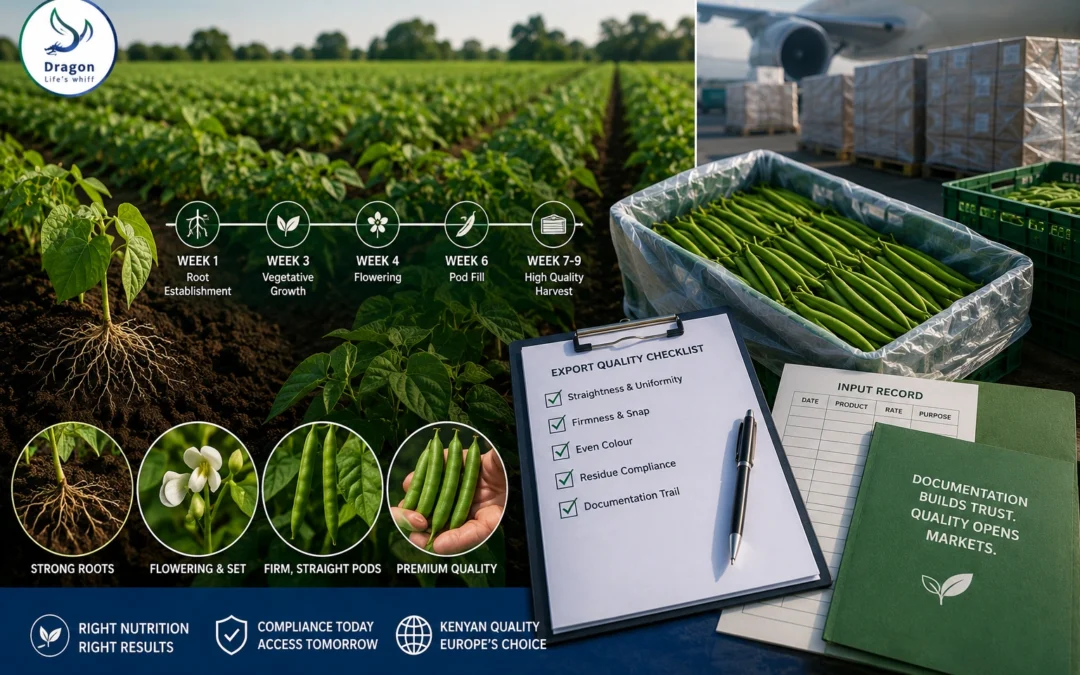
A French bean crop is in the ground about seven to nine weeks. That is the whole window. If the nutrition is wrong in week two you find out in week six, when pods come off soft or curved and there is no time left to fix it.
Kenya supplies a large share of Europe’s fresh green beans, snow peas and sugar snaps, most of it flown out of Nairobi within a day of picking. Certified export prices sit far above what the same beans fetch locally, and almost the entire gap is quality and compliance. So the nutrition plan has to be complete before you plant.
What the buyer is grading
European buyers do not assess a bean the way a local market does. Four things decide whether a consignment moves at export price: pod straightness and uniformity, since a curved pod fails the spec; firmness and snap, which is what survives handling and air freight; even colour across the pack; and residue compliance with a documented input trail an auditor can follow.
The first three are nutrition outcomes. The fourth is a documentation question, which is where your fertilizer supplier either helps you or becomes a problem.
Front-load the phosphorus
In a seven-week crop, root establishment is not a phase you revisit. The plant either builds a working root system in the first fortnight or spends its short life underfed.
Phosphorus at planting does that. Dragon High-Phosphorus Liquid is ready to inject where you fertigate, as most export blocks now do. Phosphorus lockup on highland soils matters more here than in a long-season crop, because there is no time for slow release.
The nitrogen trap
This is where growers lose consignments, and it is counterintuitive.
Generous nitrogen produces a lush plant, a heavy set of pods, and soft pod walls. Soft pods bruise in handling, arrive limp after a flight and get downgraded. A grower looking at a healthy green crop has no idea he is growing a bruising problem.
Keep nitrogen moderate and let calcium and potassium do the quality work. Dragon Fert Balanced carries the main growth phase without pushing the crop soft.
Calcium and boron decide pod quality
Pod wall firmness is calcium. Straightness and even fill trace back to boron at flowering and set.
Dragon Calibo supplies both together, saving an application in a crop this short. Dragon Flowering supports set, which gives a uniform pick rather than a spread of maturities that complicates grading.
Both must be in place before flowering. In a crop that flowers around week four, the decision is made in week three.
Iron, and why highland blocks go pale
Beans on the alkaline patches common in central Kenya go chlorotic fast, and in a seven-week crop a pale plant never recovers. Dragon Iron is chelated and stays available where iron sulphate would lock up first.
Bean foliage sheds water-based sprays, so adhesion matters. Dragon Stick keeps a foliar application on the leaf long enough to absorb, and Dragon Elixir helps a crop hold through heat stress.
The paperwork is part of the product
Export vegetables run through GLOBALG.A.P certification, KEPHIS registration, an HCD export licence and a compliant packhouse. Buyers audit input records.
This is where cheap unverifiable fertilizer costs more than it saved. An auditor asking what you applied wants a Certificate of Analysis, Technical Data Sheet, Safety Data Sheet and a label with full composition. Dragon Ferti products are made under ISO-certified quality systems and that documentation is available on request, which turns your input records into evidence rather than a liability.
Out-grower blocks
Most Kenyan export bean volume comes through out-grower schemes. The nutrition risk there is inconsistency: twenty growers running twenty different programmes produce a pack of mixed quality. The practical answer is one specified programme supplied through the scheme, so the exporter controls what goes on the crop and can document it across the supply base.
Organic beans
EU organic is a live premium route and input compliance is audited like everything else. The Dragon Organic line covers this with organic-compatible Calibo, Stick and Corrector, so a certified block runs the same plan with approved products.
Conclusion
Seven weeks leaves no room for correction, so the plan has to be right before planting. Phosphorus early, nitrogen restrained, calcium and boron before flowering, documentation you can hand an auditor. To build a programme for a block or scheme, see the Dragon Ferti range or contact the team through the contact page.
Frequently asked questions
Why do my French beans come out soft and bruise in transit?
Usually too much nitrogen and not enough calcium. Nitrogen produces soft pod walls that bruise in handling and arrive limp after air freight. Calcium builds the firmness that survives the journey. Moderate nitrogen plus calcium through flowering and pod fill fixes most cases.
What causes curved or misshapen pods?
Boron shortage at flowering and early pod set is the common nutritional cause, though uneven watering contributes. Boron affects pollen viability and even pod development, so pods that set poorly develop unevenly. A calcium and boron application before flowering, not after, is the practical prevention.
What fertilizer documentation do European buyers ask for?
Auditors generally want to see what was applied and be able to verify it, which means a Certificate of Analysis, Technical Data Sheet, Safety Data Sheet and a product label showing full composition. Buying unverifiable product creates an audit gap. Dragon Ferti supplies this documentation on request and manufactures under ISO-certified quality systems.
How do I keep quality consistent across an out-grower scheme?
Specify one programme and supply it through the scheme rather than letting each grower buy their own inputs. Twenty growers running twenty programmes produce mixed pack quality and an input trail nobody can document. Central supply also gives the exporter one record to present at audit.