
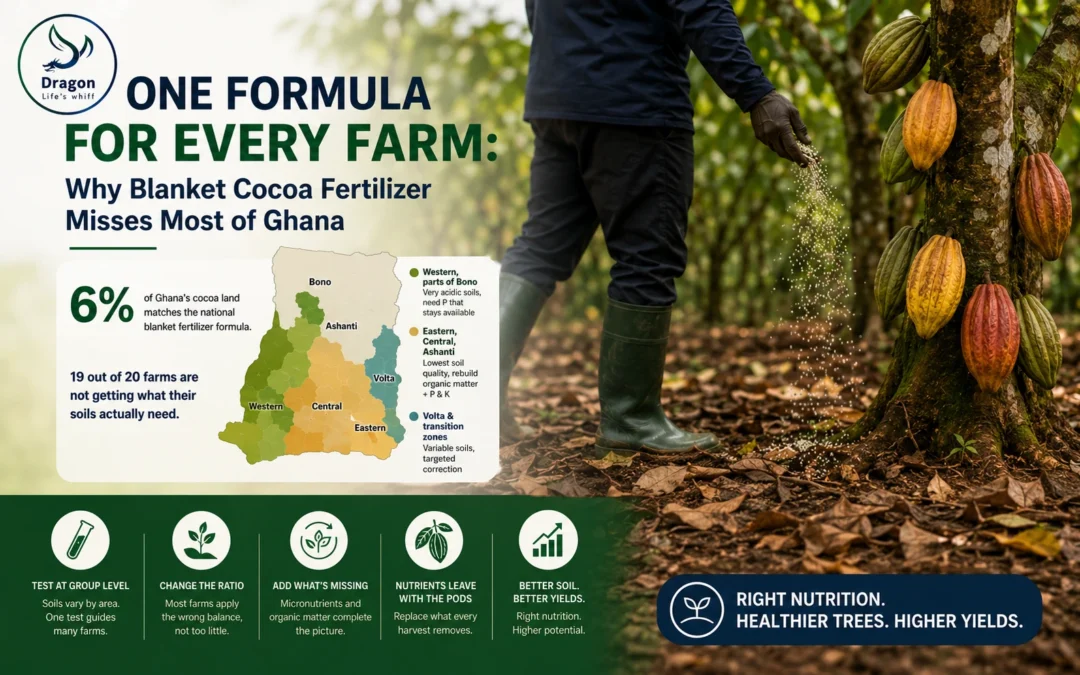
Here is a finding that should be better known than it is. When researchers mapped the nutrient requirements of Ghana’s cocoa soils against the blanket fertilizer formula recommended nationally, the formula matched only about six percent of the land actually growing cocoa.
Six percent. Which means that on roughly nineteen farms out of twenty, the standard product is not wrong exactly, but it is not what that particular soil needed either.
That reframes the usual conversation. Ghanaian cocoa yields sit around 350 to 600 kilograms per hectare against a potential well over a tonne. The question is not only whether farmers fertilize, but whether what they apply matches the ground it goes on.
Six regions, six different soils
Cocoa grows across the Western, Central, Eastern, Ashanti, Bono and Volta areas, on soils formed from different parent material with different base status. Farm surveys have found soil quality generally low, with Western, Bono and Volta scoring better than Eastern, Central and Ashanti.
The most consistent finding is phosphorus. Available phosphorus measured below 20 milligrams per kilogram on around 82 percent of farms surveyed, and potassium sat slightly below optimum on most. So the average farm is short of phosphorus, mildly short of potassium, and offered one blend designed for neither.
| Region group | Typical soil issue | What that soil actually needs |
|---|---|---|
| Western, parts of Bono | Very acidic Ferralsols, base cations depleted | Phosphorus in a form acidity cannot lock away, plus base replacement |
| Eastern, Central, Ashanti | Longest-cultivated, lowest soil quality scores | Rebuilding organic matter alongside phosphorus and potassium |
| Volta and transition zones | Variable, often better structured | Targeted correction rather than blanket rates |
Why phosphorus keeps disappearing
Research points to phosphorus as the main determinant of cocoa productivity, while potassium requirements are comparatively modest.
The complication is that on the acidic Ferralsols of the Western region, conventional phosphorus does not stay available. Iron and aluminium oxides bind phosphate on contact and hold it where roots cannot reach it. Adding more of the same product mostly feeds the soil.
Two responses work. Hold the phosphorus in humic complexes so it reaches the root first, which is what Dragon PK Humic is built to do. Or deliver it in a fully soluble form you can place precisely, such as Dragon Fert High Phosphorus. It is the same chemistry we cover for acidic soils in the Kenyan highlands.
The nutrients that leave with the pods
Every harvest carries nutrients off the farm inside the pods and beans, and nothing returns them unless you do. Decades of that, on trees many of which are past their productive age, is how depleted cocoa soil happens.
Beyond phosphorus, two elements deserve naming. Potassium supports pod filling, covered by Dragon PotaMax or a balanced base such as Dragon Paste Balanced. And copper, rarely tested for, which supports the tree’s use of everything else, available as Dragon Copper.
Boron has a long history in Ghanaian cocoa research, linked to pod malformation where it runs short. Worth checking before assuming a pod-set problem is disease.
How to move away from blanket feeding
You do not need a laboratory on every farm. Three steps get most of the way:
- Test at cooperative or district level. Soils vary by area more than by neighbouring plot, so one analysis can guide a whole group.
- Change the ratio before the rate. Most farms apply the wrong balance rather than too little. A range of ratios lets you match soil to product.
- Add what the blanket product omits, which is usually micronutrients and organic matter.
Organic and certified cocoa
Certified cocoa carries a premium, and Ghana already has organic cocoa projects plus a growing trade in organic fertilizer made from cocoa waste, so the concept is familiar here. The Dragon Organic line provides organic-compatible PK Humic and PotaMax for the same phosphorus strategy.
Conclusion
A single national formula was always going to be a compromise, and the mapping work shows how large that compromise is. The practical answer for a Ghanaian cooperative or farm is to test at group level, correct the ratio rather than simply raising the rate, choose a phosphorus form that survives acidic soil, and add what a blanket blend leaves out. For a companion view on the same crop under different conditions, see our piece on cocoa in Nigeria. To match products to a soil analysis, see the Dragon Ferti range or use the contact page.
Frequently asked questions
Is the standard cocoa fertilizer in Ghana wrong?
Not wrong so much as generic. Research mapping soil requirements against the nationally recommended formula found it suited only around six percent of Ghana’s cocoa land, because one blend cannot match six regions with different parent material. It helps many farms somewhat while falling short of what most specifically need.
Why does phosphorus fertilizer perform poorly on Western region cocoa soils?
Those soils are strongly acidic Ferralsols where iron and aluminium oxides bind phosphate into forms roots cannot absorb. The phosphorus is present in the soil but not available to the tree. Humic-complexed phosphorus and precise soluble applications both get more of it to the root before the soil captures it.
Do I need a soil test for every cocoa farm?
No. Soils vary by area more than between neighbouring plots, so testing at cooperative or district level gives you enough to adjust the ratio for a whole group of farms.
Will fertilizer alone close Ghana’s cocoa yield gap?
It closes part of it, not all. Tree age is the other major constraint, since many of Ghana’s cocoa trees are past peak productive life and no nutrition programme rejuvenates an old tree. Fertilizer matched to the soil, combined with rehabilitation and replanting, is what moves yields toward potential.