
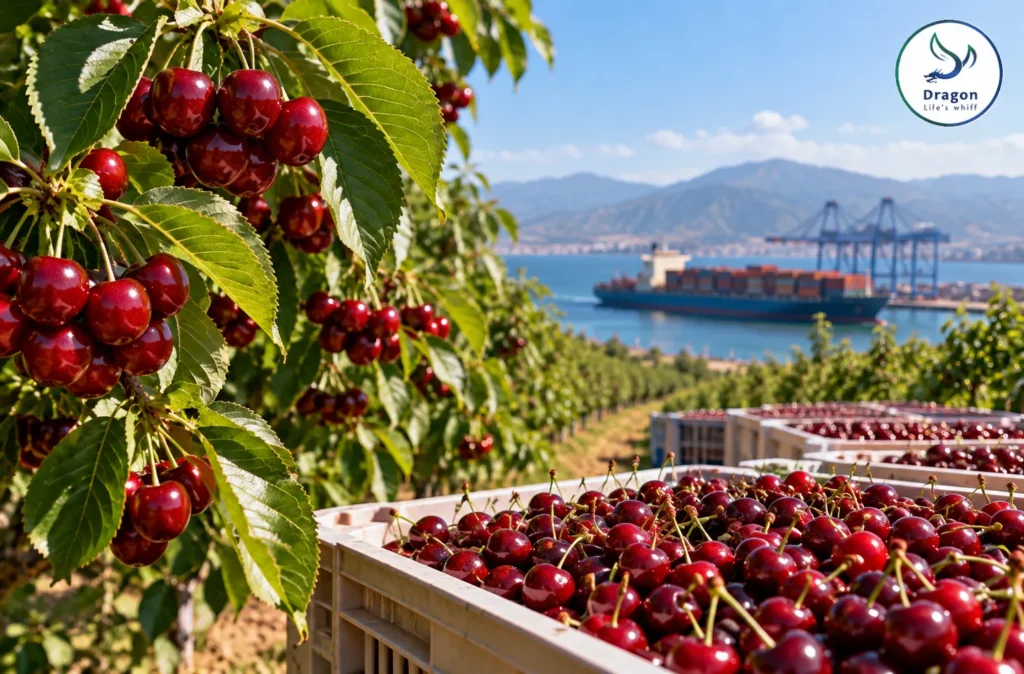
Chile shipped about 112 million boxes of cherries in the 2025 to 2026 season, roughly 561,000 tonnes. Cherries are now the country's most exported agricultural product and its second export overall after copper.
The season also showed where the pressure is. China's share of Chilean cherry exports fell from 92 per cent to 87 per cent, prices came under strain, Spain entered the Chinese market as a new competitor, and fruit was on shelves in China more than a month before the Lunar New Year at prices well below previous norms.
When supply is abundant and prices are soft, the fruit that sells is the fruit that arrives firm, glossy and sound. The Cherry Express ships have cut the voyage from San Antonio and Valparaiso to China from about 30 days to around 22 or 23. One vessel that broke down in a recent season took 52 days and arrived with catastrophic losses. Every day at sea tests what happened in the orchard months earlier.
This guide follows a Chilean cherry through that journey and looks at what nutrition decides at each point.
Stop 1: bloom, in early spring
What is at stake: how many fruit set.
Chilean cherry orchards in the central valleys flower in the southern spring. Fruit set depends on pollination and on the flower being able to use it, and boron is directly involved in pollen tube growth.
Boron has to be in the tree before the flowers open. Applied during bloom, much of it arrives too late for the flowers already open. Dragon Calibo supplies calcium with boron ahead of flowering, and Dragon Flowering supports the set itself.
Zinc also matters early, for leaf and shoot development that will feed the crop. Dragon Zinc corrects a confirmed shortage.
Stop 2: the first weeks after set
What is at stake: firmness, and the ability to resist cracking.
This is the stretch most growers underestimate. Cherry fruit grows first by cell division, and the number and strength of cells laid down now largely determine how firm the fruit will be at harvest and how well it holds up afterwards.
Calcium is the nutrient of this window. It moves in the transpiration stream, is deposited in cell walls, and does not move again once placed. Fruit transpires far less than leaves, so calcium reaching the fruit is limited to begin with, and most of what the fruit will ever receive arrives early. Calcium applied close to harvest does much less than growers hope.
Dragon PureCal supplies calcium through this window, and Dragon NPK+CaO delivers it within the base feed. The same principle governs calcium disorders in other fruit trees, as the guide to bitter pit in apple shows.
Stop 3: pit hardening and the final swell
What is at stake: size and sugar.
After pit hardening, cherries enter a final period of rapid growth where most of the fruit's size and sugar is added. This is where potassium carries the programme.
Size matters commercially. Chinese buyers grade heavily by calibre, and larger fruit commands the premium. Dragon Paste High Potassium and Dragon PotaMax support that swell.
There is a balance to keep. Potassium competes with calcium for uptake, so a programme pushing potassium very hard for size can reduce the calcium that firmness depends on. The two need to be balanced rather than each maximised on its own.
Stop 4: harvest, and the nitrogen question
What is at stake: how the fruit holds up after picking.
Excess nitrogen is one of the most common causes of soft cherries. A vigorous tree with a heavy leafy canopy pulls calcium toward shoots rather than fruit, delays maturity, and produces fruit that looks good at the orchard and softens in the cold chain.
Nitrogen belongs in the post-harvest and early-season period, when the tree is building reserves for next year, rather than in the run-up to harvest. Dragon Triple N supplies nitrogen for those windows.
Rain near harvest is a separate risk. Pre-harvest rain in Chile's spring can crack fruit as it absorbs water through the skin. Rain covers and orchard management carry most of that burden. Good calcium nutrition during fruit development contributes to skin and flesh strength, but it reduces cracking rather than preventing it, and growers should be told that plainly.
Stop 5: 23 days at sea
What is at stake: everything that came before.
In the container, the fruit can no longer be changed. It can only lose condition. Firmness declines, stems brown, and fruit damaged at harvest develops surface pitting. Good cold chain management slows all of this, but the starting condition of the fruit sets the ceiling.
That is the real argument for orchard nutrition in the Chilean cherry business. It is not mainly about yield. It is about how much of the fruit that leaves San Antonio is still premium grade when it reaches Guangzhou, Shanghai or Tianjin.
The water and the soil
Most Chilean cherry orchards are irrigated, and much of the fertilizer goes through the drip line. That makes product solubility a practical requirement, since residue that blocks emitters stresses exactly the rows you cannot afford to stress during fruit development. The principles of feeding through drip on export fruit farms along the Pacific coast are set out in the guide to fertigation on Peru's desert coast.
The Dragon Paste line is fully water soluble and runs acidic in solution, which helps where irrigation water carries bicarbonate. Dragon Fert soluble powder suits larger blocks and foliar work. Every product in the range is free of chloride, sodium and heavy metals, and cherry, like most stone fruit, does not tolerate chloride accumulation well.
Where micronutrients are short, Dragon Mix Plus covers them in one application. The foliar fertilization guide covers spray timing and mixing, and the fertigation best practices guide covers injection and scheduling.
After harvest: the next crop starts now
A cherry tree forms next season's flower buds during the current season. Nutrition after harvest, when the fruit is gone and the leaves are still working, builds the reserves those buds will draw on at the next bloom.
It is the easiest window to neglect because there is no crop to protect. It is also the one that decides how the next season starts. Dragon Boost supports recovery after the stress of a heavy crop.
What this means for a distributor
Chile's cherry industry is large, export-driven and increasingly worried about quality and oversupply. Growers who can reliably deliver firm, large fruit are protected against soft prices in a way that growers chasing volume are not.
That shifts the conversation from price per bag to condition on arrival. Dragon Ferti supplies Certificates of Analysis, Technical Data Sheets, Safety Data Sheets and Free Sale Certificates, and manufactures under ISO 9001, ISO 14001 and ISO 45001 certified management systems. The supplier evaluation guide sets out what an importer should check.
Conclusion
A Chilean cherry is judged in a Chinese market more than three weeks after it leaves the orchard, and in a soft, crowded market its condition on arrival decides its price. Boron before bloom, calcium in the weeks after set, potassium through the final swell balanced against calcium, nitrogen kept away from harvest, and reserves rebuilt after picking give the fruit the best chance of arriving firm. For specifications or distribution enquiries, see the Dragon Ferti range, review field trial results, or contact the export team through the contact page.
Frequently asked questions
When should calcium be applied to cherry trees?
Mainly in the weeks after fruit set, during cell division, when calcium is being built into the fruit's cell walls. Calcium does not move once deposited, and fruit receives relatively little of it, so applications close to harvest have much less effect on firmness than early ones.
Does calcium stop cherry cracking?
It helps but does not prevent it. Cracking is mainly caused by fruit absorbing water through the skin during rain near harvest. Good calcium nutrition during fruit development strengthens skin and flesh, but rain covers and orchard management carry most of the protection.
Why are my cherries soft at harvest?
Excess nitrogen is a common cause. A vigorous leafy canopy draws calcium away from the fruit, delays maturity and produces fruit that softens quickly in cold storage. Keeping nitrogen to the post-harvest and early-season periods, and balancing potassium against calcium, improves firmness.
When should boron be applied to cherries?
Before bloom. Boron supports pollen tube growth and fruit set, so it needs to be available in the tree before the flowers open. Applications made during bloom arrive too late for flowers that have already opened.
Why does post-harvest nutrition matter for cherries?
Because cherry trees form next season's flower buds during the current season. Feeding after harvest, while leaves are still active, builds the reserves those buds depend on at the next bloom.

Looking for a reliable specialty fertilizer partner?
We work with importers and distributors who want products that set their portfolio apart.