
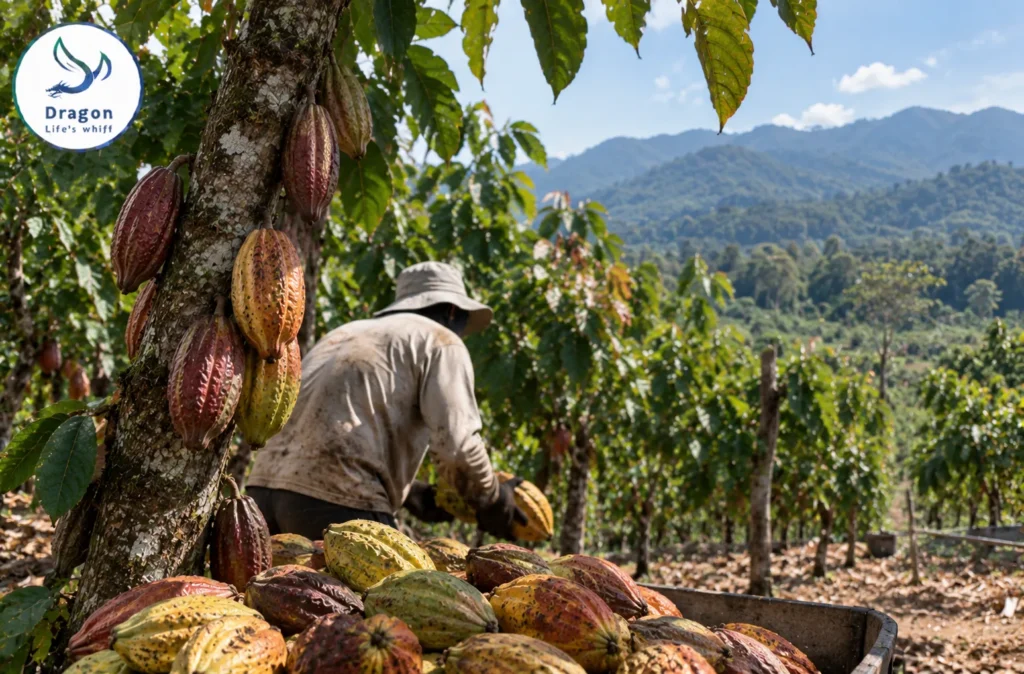
Ecuador shipped around 560,000 tonnes of cacao in 2025, and ANECACAO expects more than 623,000 tonnes in 2026. The country is on course to pass Ghana as the world's second-largest producer.
The same projection carries a harder number. At an average export price near 3,500 dollars a tonne, those extra 63,000 tonnes would earn roughly 2.2 billion dollars, less than half the 4.7 billion earned in 2025. Volume is rising and revenue is falling at the same time.
When price per tonne falls, the farms that stay profitable are the ones producing more per hectare at a lower cost per kilogram. That puts nutrition at the centre of the business in a way it rarely was when prices were high. And in Ecuador it has to be answered twice, because the country grows two very different cacaos.
Nacional and CCN-51 are not the same crop
| Nacional (fino de aroma) | CCN-51 | |
|---|---|---|
| What the market pays for | Floral and fruity flavour, sold into the fine and flavour segment | Volume and butter content, sold as bulk cacao |
| Typical yield | Often in the range of 300 to 500 kg per hectare | Can reach around 2,000 kg per hectare under good management |
| Tree form | Older plantations, tall trees, often under shade | Newer, more compact plantings, frequently in fuller sun |
| Nutrient removal | Lower, because less is harvested | Several times higher, because much more is harvested |
| Main risk of getting nutrition wrong | Pushing the tree for yield it was not bred for | Starving a high-yield clone on a low-input budget |
Ecuador is the world's largest producer of fine and flavour cacao, a segment that makes up only a small share of global supply and commands a premium. CCN-51, a clone developed in Ecuador, has driven most of the recent volume growth.
The mistake is feeding them alike. A CCN-51 block carrying a heavy crop on a programme designed for Nacional will run down its reserves and drop yield within a few seasons. A Nacional block pushed with CCN-51 rates will spend money chasing tonnage its genetics were never going to deliver.
Feeding CCN-51: the crop takes what you give it
A high-yielding clone behaves like any intensive crop. What leaves in the harvest has to come back, or the tree borrows from itself.
Potassium is the largest single removal. Much of it sits in the pod husk rather than the bean. That has a practical consequence: husks returned to the plantation floor recycle a large share of the potassium the crop removed, while husks carted away take it with them. A farm that processes pods centrally and does not return the husks needs a correspondingly larger potassium programme.
Nitrogen drives the canopy that carries the crop. Full-sun CCN-51 needs more nitrogen than shaded plantings because it is growing faster and carrying more. Excess nitrogen without matching potassium produces leaf rather than pods.
Magnesium, calcium, zinc and boron decide pod set and fill. Boron in particular affects flowering and pollination, and cacao sets a very small fraction of the flowers it produces. Anything that improves that fraction has an outsized effect on yield.
For fertigated CCN-51 plantations, Dragon Paste Balanced supports canopy and establishment, with Dragon Paste High Potassium and Dragon PotaMax carrying pod fill. Dragon MagiCal covers magnesium with calcium, and Dragon Calibo supplies calcium with boron ahead of the main flowering.
Feeding Nacional: protect the tree, protect the flavour
Nacional plantations are often old, tall and shaded, and many belong to smallholders farming a couple of hectares with little mechanisation. The goal is different: sustain a productive, healthy tree and a clean, well-developed bean rather than chase tonnage.
That usually means lower rates, more attention to micronutrients, and more reliance on foliar application, because most Nacional farms have no fertigation. Dragon Fert soluble powder dissolves fully for spraying, and Dragon Mix Plus covers the micronutrient group in one pass. The foliar fertilization guide covers timing, mixing order and coverage.
For growers in certified organic or specialty chains, the Dragon Organic line carries organic-compatible versions of the same logic.
Flavour itself is shaped far more by genetics, fermentation and drying than by fertilizer, and it would be dishonest to claim otherwise. What nutrition does is keep the tree healthy enough to carry a well-filled pod to maturity, which is the raw material good fermentation needs.
The soil question under both
Ecuadorian cacao grows across very different ground, from the coastal provinces of Los Rios, Manabi, Guayas and Esmeraldas to the Amazon provinces of Sucumbios and Orellana. Many of those soils are acidic, and acidity limits calcium, magnesium and phosphorus availability while raising aluminium.
Before designing a programme, test for pH, exchangeable aluminium, calcium, magnesium and potassium. A soil that needs lime will waste much of any fertilizer applied before the lime goes on. The guide to acid soils and aluminium in the Andes covers how to read those figures.
Soil also carries the question every Ecuadorian exporter now faces: cadmium. It occurs naturally in parts of the Andean cacao belt, the bean takes it up, and European rules limit it in finished chocolate. That subject has its own guide, cadmium in cacao and what the EU limits actually mean, because soil pH management and fertilizer purity both affect it.
Where disease fits
Frosty pod rot and witches' broom are the dominant production constraints in Ecuadorian cacao, and no fertilizer controls either. Sanitation, removing infected pods and branches, and pruning for airflow do that work.
What balanced nutrition does is keep the tree from being weakened further. A potassium-starved or boron-short tree is under more stress than a well-fed one. That is a supporting role, and it should be described as one.
Lessons from West Africa
Ghana and Nigeria have spent decades learning what blanket fertilizer recommendations cost. The site-specific approach to cocoa nutrition in Ghana and the specialty cocoa programme in Nigeria both reach the same conclusion Ecuador is now reaching through its price fall: generic rates waste money on some blocks and starve others.
What this means for a distributor
Ecuador's cacao sector now has two customers with opposite needs. Large CCN-51 operations buy volume and measure return per hectare. Nacional smallholders buy small quantities, often through associations, and need products that work without fertigation.
A supplier who can serve both, with fertigation-grade paste and powder for one and foliar-friendly soluble products for the other, is more useful than one selling a single bag to everyone. Dragon Ferti supplies Certificates of Analysis, Technical Data Sheets, Safety Data Sheets and Free Sale Certificates, and manufactures under ISO 9001, ISO 14001 and ISO 45001 certified management systems.
Conclusion
Ecuador is producing more cacao than ever at a much lower price, which makes nutrition a margin decision rather than an afterthought. CCN-51 removes far more than Nacional and has to be fed accordingly, while Nacional needs a healthier tree rather than a heavier crop. Test the soil first, return the husks where you can, and match the programme to the variety. For specifications or distribution enquiries, see the Dragon Ferti range, review field trial results, or contact the export team through the contact page.
Frequently asked questions
What is the best fertilizer for cacao in Ecuador?
It depends on the variety. High-yielding CCN-51 needs a full programme with substantial potassium, nitrogen, magnesium and micronutrients to replace what the crop removes. Nacional fine flavour cacao generally needs lower rates with more attention to tree health and micronutrients, often applied as foliar sprays.
Why does CCN-51 need more fertilizer than Nacional?
Because it can yield several times more per hectare, and every tonne of harvested cacao removes nutrients from the plantation. Feeding a heavy-cropping clone on a programme designed for low-yielding Nacional runs down the tree's reserves and reduces yield over time.
Do cacao pod husks contain nutrients?
Yes, and a large share of the potassium the crop removes sits in the husk rather than the bean. Returning husks to the plantation floor recycles much of that potassium, while removing them means the fertilizer programme has to replace it.
Can fertilizer control frosty pod or witches' broom?
No. These diseases are managed through sanitation, removal of infected material and pruning. Balanced nutrition supports tree health so disease pressure is not compounded by nutrient stress, but it does not replace disease management.
Does fertilizer affect cadmium in cacao beans?
It can play a part. Soil pH strongly influences how much cadmium the tree takes up, and some fertilizers made from contaminated raw material add cadmium to the soil. Using fertilizers free of heavy metals avoids adding to the problem.


Looking for a reliable specialty fertilizer partner?
We work with importers and distributors who want products that set their portfolio apart.