
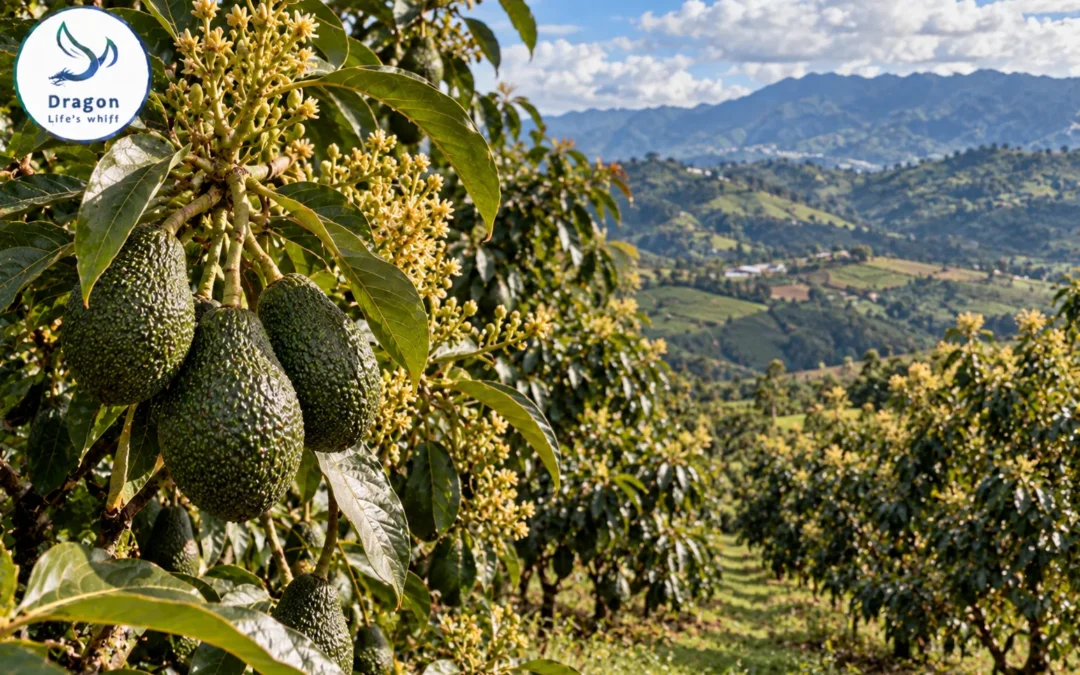
Colombian Hass avocado exports grew by 45.7 per cent in volume in 2025, according to the Ministry of Commerce. Antioquia alone accounted for nearly half of all shipments. Around 41,000 hectares are now certified for export, and the total harvest reached roughly 200,000 tonnes.
That growth happened on a crop whose nutrition in Colombia is still poorly understood. Researchers studying Hass flowering in Caldas noted that the country lacks adequate technical support for the crop, largely because there is little published information on how Hass actually behaves in Colombian conditions.
The reason is geography. Most avocado nutrition advice was written for Mexico, California, Chile and Spain, where the tree follows a clear annual rhythm. Colombia sits on the equator, and the equator does not give the tree a clear rhythm at all.
One tree, several seasons at once
In Michoacan or California, a Hass tree flowers once, sets fruit, grows it, and is harvested. The nutrition calendar follows that single cycle.
In the Colombian Andes, rainfall comes in two wet seasons a year, and the tree responds with more than one flowering. Growers distinguish a main harvest from a secondary one, locally called the traviesa. The practical result is that a single tree can carry flowers, newly set fruit and fruit halfway to maturity at the same time.
That breaks the standard advice. A programme that stops nitrogen at fruit set to protect fruit quality will starve the next flowering. A programme that pushes nitrogen for the new flush will soften the fruit already hanging. Every nutrient decision in Colombia is a compromise between cycles running in parallel.
Early 2026 showed how fragile this is. Unusual rainfall at the start of the year arrived during flowering and raised concerns about set and tree growth across producing regions. The tree responds to rain, and rain in Colombia is not reliably seasonal.
What that means in practice
Because the stages overlap, the programme works better as a steady baseline with targeted adjustments than as a sequence of distinct phases.
Keep a continuous base. Rather than large seasonal doses, supply a moderate balanced feed through the year so no single cycle is starved. Dragon Paste Balanced suits fertigated orchards, and Dragon Fert soluble powder works for foliar and soil application where drip is not installed.
Add boron and calcium ahead of each main flowering. Boron supports pollen tube growth and fruit set, and it has to be present before the flowers open rather than after. Dragon Calibo supplies calcium with boron together, and Dragon Flowering supports the set itself.
Weight potassium toward whichever crop is filling. When the main crop is sizing, shift the balance toward potassium with Dragon Paste High Potassium or Dragon PotaMax, while keeping the base running for the next flush.
Keep calcium running continuously. Calcium is deposited in fruit during cell division and does not move again, and with overlapping cycles there is almost always a young fruit in that window somewhere on the tree. Dragon PureCal and Dragon NPK+CaO provide steady supply.
The soil numbers worth aiming for
Much Colombian Hass is planted on acidic highland soils. Agrosavia’s work on avocado in Colombia describes cold-climate soils as generally extremely to strongly acidic, with pH between about 4.5 and 5.5, relatively low nutrient availability and frequent imbalances.
The same research gives tentative targets drawn from healthy, highly productive orchards:
| Soil measure | Tentative target in productive Colombian orchards |
|---|---|
| Exchangeable calcium | 4.0 to 6.0 cmol(+)/kg |
| Exchangeable magnesium | 1.5 to 2.5 cmol(+)/kg |
Agrosavia is careful to say these are observed values from good orchards rather than experimentally established critical levels. They are still the most useful reference a Colombian grower has, and they give a soil report something concrete to be compared against.
They also warn against over-liming. On these soils the instinct is to add lime until the pH rises, but excess lime creates its own problems, including micronutrient deficiencies. The recommended approach is to base any liming on a soil analysis that reports pH together with exchangeable calcium, magnesium and aluminium, not on pH alone. The guide to acid soils and aluminium in Colombia walks through reading those figures.
Where magnesium falls short of the target, Dragon MagiCal supplies it with calcium.
Roots decide everything else
Avocado has a shallow, sparse root system with few root hairs, and it is highly sensitive to waterlogging. Phytophthora root rot is the constant background threat in wet Andean conditions.
Nutrition does not cure root rot. Drainage, planting on mounds, careful irrigation and sound disease management do. What nutrition can do is support root growth and avoid adding stress. Dragon Rooty is built to support root development, and a published Dragon Rooty trial documents its effect. On soils low in organic matter, humic products such as Dragon HV15 improve the root environment.
Micronutrients matter on these soils too. Zinc shortage is common in avocado and shows in small, distorted leaves and poor fruit shape. Dragon Zinc corrects it, and Dragon Mix Plus covers the wider group.
Harvest is decided by dry matter, not by date
With overlapping cycles, fruit on the same tree reaches maturity at different times, which makes picking by calendar unreliable. Export markets judge Hass maturity by dry matter content, and fruit harvested below the required level ripens poorly and disappoints the buyer.
Nutrition affects how fruit accumulates dry matter, and potassium balance in particular influences fill. The guide to avocado dry matter and export grade covers testing and the nutritional side in detail, and the contrast with a single-cycle system is laid out in the guide to avocado fertilization in Mexico.
What this means for a distributor
Colombian Hass is expanding fast, exporting to Europe and the United States, and increasingly run by growers who need technical answers that Mexican or Chilean recommendations do not provide.
That creates room for a supplier who understands the equatorial problem. A grower told to “stop nitrogen at fruit set” by a manual written for a single-season climate has been given advice that does not fit their tree. A dealer who can explain the overlapping-cycle logic is offering something more useful than a price list.
Dragon Ferti supplies Certificates of Analysis, Technical Data Sheets, Safety Data Sheets and Free Sale Certificates, and manufactures under ISO 9001, ISO 14001 and ISO 45001 certified management systems. Every product is free of chloride, sodium and heavy metals, which matters on a salt-sensitive crop.
Conclusion
Colombian Hass grows on the equator, where two rainy seasons produce more than one flowering and the same tree carries several stages at once. Advice written for single-season climates does not fit it. A steady baseline feed, boron and calcium ahead of each main flowering, potassium weighted toward whichever crop is filling, and liming based on a full soil analysis rather than pH alone give the tree what its calendar actually demands. For specifications or distribution enquiries, see the Dragon Ferti range, review field trial results, or contact the export team through the contact page.
Frequently asked questions
Why is avocado fertilization different in Colombia than in Mexico?
Colombia sits on the equator with two rainy seasons a year, so Hass trees flower more than once and a single tree can carry flowers, young fruit and maturing fruit at the same time. Nutrition calendars written for single-season climates, which stop or change inputs at fixed stages, do not fit that pattern.
What is the traviesa in Colombian avocado?
It is the local name for the secondary harvest that follows the second flowering of the year. Its existence is what makes Colombian avocado production close to year-round, and it is also why nutrition has to support overlapping crop cycles rather than one.
What soil calcium and magnesium levels suit Hass avocado in Colombia?
Agrosavia research on healthy, highly productive Colombian orchards suggests tentative targets of about 4.0 to 6.0 cmol(+)/kg for exchangeable calcium and 1.5 to 2.5 cmol(+)/kg for exchangeable magnesium. These are observed values from good orchards rather than established critical levels.
Should I lime my avocado orchard?
Only on the basis of a soil analysis that reports pH together with exchangeable calcium, magnesium and aluminium. Many Colombian highland soils are strongly acidic, but excess lime causes its own problems, including micronutrient deficiencies. Base the rate on the full analysis rather than on pH alone.
When should boron be applied to avocado?
Ahead of the main flowerings, since boron supports pollen tube growth and fruit set and needs to be available before the flowers open. In Colombia’s overlapping cycles, that means planning applications around each significant flowering rather than once a year.