
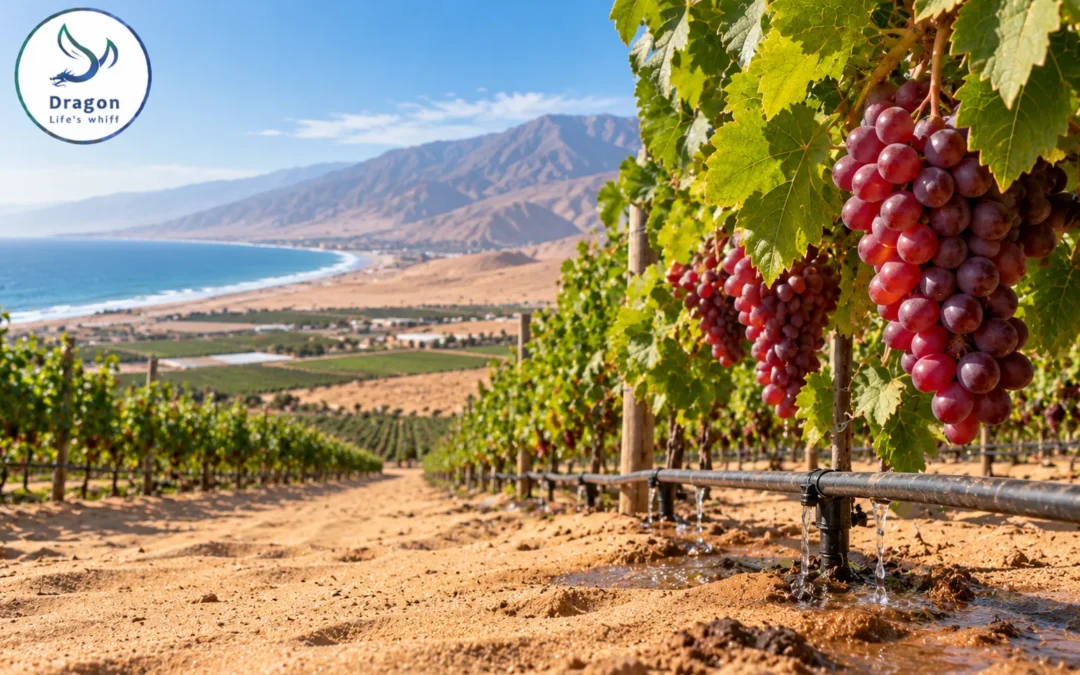
Peru is now the world’s largest exporter of table grapes and of blueberries. Almost all of it grows in one of the driest places on earth.
The coastal strip between the Andes and the Pacific gets close to no rain at all. Ica, La Libertad, Piura and Lambayeque together account for more than 80 per cent of Peru’s agricultural exports, and every hectare of that depends on water brought in by canal or pumped from below. Chavimochic, the project whose name joins the Chao, Viru, Moche and Chicama valleys, carries water from the Santa River across land that was open desert a generation ago.
That makes the drip line on a Peruvian export farm something more than an irrigation system. It is the only way anything reaches the root. And the root is sitting in sand.
Sand is not soil with less clay. It is a different system.
Most fertilizer advice is written for soil that holds things. Sand holds almost nothing, and that single fact changes every decision downstream.
| Loam or clay soil | Coastal Peruvian sand | |
|---|---|---|
| Cation exchange capacity | Moderate to high, so potassium, calcium and magnesium are held on the particles and released gradually | Very low, so there is almost nowhere for nutrients to be stored |
| Organic matter | Usually present, adding buffering and some supply | Typically very low |
| Water holding | Hours to days of reserve | Very little reserve; over-irrigation drains straight through |
| Buffering against mistakes | A missed or excess feed is absorbed | A missed feed shows quickly; an excess moves below the roots |
| What the root sees | Soil chemistry plus whatever you applied | Mostly whatever arrived in the last irrigation |
Read the last row twice. On sand, the root zone solution is close to a direct copy of what the injector delivered. That is a disadvantage when the programme is sloppy and an enormous advantage when it is precise. A grower on sand has more control over crop nutrition than a grower on almost any other ground, provided they use it.
Five rules that follow from the sand
- Feed little and often. Large weekly doses on sand either run past the root zone or spike the solution concentration and then crash it. Smaller, more frequent injections, daily on many export farms, keep the root zone steady. The total per season can stay the same. The distribution changes.
- Never fertigate at the start of an irrigation pulse and walk away. Inject in the middle of the cycle and finish with clean water, so the nutrient sits in the wetted zone rather than being pushed past it or left concentrated in the lines.
- Measure what drains, not only what goes in. The electrical conductivity and pH of the drainage or the soil solution under the dripper tell you what the plant actually experienced. On sand this reading moves fast, which makes it the most useful number on the farm.
- Treat calcium and magnesium as scheduled inputs. On a heavier soil these often come from the soil reserve. On low-exchange sand there may be very little reserve to draw on, so they belong in the programme alongside nitrogen and potassium rather than as occasional corrections.
- Watch the water as closely as the fertilizer. River and well water across the coast varies in bicarbonate and salts. With little rain to leach the profile, whatever the water carries accumulates unless the irrigation plan includes enough drainage to move it. The guide to salinity and alkaline water covers how to read those numbers.
What the product has to do on sand
Every rule above assumes a fertilizer that dissolves completely, every time, in the water that farm actually has.
That is a harder requirement than it sounds. Daily injection multiplies the chance of residue building up in emitters, and a partly blocked line on sand shows as a stressed row within days because there is no soil reserve to cover it. The Dragon Paste line is fully water soluble and runs acidic in solution, which works against bicarbonate in the water rather than adding to scaling. Dragon Fert soluble powder carries the same nutrition in crystal form for larger blocks.
Every product in the range is free of chloride, sodium and heavy metals. On a coast where the water already carries some salt and rain never arrives to wash it out, the fertilizer should not be adding more.
Where the water itself needs correcting, Dragon Corrector is built for pH and bicarbonate management in the injection stream.
Crop by crop, the same sand asks different things
Table grapes. Peru’s grape area sits mainly in Ica and Piura, and Piura’s climate allows two harvests in a year, which means the vine is almost never resting and the programme never truly stops. Potassium through berry development, calcium during cell division after set, and restraint on late nitrogen decide whether fruit holds up on the voyage to the United States, Europe or Asia. The same calcium timing decides whether Chilean cherries survive more than three weeks at sea to China. Dragon Paste High Potassium and Dragon PotaMax carry fill, and a published grape trial using Dragon Paste 10-50-20 with Dragon Thio shows how the paste line performs on the crop. The same chloride and calcium logic applies in the guide to table grapes grown for export.
Blueberries. Much of Peru’s blueberry area is grown in substrate rather than sand, which is a different system again with its own pH and iron demands. That is covered in detail in the guide to blueberry fertilization in Peru.
Avocado. Hass on sandy coastal ground has a shallow root system and low tolerance for salt. Steady calcium, boron ahead of flowering, and potassium through fruit growth matter more than any single large application. Dragon Calibo pairs calcium with boron for exactly that window. The same variety behaves very differently a few degrees further north, where equatorial rainfall produces overlapping flowerings, as the guide to Hass avocado in Colombia explains.
Mango and asparagus. Both are long-established coast crops. Mango on the northern coast needs potassium and calcium through fruit development, and a mango trial with Dragon PotaMax documents the potassium response. Asparagus is a perennial whose next season is built by the fern after harvest, so the post-harvest feeding window matters more than most growers treat it.
Micronutrients on sand
Low organic matter and low exchange capacity mean micronutrients are easily short and easily over-supplied. Little and often applies here too.
Dragon Mix Plus covers the group in one application for routine maintenance. Where tissue analysis points at a single element, Dragon Iron, Dragon Zinc or Dragon Manganese correct it directly. Foliar application is a useful second route when root uptake is limited, and the foliar fertilization guide covers mixing order and timing.
A note on the water supply itself
The coastal boom rests on water from the Andes, and a good share of it comes from glacial melt that will not last indefinitely. That is a long-horizon concern rather than a next-season one, but it points in the same direction as everything above. Every cubic metre carrying nutrient that drains past the root is wasted twice. Precision fertigation on sand is not only good agronomy. It is how the coast keeps producing on the water it has.
What this means for a distributor
Peru’s export farms are large, technical and measured. They run their own agronomists, test drainage daily and judge suppliers on consistency rather than price per bag.
That favours a supplier who can document batch-to-batch analysis and deliver product that dissolves the same way every time, because on sand a variation in the product shows up in the crop within a week. Dragon Ferti supplies Certificates of Analysis, Technical Data Sheets, Safety Data Sheets, full composition labels and Free Sale Certificates, and manufactures under ISO 9001, ISO 14001 and ISO 45001 certified management systems. The supplier evaluation guide sets out what an importer should check.
Conclusion
On Peru’s desert coast the sand holds almost nothing, rain never arrives, and the root zone solution is close to a copy of the last injection. That removes the soil’s safety net and hands the grower more control than almost anywhere else. Feed little and often, measure what drains, schedule calcium and magnesium, and use a fertilizer that dissolves cleanly every time. For specifications or distribution enquiries, see the Dragon Ferti range, review field trial results, or contact the export team through the contact page.
Frequently asked questions
Why is fertigation on sand different from fertigation on normal soil?
Sand has very low cation exchange capacity and little organic matter, so it cannot store nutrients or buffer mistakes. What reaches the root is close to whatever arrived in the last irrigation. That makes frequent small doses and constant monitoring essential, and it gives the grower unusually direct control over crop nutrition.
How often should fertilizer be injected on sandy coastal soil?
More frequently and in smaller amounts than on heavier ground, often daily on intensive export farms. The seasonal total can stay the same. Distributing it across many small injections keeps the root zone concentration steady instead of spiking and then dropping.
Should calcium and magnesium be part of a routine fertigation programme on sand?
Yes. On heavier soils these often come from the soil reserve, but low-exchange sand may hold very little of either. Scheduling them alongside nitrogen and potassium avoids deficiencies that would otherwise appear suddenly during fruit development.
What should be measured to manage fertigation on sand?
Electrical conductivity and pH of the drainage or soil solution below the dripper, alongside the same readings for the injected solution. The drainage reading shows what the plant actually experienced, and on sand it responds quickly enough to guide weekly adjustments.
Does salt build up on Peru’s desert coast?
It can. With almost no rainfall to leach the profile, salts carried in irrigation water accumulate unless the irrigation plan allows enough drainage to move them below the root zone. Choosing fertilizers free of chloride and sodium avoids adding to the load.