
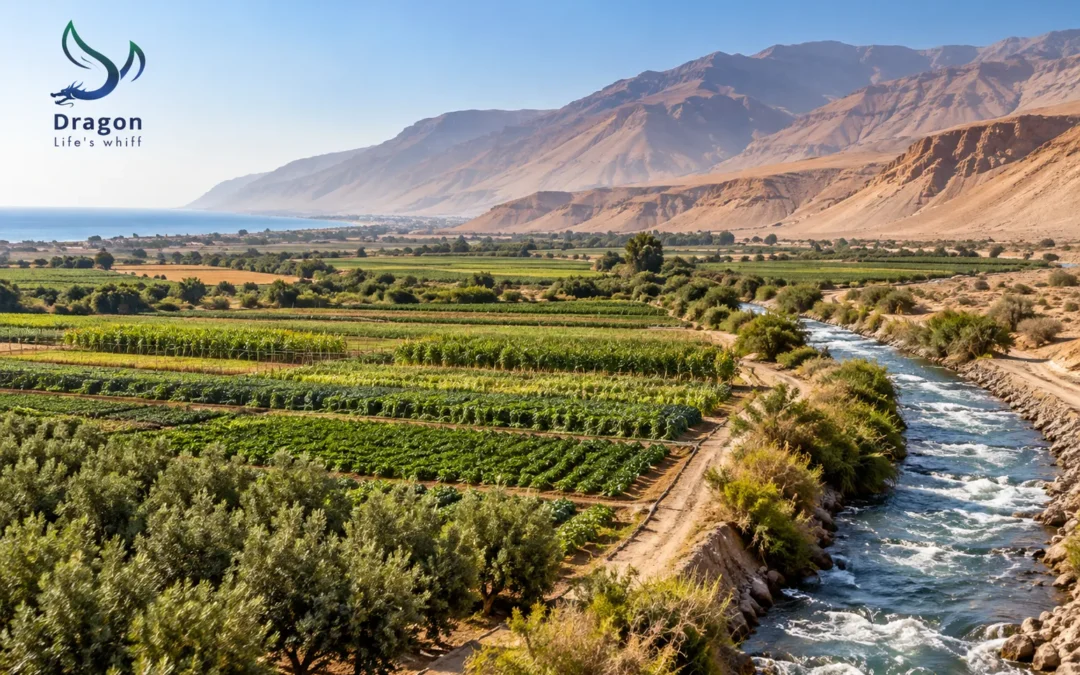
Two valleys run down to the sea at Arica, a few kilometres apart, under almost identical skies. Azapa grows olives, tomatoes and a wide range of vegetables, many of them counter-season crops that reach Chilean markets when no other region can supply them. Lluta, next door, grows a much narrower list: its well-known sweet corn, onion, garlic and alfalfa.
The difference is the water.
Research published in the Chilean journal Idesia describes the Lluta River as carrying water with electrical conductivity above 2 dS/m and boron above 11 parts per million, coming from volcanic tributaries high in its catchment. A shallow water table then pushes salts up toward the surface of the soil. Azapa’s water is considerably less saline, and that alone explains most of the gap between what the two valleys can grow.
Lluta is an extreme case, but the principle holds across the irrigated north, from Arica through the valleys of Atacama and Coquimbo. On much of this land the fertilizer programme has to be designed around the water, not the other way round.
Two different problems that arrive together
Salinity and boron toxicity often come in the same water, but they damage crops in different ways and need to be managed separately.
Salinity is about the total amount of dissolved salt. High salinity makes it harder for roots to take up water, so the crop behaves as if it were under drought even when the soil is wet. Specific salts add their own damage: sodium degrades soil structure and chloride burns leaf margins in sensitive crops.
Boron toxicity is about one element. Boron is an essential micronutrient in small amounts, but the gap between enough and too much is narrow, and most crops are damaged well below the concentrations found in Lluta water. Boron accumulates in leaf tips and margins, where it causes yellowing and then dead tissue.
How much boron is too much
FAO guidance groups crops by how much boron they tolerate in irrigation water. The ranges below are broad, and actual tolerance varies with variety, rootstock, soil and climate, but they show why northern valleys grow what they grow.
| Tolerance class | Approximate boron in irrigation water | Typical examples |
|---|---|---|
| Very sensitive to sensitive | below about 1 mg/L | Citrus, avocado, stone fruit, grapes, many berries |
| Moderately sensitive | about 1 to 2 mg/L | Some vegetables such as pepper and potato |
| Moderately tolerant | about 2 to 4 mg/L | Many vegetables and some field crops |
| Tolerant to very tolerant | above about 4 mg/L | Crops such as alfalfa and some vegetables, with the most tolerant coping at considerably higher levels |
At more than 11 mg/L, Lluta water sits far beyond what fruit trees can tolerate. That is why its agriculture concentrates on a small set of tolerant crops, and why locally adapted varieties, which researchers note carry tolerance to salinity and boron, matter so much there.
The rule most fertilizer programmes break
On boron-rich water, the correct amount of boron fertilizer is zero.
This sounds obvious, and yet it is routinely broken, because boron is included in many standard products and programmes by default. Micronutrient mixes, calcium-boron blends and flowering products often contain it. On most farms that is helpful. On a farm irrigating with boron-rich water, every one of those products adds to a toxicity problem the crop already has.
That applies to Dragon Ferti products too. On boron-affected land, do not use products that contain boron, including Dragon Calibo, BorCal or Dragon Mix Plus. They are good products for the right farm, and the wrong ones here.
Instead, correct any individual micronutrient shortfall with a single-element product, which lets you supply what is missing without adding what is already in excess. Dragon Zinc, Dragon Iron and Dragon Manganese each supply one element and nothing else.
Managing salinity through the fertilizer choice
The fertilizer cannot remove salt already in the water, but it can avoid adding more, and it can help the crop cope.
Stop adding chloride and sodium. Muriate of potash is roughly half chloride by weight. On saline land it is the single largest avoidable addition to the salt load. Every product in the Dragon Ferti range is free of chloride, sodium and heavy metals.
Keep calcium supplied. Calcium helps protect soil structure against sodium and supports the plant’s own ability to limit sodium uptake. Dragon PureCal supplies calcium without boron, which makes it suitable where Calibo is not.
Watch the potassium balance. A good supply of potassium relative to sodium helps the plant maintain its internal balance under salt stress. Dragon PotaMax and Dragon Paste High Potassium supply potassium without chloride.
Mind the magnesium. Dragon MagiCal covers magnesium with calcium, and contains no boron.
Support crops under stress. Dragon Sea is a seaweed-based biostimulant for stress recovery. It supports the crop through difficult conditions and does not change the salt or boron in the soil.
Managing the water and the soil
Fertilizer choice is only part of the answer. The larger levers are water and drainage.
Leaching. Applying more water than the crop needs, so that some drains below the root zone, carries salt down and out. Boron leaches more slowly than most salts, which means leaching for boron takes more water and more time than leaching for general salinity.
Drainage. Leaching only works if the water has somewhere to go. The Idesia research on Lluta describes restricted drainage and a shallow water table causing salts to accumulate permanently and move upward. Without drainage improvement, adding more water can make the situation worse by raising the water table.
Irrigation method. Drip keeps the area immediately around the dripper wetter and less salty, while salts concentrate at the edge of the wetted zone. That works in the grower’s favour as long as the root system stays within the wetted area and occasional heavier irrigations push the accumulated salt away.
Water blending. Where a less saline source exists, blending it with the saline supply can bring boron and salinity within the tolerance of more crops.
The general principles of salinity management are covered in the guide to salinity and alkaline water, and the guide to fertigation water quality explains how to read a water report.
Test the water first
Everything above depends on knowing what is actually in the water, and it changes. Boron and salinity vary between sources, between seasons and with river flow. A water analysis covering electrical conductivity, boron, sodium, chloride, sulphate and bicarbonate is the starting point for any programme in the north, and it should be repeated rather than assumed.
What this means for a distributor
Northern Chile is a small but specialised market, and it punishes generic advice. A dealer who sells the standard micronutrient mix to a Lluta grower is selling a product that will make the crop worse.
The dealer who asks for the water report before recommending anything, and is willing to say “this product is not for your farm”, builds the kind of trust that keeps customers in a region where everyone knows everyone. Dragon Ferti supplies Certificates of Analysis, Technical Data Sheets and Safety Data Sheets with full composition, which lets a dealer confirm exactly which products are boron-free before recommending them. Manufacturing runs under ISO 9001, ISO 14001 and ISO 45001 certified management systems. Further south, Chile’s cherry growers face a different challenge, covered in the guide to cherry nutrition for the China export market, and blueberry growers work with the opposite soil problem, set out in the guide to blueberry fertilization in Chile.
Conclusion
In Chile’s irrigated north, the water often decides what can be grown before the fertilizer is chosen. Where it carries high boron, the right boron application is zero, and products that contain boron should be left out entirely in favour of single-element micronutrients. Where it is saline, the priority is to stop adding chloride and sodium, keep calcium and potassium in balance, and manage leaching and drainage. Test the water, and test it again. For specifications or distribution enquiries, see the Dragon Ferti range or contact the export team through the contact page.
Frequently asked questions
Why is the water in the Lluta valley so high in boron?
Research describes the Lluta River carrying boron above 11 parts per million and electrical conductivity above 2 dS/m, originating from volcanic tributaries in the upper catchment. A shallow water table in the valley then brings salts toward the soil surface.
How much boron in irrigation water is harmful?
It depends on the crop. Sensitive crops such as citrus, avocado, stone fruit and grapes are generally damaged below about 1 mg/L, moderately tolerant crops cope with roughly 2 to 4 mg/L, and only tolerant crops such as alfalfa handle much higher levels. Variety, rootstock and soil all shift these thresholds.
Should I use boron fertilizer if my water contains boron?
No. On farms irrigating with boron-rich water, boron fertilizer adds to a toxicity problem. Avoid micronutrient mixes and calcium-boron products that contain boron, and correct individual shortfalls with single-element products instead.
Can fertilizer reduce soil salinity?
Not directly. Fertilizer cannot remove salt already present. Choosing products free of chloride and sodium avoids adding more, and calcium and potassium help the soil and crop cope, but leaching, drainage and water source management are what actually lower salinity.
Does boron leach out of soil like other salts?
More slowly. Boron is held more strongly in soil than most salts, so removing it by leaching takes more water and more time. Leaching also only works where drainage allows water to move below the root zone.