
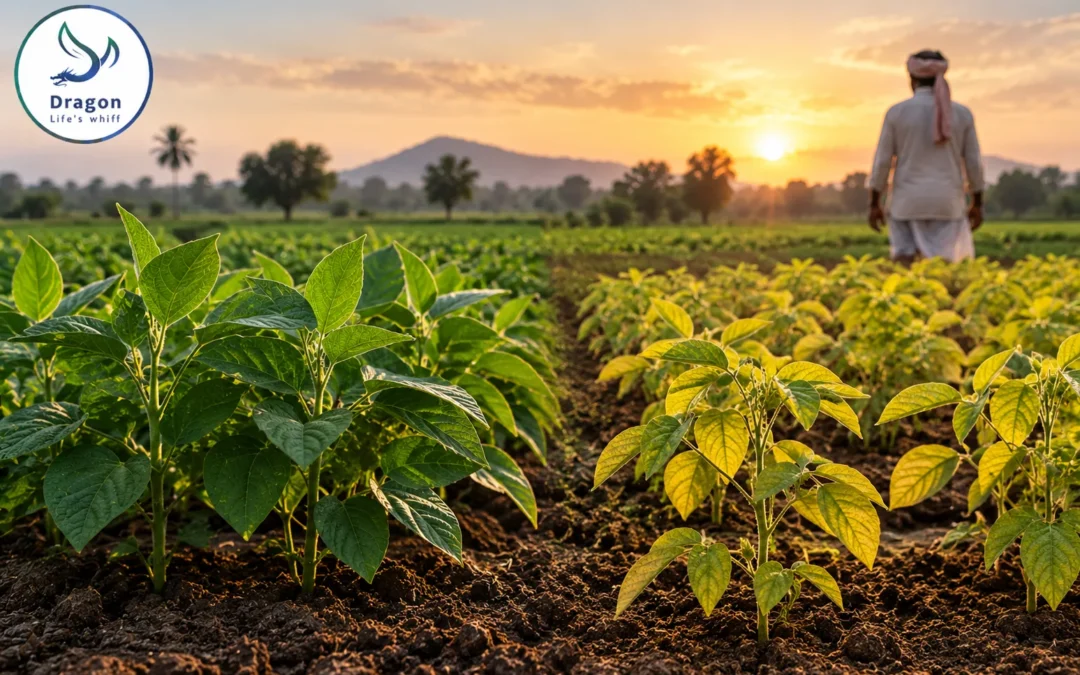
Nobody decided to remove sulphur from Indian agriculture. It happened as a side effect of two changes that were both improvements.
The first was fertilizer modernisation. Single superphosphate carries around 12 per cent sulphur and ammonium sulphate carries about 24 per cent. As Indian farming shifted toward urea and DAP, which are higher in analysis, cheaper per unit of nitrogen and phosphorus, and contain no sulphur at all, the incidental sulphur that had been arriving with every bag stopped arriving.
The second was cleaner air. Industrial sulphur dioxide used to fall on fields as a free annual dressing. Emission controls reduced it. The atmosphere improved and the soil got poorer.
Put those together with crop intensification removing more sulphur every year, and the result is measurable. The ICAR survey of 242,827 soil samples across 615 districts found sulphur deficiency affecting 58.6 per cent of Indian soils on the broadest measure, which includes acutely deficient, deficient and latent deficient bands. More than 100 districts have over half their soils below the line.
That makes sulphur the most widespread nutrient shortage in the country, ahead of zinc and boron.
Why it goes unnoticed
Sulphur deficiency looks like nitrogen deficiency, and farmers treat it with urea.
Both show as yellowing. The difference is which leaves. Nitrogen is mobile inside the plant, so the crop moves it from old leaves to new ones and the yellowing starts at the bottom. Sulphur is not mobile, so the new growth at the top yellows first while older leaves stay green.
That single distinction is the most useful diagnostic a dealer can teach. Yellow on top means sulphur. Yellow at the bottom means nitrogen. Applying urea to a sulphur-deficient crop does nothing except waste money and sometimes make matters worse, because pushing nitrogen into a plant that cannot build protein without sulphur leaves nitrogen accumulating unused.
The laboratory number to ask for is available sulphur, commonly extracted with calcium chloride, against a critical limit around 10 mg per kg. Below that, a response to applied sulphur is likely.
Where it costs the most
Sulphur is a building block of the amino acids that form protein, and of the oils and flavour compounds that several Indian crops are actually sold for. So the loss is rarely just tonnage.
Oilseeds and pulses are the obvious case. Mustard, groundnut, soybean, sunflower and sesame have far higher sulphur demand per tonne than cereals, and they occupy roughly a quarter of India’s gross cropped area while receiving comparatively little fertilizer attention. Mustard in particular responds strongly, and the gap between farm yields and research station yields under proper sulphur management is large. Reported responses in deficient soils run high, more so in rainfed conditions than irrigated ones.
Onion is the case most Indian dealers underestimate. The compounds that give onion its pungency are sulphur based, and pungency tracks storage life. A low-sulphur bulb is milder, softer and deteriorates faster in the chawl, which means sulphur applied months earlier is effectively a storage input. That connection is covered in more detail in the guide to onion nutrition and storage in Maharashtra.
Garlic follows the same logic. So does chilli, where sulphur is involved in the compounds carrying flavour and heat alongside the potassium that builds colour value in the Guntur and Warangal belt.
Sulphur also affects nitrogen use efficiency directly. A crop short of sulphur cannot convert the nitrogen it takes up into protein, so part of the urea a farmer already paid for is wasted. For a grower unwilling to spend on a new input, that is the argument that lands: sulphur makes the nitrogen work.
Where the deficiency concentrates
Three soil situations account for most of it.
Coarse, sandy soils hold little organic matter, and organic matter is where most soil sulphur is stored. This is much of the oilseed belt, which is why the crop with the highest demand is frequently grown on the soil with the lowest supply.
Calcareous and shallow black clay soils are low in organic carbon for different reasons and show the same result.
Heavily leached soils under high rainfall lose sulphate readily, since sulphate is mobile in the same way nitrate is and moves down past the root zone with water.
There is a reverse case worth knowing. Coastal saline and acid sulphate soils, including parts of the Sundarbans and coastal Kerala, carry excessive sulphur as sulphide or soluble sulphate, which injures plants rather than feeding them. Sulphur is not universally short in India. It is short in most places and dangerously abundant in a few.
Correcting it
The traditional Indian answers are gypsum, single superphosphate and elemental sulphur, and on a broadacre field crop they still make sense on cost.
They are a poor fit for drip fertigation. Gypsum is low in solubility, elemental sulphur has to be oxidised by soil bacteria before the plant can use it, which takes weeks and depends on temperature and moisture, and neither belongs in an injection line.
On a fertigated block the practical route is a soluble sulphur source applied with the potassium the crop needs anyway. Dragon Thio supplies potassium and sulphur together as potassium thiosulfate. Dragon Fruity does the same through potassium polysulfide. Both put sulphur into the root zone in a form the plant can take up immediately, and both avoid the chloride that arrives with muriate of potash.
That last point matters more than it sounds. A grower using muriate of potash is adding chloride the crop does not need while remaining short of the sulphur it does. Switching the potassium source solves both at once. The Dragon Ferti range is free of chloride, sodium and heavy metals throughout.
Timing follows the crop rather than the calendar. Sulphur is needed through active vegetative growth and again during oil or protein accumulation, which for an oilseed means from stem elongation through pod fill.
The nutrient it travels with
Sulphur deficiency rarely arrives alone. The same ICAR survey recorded sulphur and zinc occurring together across a meaningful share of samples, and sulphur with boron across another.
That matters practically. A block corrected for sulphur alone may still be limited by something else, and the grower concludes the sulphur did not work. A soil test covering sulphur, zinc and boron together costs little more than one covering sulphur, and the survey data on zinc and boron across Indian soils explains why those two are the usual companions.
Where several read low, Dragon Mix Plus handles the micronutrient group in one pass and the sulphur is supplied separately through the potassium source.
On alkaline irrigation water, check the water chemistry before concluding any correction failed. High bicarbonate neutralises a great many well-chosen applications before the root ever sees them.
What this means for a dealer
Sulphur is the easiest technical conversation in Indian fertilizer retail, because the diagnosis is visible from the doorway.
A dealer who walks into a yellowing field, looks at which leaves are yellow, and correctly says this is sulphur rather than nitrogen has demonstrated something the farmer can verify within a fortnight. That is worth more than any brochure.
It is also a category with room in it. Most Indian farms are applying nitrogen, phosphorus and potassium and nothing else, on soils where the single most widespread shortage is the nutrient nobody is selling. The commercial case for stocking water-soluble fertilizer in India applies here with an unusually clear diagnostic attached.
Dragon Ferti supplies importers and distributors with Certificates of Analysis, Technical Data Sheets, Safety Data Sheets, full composition labels and Free Sale Certificates, and manufactures under ISO 9001, ISO 14001 and ISO 45001 certified management systems. The import and registration process sets out what a distributor needs to plan for.
Conclusion
Sulphur became scarce in Indian soils because fertilizers got better and the air got cleaner, and almost nobody noticed because the symptoms look like something else. It is now the most widespread nutrient deficiency in the country, it hits hardest on the oilseeds and quality crops that can least afford it, and it is cheap to correct once it is correctly identified. For specifications, registration support or distribution enquiries, see the Dragon Ferti range, read grower reports on the testimonials page, or contact the export team through the contact page.
Frequently asked questions
How do I tell sulphur deficiency from nitrogen deficiency?
Look at which leaves are yellowing. Nitrogen moves within the plant, so the crop strips it from older leaves and the yellowing begins at the bottom. Sulphur does not move, so the newest growth at the top yellows first while lower leaves stay green.
What soil test value indicates sulphur deficiency?
Available sulphur, commonly extracted with calcium chloride, against a critical limit of roughly 10 mg per kg. Below that a yield response to applied sulphur is likely. Critical values vary somewhat by crop, with sunflower generally requiring more than groundnut or mustard.
Why has sulphur deficiency increased in India?
Mainly because fertilizer use shifted toward urea and DAP, which contain no sulphur, and away from single superphosphate and ammonium sulphate, which did. Reduced industrial sulphur dioxide deposition removed a second source, and higher yields remove more sulphur from the soil each season.
Can gypsum be used through a drip system?
Not effectively. Gypsum has low solubility and elemental sulphur must first be oxidised by soil bacteria, which takes weeks. For fertigation, a soluble source such as potassium thiosulfate or potassium polysulfide delivers sulphur in a form the plant can use straight away.
Does sulphur improve nitrogen efficiency?
Yes. Plants need sulphur to convert absorbed nitrogen into protein, so a sulphur-deficient crop cannot use the nitrogen it takes up. Correcting sulphur often improves the return on urea a farmer is already buying, which is frequently the most persuasive argument for applying it.