
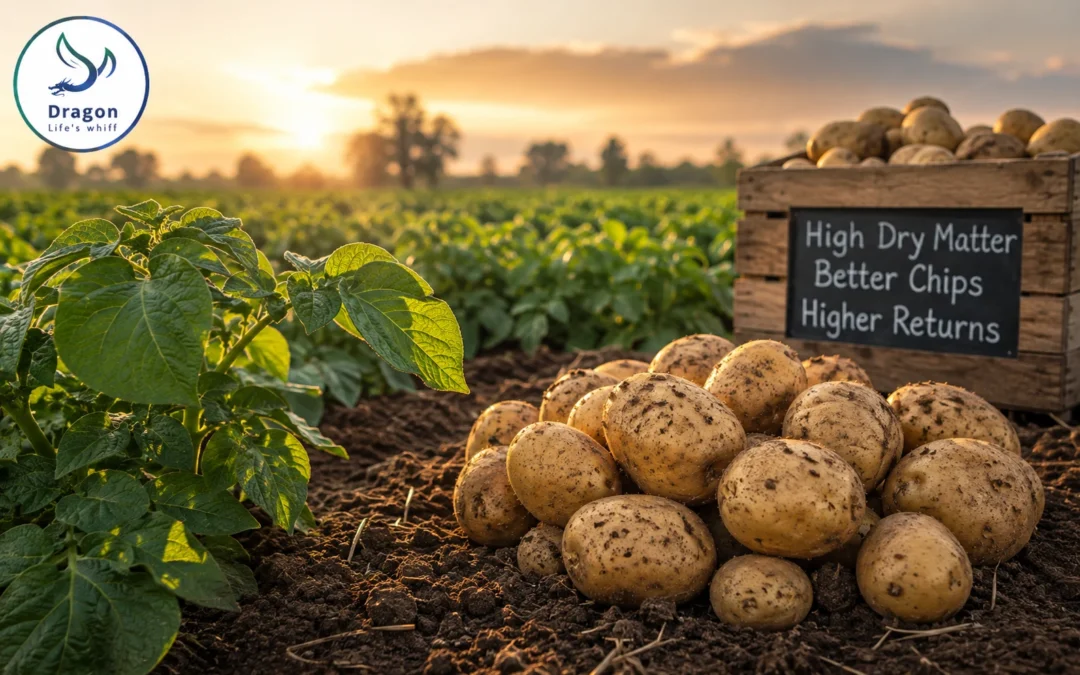
A potato grower on a processing contract is not paid for tonnes. They are paid for dry matter, fry colour and size grade, and a load that misses the specification gets downgraded to table stock at a fraction of the price.
Dry matter is the number that governs the rest. Processors generally want it in the low twenties as a percentage, because high dry matter absorbs less oil in the fryer, produces a crisper chip and yields more finished product per tonne of raw potato. Below specification, the same field becomes a different business.
Potassium has more influence on that number than any other nutrient a grower controls. So does the form the potassium arrives in, which is the part most programmes ignore.
Chloride and dry matter
Muriate of potash is potassium chloride and it is the default potassium across Indian potato growing because it is the cheapest source available.
Potato is one of the crops where that default has a measurable cost. Chloride encourages the tuber to take up more water, which dilutes starch and lowers specific gravity. Specific gravity is the field measure of dry matter, so the effect goes straight to the metric the processor pays on. Trial work comparing potassium sulphate against potassium chloride has repeatedly recorded higher dry matter under the sulphate source.
The literature is not unanimous, and the size of the effect varies with variety, rate and season. What is consistent enough to plan around is the direction. Where dry matter is the contract specification, a sulphate-based or chloride-free potassium source is the safer choice, and the premium is small against the cost of a downgraded load.
For a table-stock crop sold on weight, the argument is weaker. This is a specification decision, not a universal one, and it is worth saying that plainly to a grower rather than overselling it.
Every product in the Dragon Ferti range is free of chloride, sodium and heavy metals. Dragon PotaMax and Dragon Fruity deliver potassium without the chloride load, and Dragon Thio supplies potassium together with sulphur.
The same chloride question decides quality on onion held for storage and on table grapes grown for export.
Late nitrogen works against everything the processor wants
Nitrogen builds the canopy that fills the tubers, and it has to be there early.
Applied late, it does the opposite of what a processing crop needs. It keeps the plant growing when it should be maturing, delays skin set, produces oversized tubers that fall outside the size grade, and reduces dry matter by favouring bulking over starch accumulation. Trials in cool climates have shown late nitrogen depressing tuber dry matter directly.
In India this compounds with a scheduling problem. A crop that matures late runs into rising temperatures, and heat stress at the end of the season is itself a quality risk.
Nitrogen belongs in the early canopy phase, where Dragon Triple N and Dragon Paste High Nitrogen do their work. From tuber initiation onward the programme should be shifting toward potassium, which is what Dragon Paste High Potassium and Dragon Fert High Potassium are for.
Magnesium and manganese are quietly involved
Both affect starch accumulation, and both are commonly short on the light soils where Indian potato is grown.
Magnesium sits at the centre of the chlorophyll molecule, so a shortage reduces photosynthesis and with it the starch being produced. Deficiency shows as interveinal yellowing on older leaves and gets mistaken for nitrogen shortage, then treated with urea, which does nothing for it. Dragon MagiCal addresses magnesium with calcium.
Manganese shortage also reduces tuber starch content. Dragon Manganese corrects a confirmed deficiency, and Dragon Mix Plus covers the group where a soil test flags several at once.
Zinc is worth checking on any Indian potato block, given the survey data showing how widely it reads below threshold. Dragon Zinc handles it.
Calcium is about skin and bruising
Calcium rarely gets discussed in potato nutrition and it should.
It strengthens cell walls in the tuber periderm, which affects skin set, resistance to bruising during harvest and handling, and susceptibility to storage rots. Bruised or damaged tubers are downgraded and are the entry point for the rots that develop in store, so the cost lands after the crop has left the field.
Like everywhere else, calcium has to be present while cells are dividing, which for potato means during tuber initiation and early bulking rather than near harvest. Dragon PureCal and Dragon NPK+CaO supply it through that window.
Fertigation suits this crop better than most
Potato is shallow rooted with limited ability to forage, grown on light soils where nutrients leach readily, and it needs a nutrient ratio that changes sharply between canopy building and tuber bulking.
That combination is exactly what fertigation is good at. Placement in the small volume the roots occupy, doses adjustable week to week, and no losses to a broadcast application that rain moves past the root zone.
Where a block has drip, the Dragon Paste and Dragon Fert soluble powder lines are made for it. Where it does not, powder applied as a foliar spray is the practical route for micronutrient and stage correction. The comparison of paste, powder and liquid formats covers which suits which operation.
Irrigation water quality is worth checking first. Light potato soils combined with alkaline borewell water is a common Indian combination, and the guide to fertigation water quality sets out what to test.
What this means for a dealer
Processing contracts change the sales conversation completely.
A contract grower has a written specification, a buyer who tests every load, and a documented penalty for missing the number. That grower is not comparing bag prices. They are managing a risk, and a dealer who can explain why the chloride in their potash is working against their dry matter specification is selling risk reduction rather than fertilizer.
It is also a repeatable relationship. Processing acreage in India is contracted season after season with the same growers, so getting one specification right converts into a customer who does not shop around. The broader case for stocking water-soluble fertilizer in India follows the same logic across other crops.
Dragon Ferti supplies importers and distributors with Certificates of Analysis, Technical Data Sheets, Safety Data Sheets, full composition labels and Free Sale Certificates, and manufactures under ISO 9001, ISO 14001 and ISO 45001 certified management systems. The import and registration process covers what a distributor needs to plan for.
Conclusion
A processing potato is sold on dry matter, fry colour and size, and all three are built by nutrition decisions made months before the load is tested. Potassium without chloride, nitrogen stopped early, and calcium, magnesium and manganese supplied while they still matter. For specifications, registration support or distribution enquiries, see the Dragon Ferti range, read grower reports on the testimonials page, or contact the export team through the contact page.
Frequently asked questions
Does the potassium source affect potato dry matter?
Trial work comparing potassium sulphate with potassium chloride has repeatedly recorded higher tuber dry matter and specific gravity under the sulphate source. Chloride encourages water uptake into the tuber, which dilutes starch. The size of the effect varies with variety and rate, but the direction is consistent enough to plan around where dry matter is a contract specification.
Why is dry matter important for processing potatoes?
High dry matter absorbs less oil during frying, gives a crisper product and better fry colour, and yields more finished product per tonne of raw potato. Processors specify it, test it on delivery, and downgrade loads that fall short, so it usually determines what the crop is worth.
Should table-stock potato growers also avoid muriate of potash?
The argument is weaker for a crop sold on weight rather than on dry matter, since the quality penalty is what makes the chloride matter. Where the crop goes to a processor with a specification, the case for a chloride-free potassium source is much stronger.
What causes bruising and storage rot in potato?
Physical damage during harvest and handling is the immediate cause, but tuber skin and cell wall strength determine how much damage occurs at a given handling standard. Calcium supplied during tuber initiation and early bulking builds that strength, and damaged tubers are the usual entry point for storage rots.
Does Dragon Ferti supply potato growers in India?
Dragon Ferti exports to more than 50 countries and works with importers and distributors across Asia, Africa and the Middle East. Paste ships in 5, 10 and 20 kilogram formats, soluble powder in 10 and 25 kilogram sacks, and liquid in 1, 5 and 20 litre containers. Registration and distribution status for India is best confirmed with the export team.