
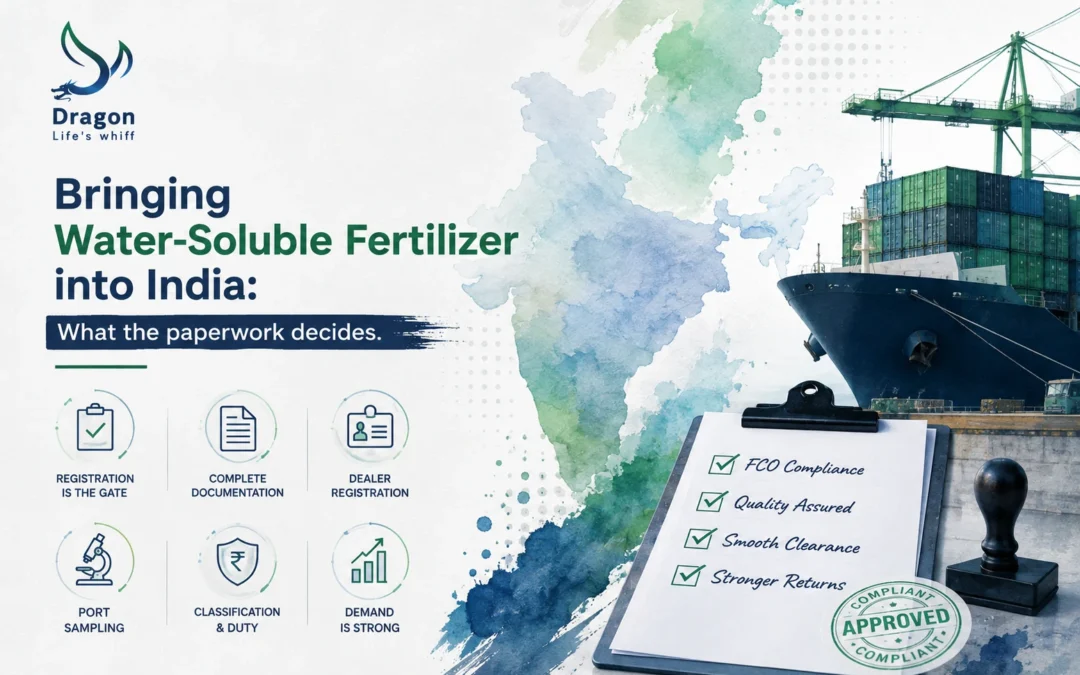
An importer looking at a new fertilizer supplier is not really evaluating the fertilizer. They are working out whether it can be registered, whether it clears the port, whether the documentation holds up when a sample is drawn, and whether they can move it once it lands.
The agronomy is the straightforward part of that conversation.
Registration is the gate
Fertilizer in India is governed by the Fertiliser (Control) Order of 1985, issued under the Essential Commodities Act and administered through the agriculture ministry. The FCO sets out which substances qualify as fertilizers, the specification each product must meet, how samples are drawn and analysed, and the procedure for registration as a manufacturer, importer or dealer.
Clause 19 is the one that matters most to an importer. It prohibits importing for sale, selling, stocking or distributing any fertilizer that does not meet the standard prescribed in the Order. A product that is not covered by an FCO specification cannot simply be brought in and sold.
For newer categories, including water-soluble and liquid formulations, the route runs through getting the product recognised in the Order. That has been done repeatedly as the specialty segment has grown, sometimes with provisional permission to import for a fixed period while the product is assessed. Which specific products currently sit inside the schedules, and on what terms, changes as amendments are issued, so it is worth verifying rather than relying on what was true last season.
What actually slows an application down
It is rarely the regulator.
An application needs composition documented, analysis certified by a recognised laboratory, safety information available, and evidence the product is legitimately manufactured and sold in its country of origin. Applications stall when a manufacturer cannot produce that package quickly, completely, and in a form an official will accept.
Dragon Ferti supplies it as a set: Certificate of Analysis, Technical Data Sheet, Safety Data Sheet, labels carrying full composition, and Free Sale Certificates. Manufacturing runs under ISO 9001, ISO 14001 and ISO 45001 certified management systems, which gives an assessing officer an independent reference point rather than a supplier’s own assurance.
Whether a given Dragon product is currently registered in India is a question for the export team, since the answer moves as applications progress.
Dealer registration is a separate step
Import registration and the right to sell are not the same thing.
Selling fertilizer as a wholesale or retail dealer requires its own registration or authorisation, and it is handled at state level. An importer planning to distribute across Maharashtra, Gujarat, Karnataka and Andhra Pradesh is dealing with several state authorities rather than one national process.
That has a practical consequence for how a business is built. It is usually faster to establish in one or two states properly than to attempt national coverage from the start, and the states with the deepest water-soluble demand are the sensible place to begin.
Sampling happens at the port
Imported fertilizer is sampled differently from domestic product. Inspectors acting for the central government draw samples from ships and containers, while state inspectors handle material already in the trade.
The implication is that consistency between batches is not a quality nicety, it is a clearance issue. A product whose analysis varies between shipments will eventually produce a sample that fails, and a failed sample at the port is expensive in a way that is difficult to recover from commercially. Batch-level documentation available on request protects the importer as much as the farmer.
Classification and duty
Mineral and chemical fertilizers containing two or three of nitrogen, phosphorus and potassium fall under HSN heading 3105, with 31052000 covering products containing all three. The heading also picks up goods of the chapter in packages not exceeding 10 kilograms, which is relevant to the smaller pack formats specialty product moves in.
Micronutrient products often classify elsewhere, since a chelated or sulphate micronutrient is not an NPK fertilizer. Getting the code right determines duty and any applicable benefit, and an incorrect classification creates exposure with customs later rather than a saving now. Duty rates change with budgets. Confirm both classification and rate with a customs broker against the specific product rather than working from a general heading.
An importer also needs an Import Export Code before any of this becomes relevant.
Where the demand sits
India’s water-soluble fertilizer market runs somewhere in the range of 1.2 to 1.5 million tonnes, and it is concentrated rather than spread.
Micro-irrigation coverage passed 9.5 million hectares under the Pradhan Mantri Krishi Sinchayee Yojana, and Maharashtra alone runs close to 1.8 million hectares of drip. Water-soluble products account for roughly 12 to 15 per cent of local fertilizer demand in Gujarat and Maharashtra, which is well above the national picture. Karnataka, Andhra Pradesh and Telangana follow on the back of horticulture.
That concentration is useful. A distributor does not need national reach to build a serious business, because the demand for this category sits in a handful of states and a handful of crops.
Those crops are worth knowing in detail before choosing a territory. Table grapes in Nashik run the highest input spend per hectare in the country and sell into an audited export channel. Banana in Jalgaon carries the heaviest potassium demand of any Indian crop with near-universal drip adoption. Onion across Maharashtra is paid on what survives storage rather than what comes off the field. Chilli in Guntur and Warangal is graded on colour value, which is a nutrition outcome. Pomegranate sits alongside grape across the same belt.
Underneath all of them, the zinc and boron deficiency measured across Indian soils gives a dealer a diagnostic entry point into any of these farms.
Pack sizes are a commercial decision
Pack format determines who can buy from you, which makes it more than logistics.
The Dragon Paste line ships in 5, 10 and 20 kilogram formats, Dragon Fert soluble powder in 10 and 25 kilogram sacks, and Dragon Liquid in 1, 5 and 20 litre containers. That range lets a dealer serve a two-acre grape block and a large banana estate from the same stock rather than choosing between them.
The full range runs to six lines: paste, soluble powder, liquid, specialty products, chelated micronutrients, and an organic-compatible line for certified production, which matters as Indian horticulture pushes further into audited export channels.
Why Jordan to India works
Dragon Ferti manufactures in Amman with Red Sea access through Aqaba, and raw material comes from Jordanian potash and phosphate reserves, so the supply chain is short and traceable to source.
Jordan and India have a long-standing fertilizer trade relationship built on those same reserves, which means the route, the documentation conventions and the shipping lanes are established rather than novel. For an importer that reduces the number of things that can go wrong on a first shipment.
The margin argument you will need
A distributor coming into this category from commodity fertilizer usually has to make the case to their own customers before they can make it to their bank. The commercial argument for why water-soluble fertilizer earns its price in India sets out how that conversation goes with a price-sensitive farmer, and why the technical sale produces repeat business that commodity urea does not.
Conclusion
The product is rarely what decides a distribution relationship in India. Whether it can be registered, whether the batch analysis holds at the port, whether the pack sizes match your customers, and whether the manufacturer produces paperwork on request matter more. For specifications, registration support or distributor enquiries, see the Dragon Ferti range, read grower reports on the testimonials page, or contact the export team through the contact page.
Frequently asked questions
What governs fertilizer import into India?
The Fertiliser (Control) Order 1985, issued under the Essential Commodities Act. It defines which substances qualify as fertilizers, sets product specifications, prescribes sampling and analysis methods, and lays out registration procedures. Clause 19 prohibits importing for sale any fertilizer that does not meet the prescribed standard.
What documentation does a manufacturer need to provide?
Composition details, a certified analysis, safety information and evidence the product is legitimately sold in its country of origin. Dragon Ferti supplies Certificates of Analysis, Technical Data Sheets, Safety Data Sheets, full composition labels and Free Sale Certificates to support importers through the process.
Which HSN code applies to water-soluble NPK fertilizer?
Heading 3105 covers mineral and chemical fertilizers containing two or three of nitrogen, phosphorus and potassium, with 31052000 for those containing all three, and the heading also covers packages not exceeding 10 kilograms. Micronutrient products frequently classify elsewhere. Confirm classification and current duty against the specific product with a customs broker rather than working from the heading alone.
Do I need separate permissions to sell after importing?
Yes. Registration or authorisation as a wholesale or retail fertilizer dealer is a separate requirement handled at state level, so distributing across several states means dealing with several state authorities. Building properly in one or two states is usually faster than attempting national coverage immediately.
How is imported fertilizer inspected?
Inspectors acting for the central government draw samples from ships and containers, while state inspectors sample product already in the trade. Batch-to-batch consistency therefore affects clearance and not just customer satisfaction, which is why batch-level documentation from the manufacturer is worth having.
Is Dragon Ferti registered in India?
Dragon Ferti exports to more than 50 countries and works with importers and distributors across Asia, Africa and the Middle East. Registration and distribution status for specific products in India is best confirmed directly with the export team, since it changes as applications and partnerships progress.