
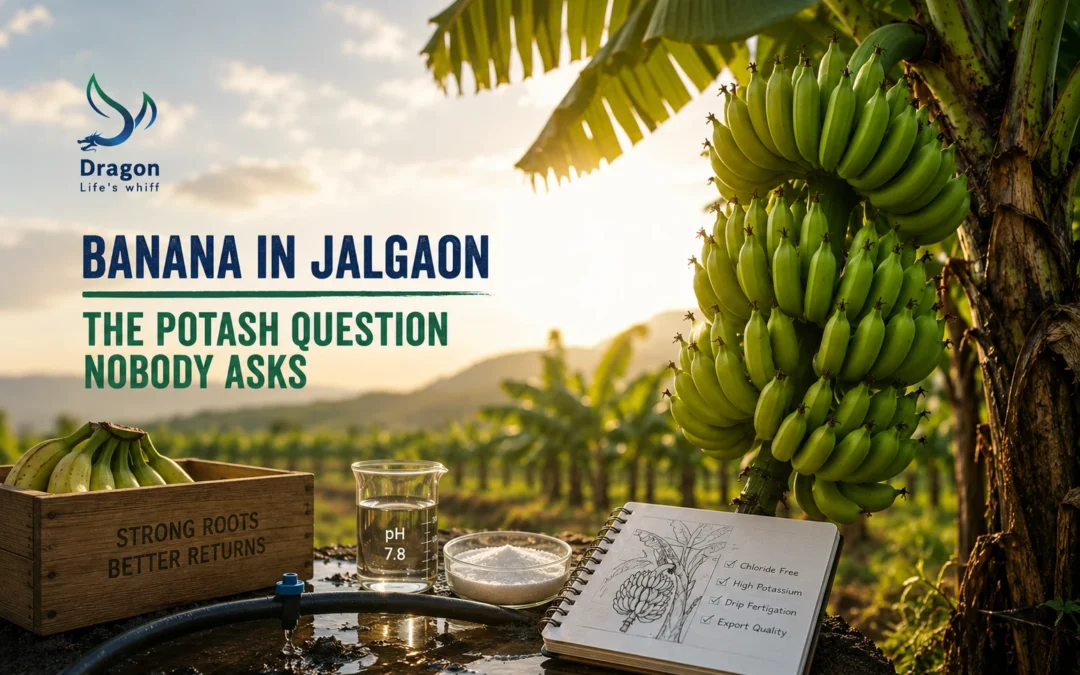
Banana takes more potassium out of the ground than almost anything else grown in India. Not slightly more than nitrogen. Substantially more.
Jalgaon runs roughly 48,000 hectares of it, mostly tissue culture Grand Naine on black soils, with yields in the 65 to 80 tonne range that put the district well ahead of world averages. The potassium leaving those fields every season is considerable, and most of it goes in as muriate of potash because muriate of potash is the cheapest potassium available.
That works until the soil pH climbs. The National Horticulture Board’s own banana guidance makes the point plainly: above pH 7.5, potassium sulphate is the better source. A lot of Jalgaon sits above pH 7.5.
What the chloride is doing
Muriate of potash is potassium chloride, and roughly half of what you apply by weight is the chloride, not the potassium.
Under drip the wetted volume is small, so the chloride concentrates at the edge of it, which is where the roots are. Season after season on a perennial crop with a ratoon cycle, that accumulates. The effect is slow enough to be invisible and it rarely gets diagnosed, because the grower is comparing this year to last year rather than to what the block did in its first cycle.
The same problem shows up faster on onion under drip in Nashik, where the root system is shallow, and on table grapes, which are outright chloride sensitive.
There is a second cost. Chloride raises the salinity the plant has to work against, and banana is a heavy water user in a semi-arid district that is already managing water carefully.
The Dragon Paste and Dragon Fert soluble powder lines are free of chloride, sodium and heavy metals, so the potassium arrives without the passenger.
Fertigation is not just a delivery convenience
The trial data on this crop is unusually clear. Work at Mahatma Phule Krishi Vidyapeeth in Rahuri compared drip fertigation against surface irrigation on Grand Naine in clay soils and found yields above 80 tonnes per hectare under staged fertigation against roughly 51 tonnes under surface irrigation, with fertilizer savings around 40 per cent.
Two details in that result matter more than the headline.
The first is that scheduling by crop growth stage beat splitting the same quantity into equal doses. Same total fertilizer, different timing, measurably different yield.
The second is that the 60 per cent fertigation treatment still beat surface irrigation while using far less product. Delivery method was doing more work than dose.
For a dealer, that reframes the conversation. The grower is not being asked to spend more. They are being asked to spend it differently, which is the same argument behind why water-soluble fertilizer earns its price in India.
Where the potassium actually needs to be
Banana potassium demand is not flat across the cycle. It builds through the vegetative phase and peaks around shooting and bunch filling, which is when finger length, finger girth and bunch weight get decided.
Dragon Paste High Potassium and Dragon Fert High Potassium carry that phase. Dragon PotaMax suits a block where bunch weight is the specific target and nitrogen is already adequate.
Earlier in the cycle the balance is different. Root establishment on a newly planted tissue culture sucker responds to phosphorus and root-directed nutrition, which is what Dragon Rooty and Dragon Paste High Phosphorus are for. Through vegetative build, nitrogen drives the leaf area that determines how large a bunch the plant can carry, and Dragon Triple N supports that push.
Getting the sequence right matters more than the total. A plant that did not build enough functional leaf before shooting cannot fill a heavy bunch no matter what goes on afterwards. Potassium timing decides quality on chilli in Guntur and Warangal in much the same way, for a different reason.
The nutrients that decide grade rather than weight
Bunch weight sells the crop domestically. Finger appearance sells it for export, and India ships banana mainly into the Gulf markets, where uniformity and shelf life are graded.
Calcium determines finger firmness and how the fruit holds up in transit. Dragon PureCal and Dragon NPK+CaO cover it, and calcium has to be supplied while cells are dividing rather than near harvest, because it does not move again once deposited.
Boron shows up in the bunch as poor finger development and distorted fruit. Dragon BorCal handles boron and calcium in one pass.
Magnesium deficiency is common on banana and easy to misread, since the yellowing on older leaves gets mistaken for nitrogen shortage and treated with more urea, which does nothing. Dragon MagiCal addresses it directly.
Zinc is worth checking on any Maharashtra block, given how much of the state’s soil reads below threshold. Dragon Zinc corrects a confirmed deficiency and Dragon Mix Plus covers the wider set where the picture is less clear.
The ratoon crop is where soil condition shows
Banana is usually grown for a plant crop and then one or more ratoons, and the ratoon is where accumulated problems surface. Salinity, compacted structure and depleted organic matter all reduce the second cycle rather than the first.
Dragon HV15 from the Dragon Organic line combines humic acids with micronutrients, which suits a block heading into ratoon on soil that has carried banana for several years. That is a slower return than a potassium application and should be sold as such.
Dragon Ferti supplies importers with the documentation registration requires, including Certificate of Analysis, Technical Data Sheet, Safety Data Sheet, full composition labels and Free Sale Certificates, and manufactures under ISO 9001, ISO 14001 and ISO 45001 certified management systems. The import and registration process covers what a distributor needs to plan for.
Conclusion
The single most useful change available to a Jalgaon banana grower is not more fertilizer. It is switching the potassium source on high pH ground, and scheduling it by growth stage rather than in equal splits. The trial evidence for both is local and it is strong. For specifications, registration support or distribution enquiries, see the Dragon Ferti range, read grower reports on the testimonials page, or contact the export team through the contact page.
Frequently asked questions
Why switch from muriate of potash on banana?
Above roughly pH 7.5, potassium sulphate is the better potassium source, and much of the black soil banana ground in Maharashtra sits above that. Muriate of potash is potassium chloride, so about half of what you apply is chloride that concentrates in the small wetted zone under drip and builds across a perennial crop and its ratoons.
Does fertigation reduce fertilizer cost or increase it?
Trials at Rahuri on Grand Naine recorded fertilizer savings around 40 per cent alongside substantially higher yield compared with surface irrigation. The treatment scheduled by crop growth stage outperformed the same quantity split into equal doses, so timing carried much of the benefit rather than dose.
When does banana need the most potassium?
Demand builds through the vegetative phase and peaks around shooting and bunch filling, which is when finger length, girth and bunch weight are determined. Potassium applied after that window has limited effect on the bunch already forming.
My leaves are yellowing on the older foliage. Is that nitrogen?
Not necessarily. Magnesium deficiency shows on older leaves and is frequently mistaken for nitrogen shortage, then treated with more urea without result. Confirm with a leaf or soil test before adding nitrogen, since the two problems look similar and only one responds to urea.
Can these products be used on a rainfed or flood-irrigated block?
Yes. The soluble powders work as foliar sprays, which is the practical route for micronutrient and stage correction without drip. Fertigation gets considerably more out of the same product where the system is installed.