
Two national programmes have measured micronutrients in Indian soils using different methods and different sample sizes. ICAR’s coordinated project analysed about 243,000 samples across 615 districts. The Soil Health Card programme analysed more than 30 million.
They landed within three percentage points of each other. Somewhere between 36 and 39 per cent of Indian soils cannot supply enough zinc for a full-yield crop.
For a nutrient applied in grams per hectare, that is a large number to keep ignoring.
Where it concentrates
Zinc deficiency is not spread evenly, and the map matters commercially.
Karnataka runs above 60 per cent of samples below threshold. Maharashtra and Bihar sit just above half. Rajasthan is close behind. A separate survey put Bihar higher still.
The pattern follows soil type rather than state lines: calcareous and old alluvial soils in Bihar, heavily leached acidic soils in West Bengal and Odisha, red laterites across Karnataka. Different chemistry arriving at the same result.
What makes this interesting for a supplier is that Karnataka and Maharashtra are also where India’s drip-irrigated horticulture sits. Maharashtra alone runs somewhere near 1.8 million hectares under drip. Those are grape, pomegranate, banana, onion and vegetable blocks with the highest input spend per hectare in the country, and the most to lose from a nutrient ceiling nobody has diagnosed.
Why the zinc is there but unavailable
Most Indian soils hold plenty of total zinc. What they lack is zinc a root can take up.
Above pH 7 the metal converts to forms the plant cannot reach, and above pH 8 availability drops off sharply. Much of the Indo-Gangetic plain, Saurashtra and the black cotton soils sit in that range. Heavy phosphorus application makes it worse, and decades of subsidy weighted toward DAP and urea have left phosphorus loading high in intensively farmed districts. Flooded paddy immobilises zinc through a different mechanism again, which is why the rice and wheat belt was where the problem was first identified.
Low organic carbon ties it together. Without organic matter there is little to hold zinc in a mobile form, and continuous cropping without organic return has pushed organic carbon under 0.5 per cent across large areas.
Boron arrives at the same place by a different route. It leaches out of sandy soils in Haryana and Rajasthan, and it gets fixed and made unavailable at high pH in the calcareous soils of Bihar, eastern Uttar Pradesh, Saurashtra and Tamil Nadu. It also has a narrow gap between too little and too much, which is why cautious growers skip it entirely.
Reading the soil test properly
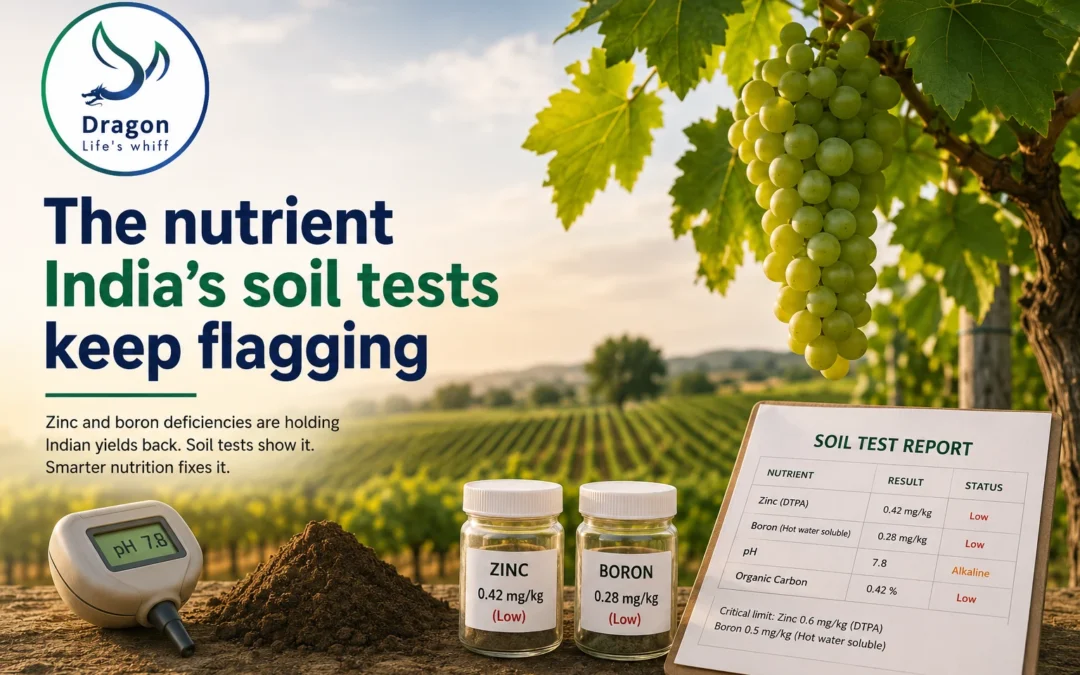
Indian laboratories report DTPA-extractable zinc against a critical limit of 0.6 mg/kg, with Gujarat working to 0.5 and Tamil Nadu to 1.2. Boron is reported as hot-water-soluble, commonly against 0.5 mg/kg.
A result sitting just above the line is not a clean pass. The critical limit marks where a yield response becomes probable, not where the crop stops responding. A grape block reading 0.7 under heavy phosphorus fertigation will often still pay for a correction.
Two things are worth checking alongside the soil test. Irrigation water carrying bicarbonate above roughly 3 meq/L will raise pH around the root regardless of what the soil report says. And symptom timing tells you which nutrient you are chasing: zinc shows early, as interveinal chlorosis on young leaves with short internodes, what Maharashtra citrus growers call little leaf. Boron shows late and expensively, as poor fruit set, cracking, corky tissue and fruit that fails at grading.
The delivery method decides the outcome
This is where micronutrient programmes in India usually fail, and it has nothing to do with the analysis on the label.
Zinc sulphate broadcast on soil works below pH 7 and costs least. On calcareous ground much of it reverts to unavailable forms inside a season, so the grower concludes zinc was not the problem and stops buying. Foliar application skips soil chemistry entirely and corrects fastest, though each pass delivers a small amount. Fertigation gives precise dosing across the season at almost no extra labour on a farm that already has the injector installed.
With micro-irrigation now past 9.5 million hectares nationally, the last two are where the volume is. The constraint is no longer whether the grower can apply a product. It is whether the product dissolves cleanly and stays in solution. A dealer whose micronutrient blocked a drip line once will not sell that product twice.
Building the correction
Dragon Zinc answers a confirmed deficiency directly. On calcareous soils, split doses through the drip line generally beat one larger soil application, because each dose reaches the root before soil chemistry can lock it away.
For boron, Dragon BorCal pairs it with calcium deliberately. The two work together on cell wall formation and fruit firmness, and correcting boron in a crop that is also short of calcium usually disappoints. Dragon Calibo covers similar ground with a different balance.
Where several micronutrients read low at once, which is common in Karnataka and Maharashtra, Dragon Mix and Dragon Mix Plus handle the group in one pass instead of four. Dragon Mix is organic-compatible, which matters on grape and pomegranate blocks growing for certified export. Iron chlorosis usually travels with zinc in the same high-pH soils, and Dragon Iron addresses it.
On timing, zinc and boron both belong before flowering rather than during it. Boron is needed for pollen tube growth ahead of the event, and applying it at flowering is a common and expensive miss.
What the correction looks like crop by crop
The soil chemistry is national. What it costs a grower is not.
On table grapes in Nashik, free lime makes iron and zinc chlorosis routine rather than unusual, and the loss shows up in the export fraction rather than in tonnage. On banana in Jalgaon, zinc shortage compounds a potassium programme that is often already using the wrong potassium source for high pH ground. On chilli in Guntur and Warangal, the black cotton soils lock up soil-applied micronutrients so reliably that foliar application is usually the only route that works. On onion in Nashik, boron affects skin retention and bulb quality, and the bill arrives months later in the chawl. On pomegranate, boron shortage at pollination shows directly in fruit set.
Same deficiency, five different commercial consequences.
What this means for a distributor
Micronutrients are a sensible entry point for a dealer building a specialty line. Order sizes are smaller than NPK, margin per kilogram is higher, and the sale is technical, which puts the dealer in the field with the grower instead of behind a counter.
There is a follow-on effect worth naming. A dealer who reads a soil health card correctly, fixes a zinc problem and is proved right by the crop becomes the person that farm calls about its NPK programme too. Commodity urea does not generate that call. The commercial case for carrying water-soluble fertilizer in India sets that argument out in full.
Dragon Ferti supplies the documentation importers need for registration: Certificate of Analysis, Technical Data Sheet, Safety Data Sheet, labels with full composition and Free Sale Certificates. Manufacturing runs under ISO 9001, ISO 14001 and ISO 45001 certified management systems. The registration and import process covers what an importer needs to plan for, and registration status for specific products in India is a question for the export team, since it changes as applications move.
Conclusion
Zinc and boron deficiency in India is among the best-measured soil problems anywhere, across tens of millions of samples, and it sits directly under the highest-value crops in the country. Correcting it is a matter of matching delivery to soil chemistry and using a product that survives the trip from tank to root. For specifications, registration support or distribution enquiries, see the Dragon Ferti range, read grower reports on the testimonials page, or contact the export team through the contact page.
Frequently asked questions
Should I use zinc sulphate or a fertigated zinc product?
Check soil pH first. Below about 7.0, soil-applied zinc sulphate works and costs less. Above 7.5, and particularly on calcareous soils, much of what you apply reverts to unavailable forms within the season, so fertigation or foliar application gets more of the nutrient into the crop for the same spend.
Can zinc and boron go on together?
Yes, and pre-flowering is usually the right window for both. Confirm tank compatibility with anything else in the same injection, and stay within the label rate for boron, which has a narrow margin between correcting a deficiency and causing toxicity.
My soil test reads slightly above 0.6 mg/kg zinc. Do I still apply?
Often yes. The critical limit marks where a response becomes likely, not where it stops. Under high soil pH or heavy phosphorus fertigation, blocks reading just above threshold frequently still respond, and in high-value horticulture the correction costs little against what it protects.
Do these products work through drip systems?
Yes. The minor elements range is made as water-soluble powders and micro-granules for fertigation and foliar use, without chloride, sodium or heavy metals, so there is no precipitate risk to emitters.
Does Dragon Ferti supply the Indian market?
Dragon Ferti exports to more than 50 countries and works with importers and distributors across Asia, Africa and the Middle East. Paste ships in 5, 10 and 20 kilogram formats, soluble powder in 10 and 25 kilogram sacks, and liquid in 1, 5 and 20 litre containers. Registration and distribution status for India is best confirmed directly with the export team.