
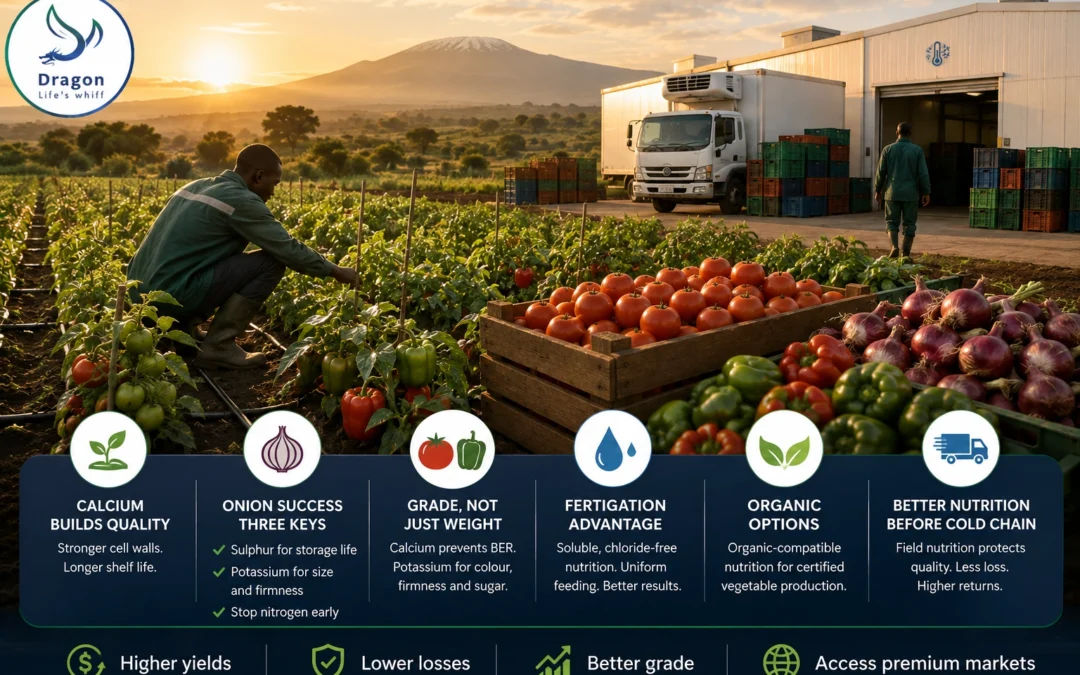
Horticulture has quietly become Tanzania’s biggest agricultural export earner, bringing in around 569 million US dollars in 2024, ahead of tobacco and cashew, and aiming at two billion by 2030.
The bottleneck now is not growing the crop. It is getting it to a buyer in sellable condition. Post-harvest losses stay high and cold chain is thin outside the largest operations.
Everybody knows the answer is refrigeration. Fewer notice that much of shelf life is decided in the field, weeks before harvest, at a fraction of the cost.
Shelf life is mostly calcium
When a tomato collapses in transit or an onion rots in storage, the verdict is usually heat or handling. Often the real cause is a cell wall that was never built properly.
Calcium gives fruit and bulb tissue its structural strength, and it moves into the crop only while that crop is actively growing. You cannot add it late and you cannot add it after harvest. A continuous, low-dose supply through the growing period is the most useful thing most Tanzanian vegetable growers are not doing.
Dragon PureCal runs through drip and stays available. Little and often beats one heavy dose, because the crop only takes up what arrives while it is growing.
Onion is the crop most often underfed
Onion is one of Tanzania’s largest vegetable crops and among the most mismanaged, because its demand curve is not intuitive. Three things decide it:
Sulphur drives pungency and, more importantly for a seller, storage life. Low-sulphur onions are mild and rot early. Dragon Fruity supplies potassium with sulphur, covering both in one pass.
Potassium sets bulb size and firmness, and firmness is what survives the trip to Dar es Salaam or across a border.
Nitrogen timing is where crops are lost. Late nitrogen keeps the plant vegetative, delays maturity and leaves thick-necked bulbs that will not store. Cut it off before bulbing finishes, even when the crop looks like it wants more.
Tomato and pepper: quality is graded, not weighed
Tomato and sweet pepper are the volume crops of the Northern Zone and Southern Highlands, and both are bought on appearance as much as weight.
Blossom-end rot is the classic complaint, and it is a calcium transport failure rather than a soil shortage. Continuous calcium through fruit set and early growth prevents most of it. Potassium then drives colour, firmness and sugar, separating a graded fruit from one sold cheap at the roadside.
Dragon Flowering supports flower set, and Dragon Fert Balanced carries the main growth phase under fertigation.
Two markets, two standards
A grower serving Dar es Salaam and one serving a European buyer are not chasing the same crop.
| Regional and domestic | Export | |
|---|---|---|
| Sold on | Weight and price | Grade and appearance |
| Journey | Hours to a few days | Days to weeks, often chilled |
| Nutrition priority | Yield and volume | Calcium for firmness, potassium for grade |
| Cost of a mistake | Lower price | Rejected consignment |
Most growers sell into both. Build the export-standard programme and let domestic sales benefit from it, rather than the other way round.
Fertigation changes what you can use
As irrigation investment spreads across the Southern Highlands and Northern Zone, more growers feed through drip. That rules out anything that does not dissolve completely, since undissolved product blocks emitters and feeds a block unevenly.
The Dragon Liquid range is ready to inject, with Dragon Flow Balanced for general feeding and Dragon Flow High-PK through flowering and fruiting. The Dragon Fert soluble powder range does the same job in concentrate. Both are chloride-free, which matters over successive seasons on the same beds.
For micronutrient gaps, Dragon Mix Plus covers the set in one pass, and Dragon Boost helps a crop hold through heat and dry spells.
Organic vegetables
Certified organic is part of Tanzania’s push into premium export channels. The nutrition logic does not change, only the approved input list. The Dragon Organic line includes organic-compatible PureCal and Sea, so a certified block runs the same calcium-led programme.
Conclusion
Cold chain matters and Tanzania needs more of it. But calcium during fruit and bulb development, potassium for grade, and disciplined nitrogen timing on onion are available this season at a fraction of the cost, and they reduce the same losses. Build the programme first. For products matched to your crop and irrigation, see the Dragon Ferti range or contact the team through the contact page.
Frequently asked questions
What causes blossom-end rot in tomatoes?
It is a calcium transport failure rather than a soil shortage, which is why soils that test adequate still produce affected fruit. Calcium moves into fruit only during active growth, so a continuous low-dose supply across fruit set and early development prevents most cases. Erratic watering makes it worse regardless of nutrition.
Why do my onions rot in storage?
Two nutrition causes usually sit behind it. Sulphur shortage produces mild onions that store poorly, and late nitrogen delays maturity and leaves thick necks that will not cure. Cutting nitrogen off before bulbing completes and supplying sulphur through the season both extend storage.
Is specialty fertilizer worth it for a grower selling locally rather than exporting?
Often yes, because the nutrition that meets export grade also reduces spoilage on the way to a domestic market. If losses between field and sale are high, calcium and potassium cost less than the volume you write off. If you sell at the farm gate the same day, the case is weaker.
Can Dragon Ferti products be used without a drip system?
Yes. The soluble powders and liquids work as foliar sprays where there is no fertigation, which is an effective route for micronutrient correction and heat-stress support. Fertigation gets more from the same product, but it is not a requirement to start.