
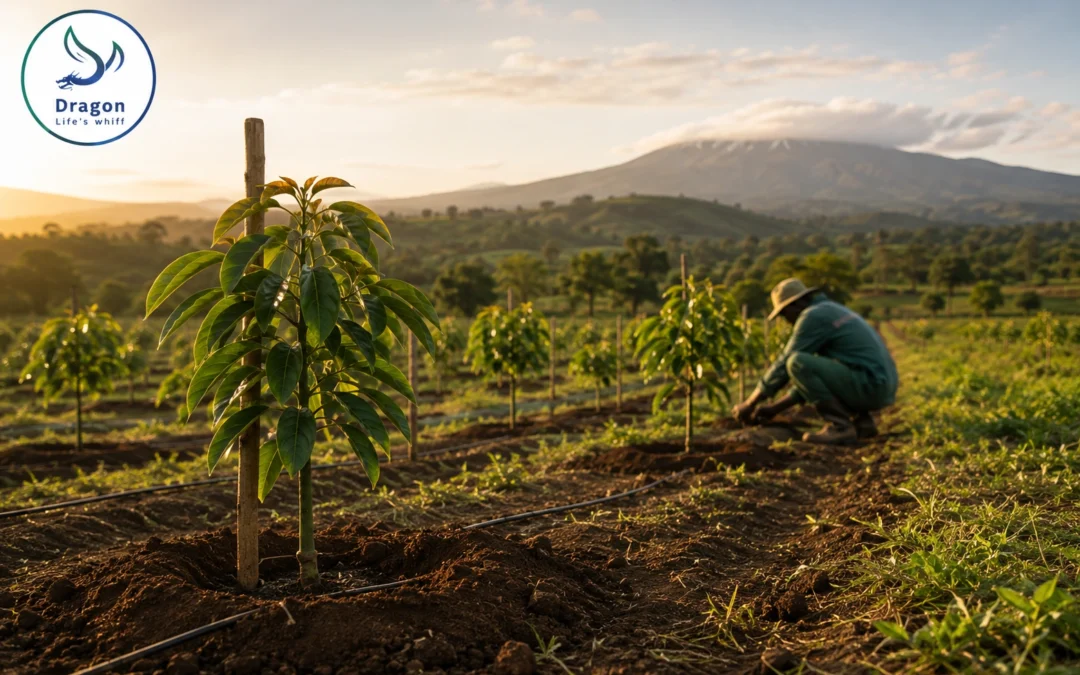
Tanzania is planting avocado at a pace few countries have attempted. More than 1.7 million subsidised seedlings are being distributed, thousands of farmers and hundreds of extension officers are being trained, and collection centres are going up across the producing regions. The country already sits third in Africa for avocado production, and government targets push output higher again for 2026/27.
Which raises a question almost nobody is writing about. Nearly all avocado nutrition advice is written for orchards that already bear fruit. If you planted this season, none of it applies to you yet.
A tree planted now will not pay you for three or four years. What you do in the meantime decides whether it pays well or barely at all.
Year zero: the planting hole decides a lot
Avocado roots are shallow, fleshy and unusually fragile. They rot in standing water and they burn on salt. Two thirds of the losses in a new orchard happen in the first few months, and almost all of them trace back to root conditions rather than anything above ground.
Get three things right at planting:
- Drainage before nutrition. A well-fed tree in a waterlogged hole still dies. Plant on a mound or ridge if your block holds water at all.
- Phosphorus placed where new roots will find it. Dragon Paste High Phosphorus supports the root architecture the tree will rely on for its whole life.
- A root stimulant at transplant. Dragon Rooty shortens the stall between planting out and active growth, which is when seedlings are most often lost.
Chloride matters more here than at any later stage. Young avocado roots have no reserves to buffer salt injury, so a chloride-free source is not a refinement, it is basic protection. Every Dragon Ferti product is free of chloride and sodium.
Year one: build a frame, not a flush
The temptation in year one is to push growth hard with nitrogen and admire the result. Soft, fast growth does not survive a Tanzanian dry season, and it invites problems the tree cannot yet defend against.
Aim for steady structural growth instead. A balanced feed with sustained phosphorus through the first rains, using Dragon Fert High Phosphorus where you are fertigating, builds a frame that carries fruit later.
This is also when highland soils show their hand. Around Njombe, Iringa and Mbeya, and up in the Kilimanjaro and Arusha zones, young leaves yellowing between the veins usually means iron the tree cannot reach. Dragon Iron is chelated and stays available where an iron sulphate would simply lock up.
Stress support earns its cost in year one. Dragon Sea and Dragon Spark help a young tree hold through heat and the first dry spells it faces without a mature root system underneath it.
Years two and three: stop feeding for leaves
Here is the mistake that costs a season. A grower who keeps pushing nitrogen into year three gets a beautiful tree that will not flower. Avocado moves from vegetative growth to reproductive readiness only when nitrogen eases and the balance shifts. Keep the nitrogen high and you delay your first crop.
Ease nitrogen back, hold phosphorus and potassium steady, and let the tree change gear. Soil health work pays here too: Dragon HV15 combines humic acids with micronutrients, which suits the thin-organic-matter soils common in newly opened orchard land.
If you are planning to certify organic
Conversion takes years, so the decision belongs at establishment rather than later. Building soil biology from year zero is both cheaper and easier than repairing it once a canopy is closed. The Dragon Organic line covers this stage with organic-compatible HV15 and Sea, which means an orchard can start as it intends to finish.
Conclusion
Establishment nutrition is an investment decision, not an input cost, because nothing you spend in year one shows up in revenue until year four. Protect the roots, build structure rather than flush, and ease nitrogen back in time to let the tree flower. Tanzanian avocado is heading to Europe, India, the Middle East and now China, and orchards planted properly this season are the ones that will supply it. See the Dragon Ferti range or reach the team through the contact page.
Frequently asked questions
When will a newly planted avocado tree start bearing?
Grafted trees typically carry a first useful crop in the third or fourth year, with commercial volumes from around year five. Establishment nutrition does not change avocado’s biology, but poor establishment reliably delays first bearing and weak trees never catch up to their neighbours.
What kills the most young avocado trees?
Root problems, chiefly waterlogging and salt injury, rather than anything visible in the canopy. Avocado roots are shallow and fleshy with very little tolerance for standing water. Plant on mounds where drainage is doubtful, and use chloride-free and sodium-free inputs so you are not adding salt to a root system that cannot cope with it.
Should I fertilize a young avocado tree with high nitrogen?
Moderately, and less than instinct suggests. Nitrogen builds canopy, which a young tree needs, but excess nitrogen produces soft growth that struggles through the dry season and it delays the shift into flowering. By years two and three, easing nitrogen back is what brings the first crop forward.
Are Dragon Ferti products suitable for a smallholder with a few hundred trees?
Yes. The products come in packaging sized for different operations, from 5 kilogram paste up to 25 kilogram soluble powder, and the same programme scales down to a smallholder block or an out-grower group. For local sourcing and pack sizes, contact the team through the contact page.