
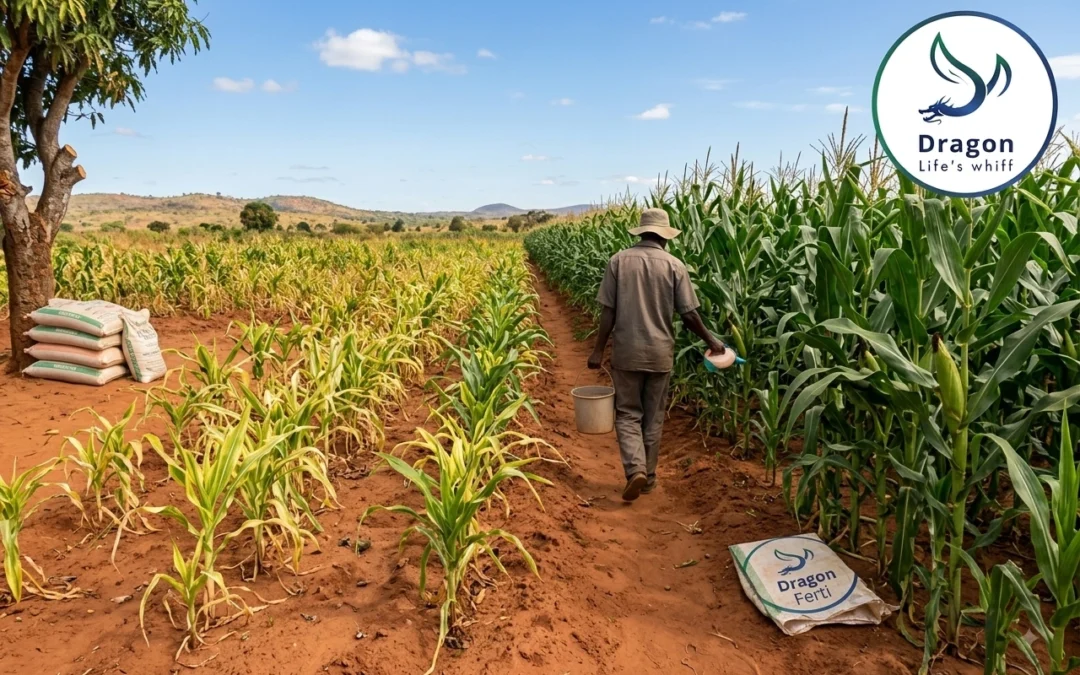
No Tanzanian smallholder walks past subsidised urea. When a bag that cost around 131,000 shillings comes down closer to 70,000, that is what most farmers buy, and arguing otherwise wastes everyone’s time.
The useful question is why a bag that should transform a maize crop so often produces a disappointing one, and what a small addition alongside it can do.
Where the nitrogen goes
A good share of applied urea never reaches the plant. On hot dry soil it loses nitrogen to the air before rain moves it in. On sandy ground heavy rain carries it past the root zone. And one large dose arrives when a young plant cannot use most of it.
Splitting the application solves more of this than any product will. Some at planting, the rest as top dressing when the crop is growing fast enough to use it. That costs nothing but a second trip across the field.
A soluble source helps in the top dressing itself, because you place it when the crop needs it. Dragon Fert High Nitrogen dissolves completely, and Dragon Triple N supports the vegetative push that sets cob size.
What the subsidised bag does not contain
This explains the plateau most farmers hit.
Subsidised urea supplies nitrogen. DAP supplies nitrogen and phosphorus. Neither supplies zinc, and zinc deficiency is common enough across Tanzanian maize soils to cap yield on fields where the farmer is doing everything else right. A zinc-short crop stunts, shows pale striping on young leaves, and ignores more nitrogen because nitrogen was never the constraint.
Correcting it is cheap. Dragon Zinc handles a confirmed deficiency, and Dragon Mix Plus covers the wider set in one foliar pass where the picture is less clear.
Sulphur is the other gap. Maize needs it to build protein, and a sulphur-short crop cannot use the nitrogen sitting in the soil beside it.
Sunflower is a different crop with a different paid metric
Sunflower has government backing as an import-substitution crop for edible oil, and seed subsidy has pushed plantings up. Farmers moving into it often treat it as low-input, which is where the money leaks.
Sunflower is bought on oil content. A processor pays for oil percentage, not tonnage alone, which changes what nutrition should aim at.
Sulphur is directly involved in oil formation, so a short crop produces seed that weighs the same and tests lower. Boron matters because sunflower is unusually boron-sensitive, and a shortage shows as poor seed set in the centre of the head: a large head with a hollow middle, a loss that looks like nothing in the field.
The single rainy season problem
Most of this farming runs on one rainy season with no irrigation, so every crop meets a dry spell and the timing decides what it costs.
Nutrition does not make rain. It helps a crop hold condition through a gap rather than shutting down and failing to recover. Dragon Fighter supports a crop through heat and moisture stress, which is reasonable on a field where you know a dry spell is coming and cannot say when.
The arithmetic
The argument for adding anything has to survive a farmer’s own maths.
A micronutrient correction costs a fraction of the subsidised bag. If nitrogen is adequate and zinc is the constraint, that small addition releases the response you already paid for. If nitrogen is genuinely short, fix nitrogen first, because micronutrients will not compensate for an underfed crop.
Sequence beats spend on a tight budget.
Building soil for the seasons after this one
Continuous cropping without returning organic matter drains these soils gradually enough to miss. Dragon HV15 from the Dragon Organic line combines humic acids with micronutrients, which suits a field in maize for years that produces less each season for reasons the farmer cannot point to.
That is a slower return than a bag of urea and should be presented as such. It suits a farmer thinking about the next five seasons rather than this one.
Conclusion
Subsidised fertilizer is a good deal that often underperforms for reasons that have nothing to do with the bag. Split the nitrogen so less of it is lost, check zinc and sulphur before buying more nitrogen, and treat sunflower as an oil crop rather than a seed crop. To match products to a farm or a dealer’s stock list, see the Dragon Ferti range or contact the team through the contact page.
Frequently asked questions
Should I stop using subsidised fertilizer and buy specialty instead?
No. Subsidised urea and DAP are the most cost-effective bulk nitrogen and phosphorus available to a Tanzanian smallholder. Specialty products work best alongside them, correcting the gaps a standard bag does not cover, particularly zinc and sulphur.
Why does my maize stop responding when I add more urea?
Because nitrogen has stopped being the limiting factor. On many Tanzanian soils zinc or sulphur becomes the constraint once nitrogen is adequate, and neither is present in subsidised urea or DAP. Adding more nitrogen at that point produces no further yield, while a small micronutrient correction releases the response you already paid for.
What nutrition raises sunflower oil content?
Sulphur above all, since it is directly involved in oil formation, and boron, because sunflower is boron-sensitive and a shortage causes poor seed set in the centre of the head. Since processors pay on oil percentage rather than seed weight alone, these two matter more to a sunflower grower’s income than extra nitrogen does.
Can I use Dragon Ferti products without irrigation?
Yes. The soluble powders work as foliar sprays, which is the practical route for micronutrient correction on rainfed fields, and foliar application reaches the crop during the growth stages that matter regardless of whether you can irrigate. Fertigation gets more from the same product where it is available.