
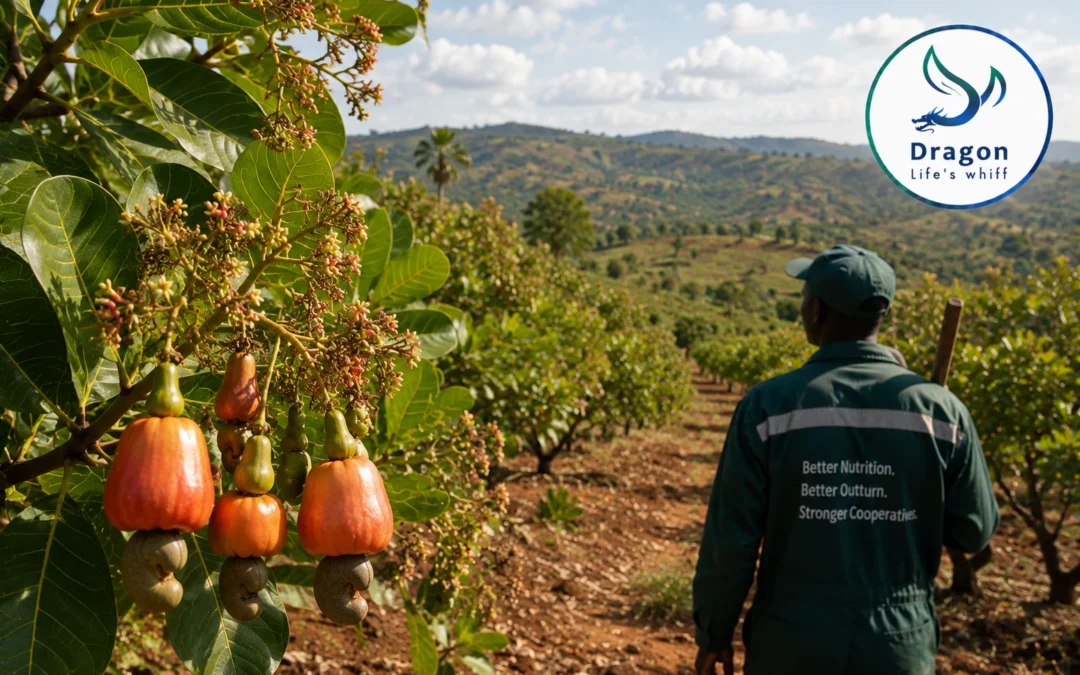
Walk a cashew farm in Mtwara or Lindi at flowering and you will see thousands of flowers on a single tree. Come back at harvest and count the nuts. The gap between those two numbers is where most of Tanzania’s cashew income disappears.
Cashew is Tanzania’s largest traditional cash crop by volume, ahead of sugar, cotton and tobacco, grown overwhelmingly by smallholders across the southeast. It is also a crop where trees look healthy and still underperform, because the limiting factor is not bulk growth. It is those few weeks of flowering.
The crop is won or lost on the panicle
A cashew tree produces an enormous number of flowers, and only a small fraction of them ever become harvestable nuts. That conversion rate is the number that matters, and it responds to micronutrients far more than to nitrogen.
Where flowering fails, the causes cluster:
- Boron shortage. Boron governs pollen viability and nut retention. Where it is short, flowers abort, nuts come out small or deformed, and gum-type disorders appear on the tree. On the sandy coastal soils of the plateau, boron leaches readily, so a soil that had enough last season may not this season.
- Zinc shortage. Zinc shortens internodes, delays flowering and pushes fruit set later than it should be. Young leaves go pale, and the tree flowers out of step with the season.
- Copper shortage. Less discussed and often undiagnosed, copper supports the tree’s overall use of the other nutrients you have already paid for.
Foliar application is the right route for all three. These are sandy, low-organic-matter soils where soil-applied micronutrients leach away before roots find them.
Dragon BorCal delivers boron with calcium at panicle emergence and through flowering. Dragon Zinc and Dragon Copper handle the other two where analysis or symptoms point to them.
Cashew leaves are leathery and shed water-based sprays easily, so adhesion is not a detail. Dragon Stick keeps the spray on the leaf long enough to be absorbed instead of running onto the ground.
Setting nuts is only half the job
Here is the part that separates a good cashew season from a profitable one. Tanzanian cashew is bought on quality, and the number that decides your price is kernel outturn, the weight of usable kernel recovered from a given weight of raw nut. Setting plenty of nuts that turn out poorly filled does not pay.
Kernel filling runs on potassium. It drives the movement of reserves into the developing kernel, supports oil content, and improves storage life in a crop that often sits before it is sold. Potassium also helps a rain-fed tree hold through dry spells.
Dragon Fert High Potassium covers this stage, and Dragon Potron supports productive growth alongside it. Because the range is chloride-free, the potassium arrives without adding salt to light coastal soils that have no capacity to buffer it.
A practical sequence
For a smallholder or a cooperative advising members, the season reduces to three moves:
- At panicle emergence: foliar boron with calcium, plus adhesive. This is the highest-return single spray on a cashew tree.
- Through flowering and early set: repeat the boron pass, and add zinc where flowering has run late or leaves are pale.
- During nut filling: potassium, to convert set nuts into filled kernels.
Miss the first two and the third has little to work on. Miss the third and you sell a large volume of light nuts at a poor outturn price.
Organic cashew
Organic-certified cashew is a real premium segment for Tanzanian exporters, and the programme above adapts without redesign. The Dragon Organic line includes organic-compatible BorCal and Stick, so a certified farm runs the same three moves with approved inputs.
Conclusion
Cashew rewards precision at two narrow moments and ignores most of what you do in between. Boron and zinc during flowering decide how many nuts you get. Potassium during filling decides what those nuts are worth. Both are cheap relative to the value of the crop they protect. To build a programme for a farm or a cooperative membership, see the Dragon Ferti range or contact the team through the contact page.
Frequently asked questions
Why does my cashew tree flower heavily but set few nuts?
This is the normal pattern for cashew, which sets only a small share of the flowers it produces, but boron shortage makes it much worse. Boron is required for pollen viability and nut retention, and it leaches quickly from the sandy soils of the southeast. A foliar boron application at panicle emergence and again during flowering is the most reliable way to lift the conversion rate.
What is kernel outturn and why does nutrition affect it?
Kernel outturn is the weight of usable kernel recovered from raw nuts, and it is a major factor in the price a buyer pays. Nutrition affects it because filling the kernel depends on moving reserves into the nut, which potassium regulates. A tree that sets nuts but runs short of potassium during filling produces light nuts with poor recovery.
Should I apply micronutrients to the soil or as a foliar spray on cashew?
Foliar, in most cases on the Makonde Plateau. The soils are sandy with low organic matter, so boron and zinc applied to the ground move below the root zone quickly. A spray delivers the nutrient at the moment of flowering when the tree needs it, and it works even where there is no irrigation to carry soil-applied product.
Can Dragon Ferti products be used by a cashew cooperative rather than a single farm?
Yes, and cooperatives are often the practical route in this sector, since most Tanzanian cashew is smallholder-grown and marketed through cooperative unions. Packaging ranges from 5 kilogram to 25 kilogram formats, which suits group purchasing and distribution to members. Contact the team for cooperative supply arrangements.