
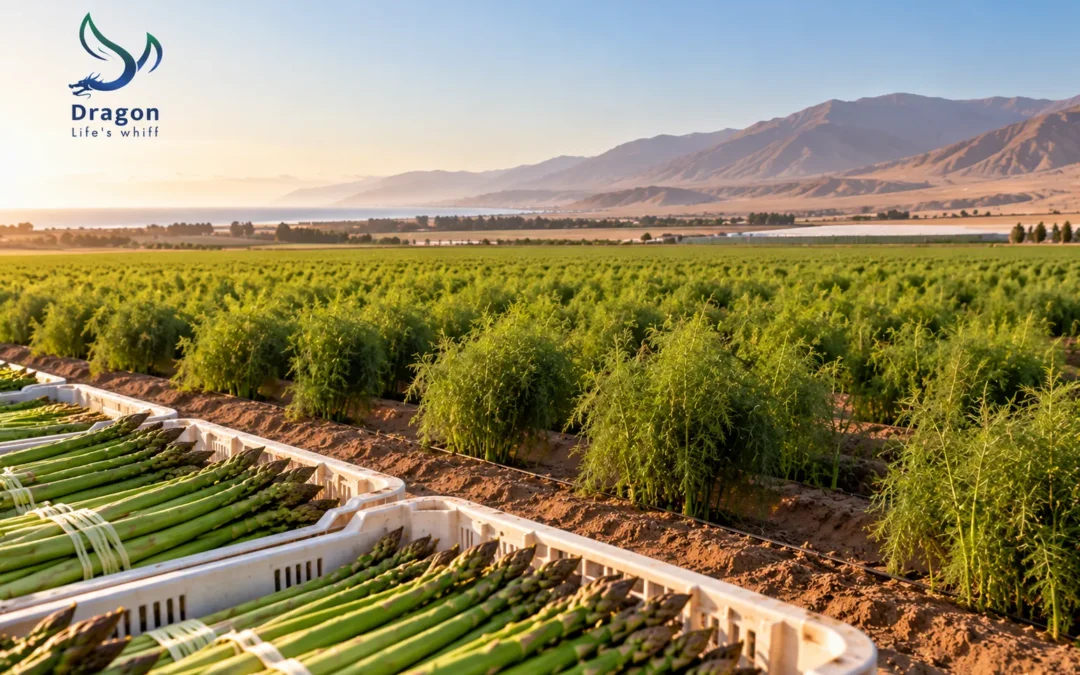
In most of the world, asparagus rests because winter arrives. In Peru it rests because the grower turns off the water.
On the desert coast there is no cold season to send the crop into dormancy, so growers create one. They stop irrigating, the fern dries down, the crown goes quiet, and when water returns the spears come up. Managed this way, a field can be harvested twice a year, and the industry can schedule supply to match demand in its export markets rather than wait for the weather.
That is a large part of why Peru became the world’s second-largest asparagus exporter. It also means that asparagus nutrition in Peru follows a calendar the grower writes, not one the climate imposes.
Where the industry stands
Peru grows asparagus on roughly 28,000 hectares, with La Libertad holding about half of it, Lambayeque about a fifth and Ica about a fifth. Between January and August 2025 the country shipped almost 73,000 tonnes, worth about 256 million dollars. Volume rose by around 20 per cent, but value rose by only 1 per cent, because the average price fell by about 16 per cent to roughly 3.50 dollars a kilogram. Sea freight on some routes adds substantial cost per kilogram on top of that.
More tonnes for the same money is a squeeze, and the industry trend has been toward fewer hectares as some growers switch to more profitable crops. For those who stay, the path to margin is yield and quality per hectare, and that is where nutrition earns its place.
The cycle, stage by stage
Asparagus is a perennial. What you harvest this season was paid for by the fern that grew after the last one. The crown is a storage organ, and every spear is built from carbohydrate the fern sent down to it.
| Stage | What the plant is doing | What nutrition should do |
|---|---|---|
| Fern growth after harvest | Leaves photosynthesise and pump carbohydrate into the crown | This is the main feeding window. Nitrogen and potassium build a strong fern, which builds the reserves for the next harvest |
| Forced dormancy | Water is withheld, the fern senesces and the crown stops growing | Little or no feeding. Nutrients applied now are largely wasted |
| Harvest | Spears grow from reserves stored in the crown | The crown is spending, not earning. Heavy feeding during harvest does less than growers expect |
| Recovery | Harvest stops and a new fern is allowed to grow | Feeding resumes to rebuild reserves |
The table carries the single most useful idea in asparagus nutrition, and the one most often missed. The crop is fed for the next harvest, not the current one. A grower who pours fertilizer on during cutting and neglects the fern afterward is spending at the wrong end of the cycle. Tree crops can work on a similar principle: hazelnut in Chile bears on wood grown the season before, so this year’s feeding shapes next year’s crop.
Feeding the fern
The fern period is where the money is made, and it is often cut short because it produces nothing to sell.
Nitrogen drives fern growth, but more is not always better. A fern pushed too hard with nitrogen can grow lush and prone to disease without storing proportionally more in the crown. Moderate, steady nitrogen through fern growth serves the crown better than large doses. Dragon Paste Balanced suits the early fern.
Potassium supports photosynthesis and the movement of carbohydrate from fern to crown. It is removed heavily in the harvested spears and has to be replaced. Dragon Paste High Potassium and Dragon PotaMax carry the later fern period, when storage is the priority.
Phosphorus supports root and crown development, especially in young plantings and after establishment. Dragon Fert High Phosphorus supplies it in fully soluble form for fertigation.
Calcium and magnesium are easily short on the low-exchange sandy soils of the coast. Dragon MagiCal supplies both.
Spear quality is decided before the spear appears
Export buyers grade asparagus on straightness, tight tips, diameter, colour and freedom from fibre. Much of that is set by crown reserves and growing conditions rather than by anything applied during harvest.
A well-stocked crown produces thicker spears. A depleted one produces thin spears that fall into lower grades. Tips that open early, known as ferning out, are mostly a temperature and timing problem, but a crop under nutritional stress is less able to hold quality in warm spells.
This is why the forced dormancy decision matters as much as the fertilizer. Drying a field down before the fern has refilled the crown sacrifices the next harvest for the sake of an earlier one.
Why the sand makes it harder
Most of Peru’s asparagus grows on the same sandy desert ground as its grapes and blueberries. Sand holds very little: little water, little nutrient, and almost no buffer against mistakes. What the roots receive is close to whatever arrived in the last irrigation.
That makes the fern period more demanding, not less. Feeding has to be little and often through the drip line, and calcium and magnesium have to be scheduled because the soil holds little reserve. The general principles of feeding through sand are set out in the guide to fertigation on Peru’s desert coast, and the Dragon Paste and Dragon Fert soluble powder lines dissolve completely for exactly this kind of frequent injection.
An unusually tolerant crop
Asparagus is more tolerant of salinity and boron than most crops grown on the coast. FAO guidance places it among the most boron-tolerant crops of all, which is part of why it has thrived on water that would damage more sensitive species.
Tolerant is not immune. Over years of drip irrigation, salts still concentrate at the edge of the wetted zone, and yields drift down if the profile is never flushed. Avoiding chloride and sodium in the fertilizer is still worthwhile, and every product in the Dragon Ferti range is free of both, along with heavy metals. The contrast with far more sensitive crops is covered in the guide to salinity and boron in northern Chile.
Micronutrients and the long-lived crown
A plantation can produce for many years, which gives small deficiencies time to add up. Zinc and boron are the ones most often worth checking on coastal sand. Dragon Zinc corrects a confirmed shortfall and Dragon Mix Plus covers the group during fern growth. Leaf analysis of the fern, taken at the same point in each cycle, is the most useful way to track them over the life of the crown.
What this means for a distributor
Peru’s asparagus growers are experienced, export-focused and under price pressure. They do not need to be told that asparagus needs potassium. What they value is a supplier who understands that the feeding calendar is built around the forced dormancy cycle rather than around the harvest, and who supplies products that dissolve reliably under frequent injection.
For exporters who must document every input across two harvests a year, each Dragon Ferti shipment arrives with its Certificate of Analysis, Technical Data Sheet and Safety Data Sheet, backed by Free Sale Certificates and production under ISO 9001, ISO 14001 and ISO 45001 certified management systems. Peru’s other export crops on the same coast are covered in the guides to blueberry fertilization in Peru and coffee fertilization in Peru.
Conclusion
Peruvian asparagus sleeps when the grower withholds water, which lets the coast produce twice a year and supply export markets on schedule. The same system sets the nutrition calendar. Feed the fern after harvest, when it is filling the crown for the next crop, and hold back during dormancy and cutting, when feeding does least. On the coast’s sandy soils, that means little-and-often fertigation with calcium and magnesium built in. To plan a fern-period programme for your plantation, browse the Dragon Ferti range, see how the products have performed in field trial results, or reach the export team through the contact page.
Frequently asked questions
How does Peru produce asparagus without a winter?
Growers induce dormancy by withholding irrigation. The fern dries down and the crown stops growing, and when water returns the spears emerge. This forced dormancy allows two harvests a year and lets growers schedule production to meet export demand.
When should asparagus be fertilized?
Mainly during fern growth after harvest, when the fern is sending carbohydrate down to the crown. Those reserves produce the next harvest’s spears. Feeding during dormancy or heavily during harvest does less than feeding the fern.
Which nutrients matter most for asparagus?
Nitrogen for fern growth, potassium for carbohydrate storage and replacing what the spears remove, and phosphorus for root and crown development. On sandy coastal soils, calcium and magnesium also need to be scheduled because the soil holds little reserve.
What makes asparagus spears thin?
Most often a depleted crown. Spear diameter depends largely on the carbohydrate reserves built during the previous fern period. A fern cut short, underfed or dried down too early leaves the crown with less to spend on the next harvest.
Is asparagus tolerant of salty water?
It is more tolerant of salinity and boron than most crops, and FAO guidance places it among the most boron-tolerant. It is not immune, however, and salts can still accumulate under long-term drip irrigation, so avoiding chloride and sodium in the fertilizer remains worthwhile.