
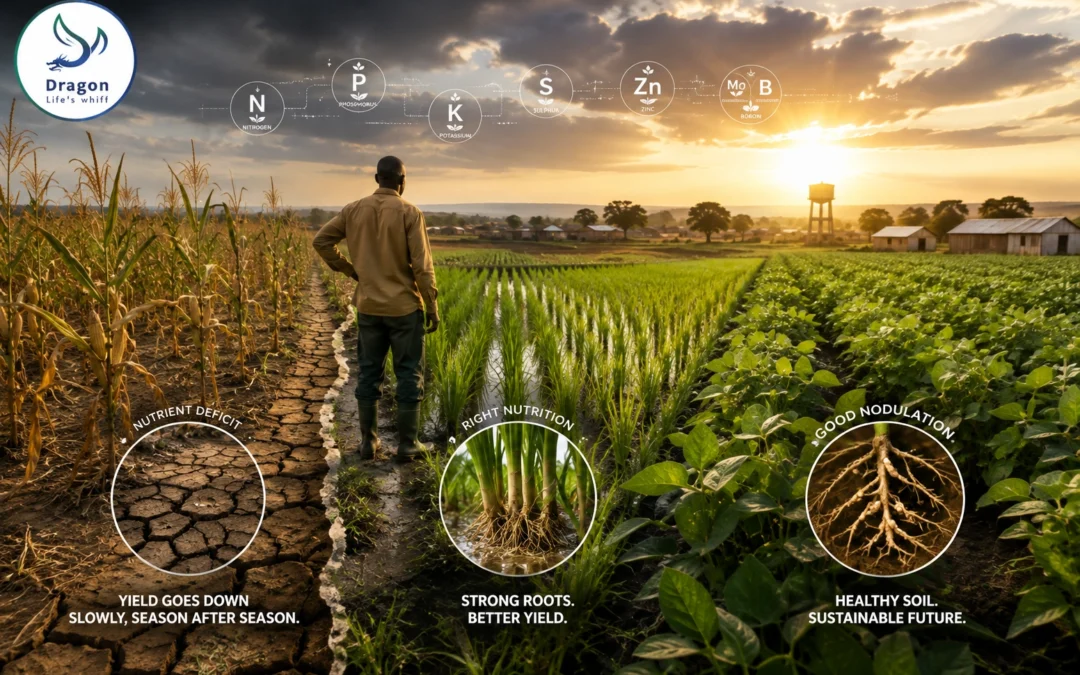
Every harvest takes nutrients off the farm. Grain leaves in a truck, residues get burned or grazed, and almost nothing goes back. Nutrient balance studies for Ghanaian crops show a deficit for nearly all of them.
Do that for twenty years around Tamale and the result is not dramatic. It is a yield that drifts down slowly enough that each season feels like the last, until you compare the field to what it produced when your father farmed it.
The market changed, and so did the question
When the fertilizer component of Planting for Food and Jobs was discontinued, the market moved from government tender toward private supply.
For a farmer that changes the question. It used to be what the government would allocate. Now it is what to buy, from whom, and whether it is worth the price. Harder, and better.
Maize: nitrogen is not usually the binding constraint
Most northern maize gets nitrogen, usually urea or a compound NPK. Yields respond, then stop, and the assumption is that more nitrogen is needed. By that point nitrogen is usually not the constraint. Two things commonly are.
Sulphur, which northern soils are frequently short of and most compound fertilizers do not supply. A sulphur-short crop cannot use the nitrogen you already applied.
Zinc, widely deficient across savannah soils, cheap to correct, and directly limiting. Dragon Zinc corrects it, and Dragon Mix Plus covers the wider set in one pass.
For nitrogen itself, splitting matters more than the total. Dragon Triple N and Dragon Fert High Nitrogen applied across the season lose less than one heavy dose before the crop can use it.
Rice: flooded and upland are different crops nutritionally
Lowland flooded and upland rainfed rice get discussed as one crop and behave differently.
In flooded systems nitrogen loss dominates. Applied nitrogen escapes waterlogged soil quickly, so form and timing matter more than quantity. Getting nitrogen in when the crop can take it up beats getting more in.
Upland rice has the opposite problem. Water limits it, so phosphorus for root development matters more, since a deeper root system carries a rainfed crop through gaps in the rains. Dragon Fighter supports a crop through the stress a single rainy season guarantees.
The soybean misconception worth correcting
Soybean spread across northern Ghana partly on the understanding that it needs less fertilizer. That is half right, and the wrong half costs yield.
Soybean fixes its own nitrogen, so the nitrogen bill drops. It does not fix phosphorus, potassium or sulphur, and it removes all three at rates comparable to any other crop. A soybean rotation on unfertilized land mines phosphorus and potassium steadily while the farmer believes the crop is undemanding.
Second point: fixation depends on nodulation, and nodulation depends on molybdenum and boron. A soybean crop short of those fixes less nitrogen, so the one thing it should do for free, it does badly.
Dragon Potron supports productive growth, and micronutrient correction through Dragon Mix Plus covers the nodulation requirement.
Rebuilding rather than just replacing
A deficit is not fixed by matching what you remove. It is fixed by putting back more than you take for a while.
Organic matter gets neglected because the return is slow. It holds nutrients and water in soils that do neither well, which is what a savannah soil under one rainy season needs. Dragon Mix is an organic-compatible micronutrient blend, and Dragon Sea supports soil biology and recovery.
It does not replace the nitrogen a maize crop needs, and pretending otherwise would be dishonest, but it addresses the decline that fertilizer alone does not.
What an agro-dealer can do with this
Dealers in Tamale now advise farmers who buy commercially rather than collect an allocation. The advice that builds a repeat customer is rarely more of the same compound NPK. It is asking what the farmer grew last season and what they are rotating into, noting that soybean still needs phosphorus and potassium, and adding the sulphur and zinc the standard bag leaves out. Small basket, visible result, farmer comes back.
Conclusion
Northern Ghana’s yield problem is an accounting problem. More leaves the field than returns, and the fix is not only more nitrogen. Correct the sulphur and zinc that cap maize response, treat flooded and upland rice differently, and stop treating soybean as a crop that feeds itself. To match products to a rotation or stock list, see the Dragon Ferti range or contact the team through the contact page.
Frequently asked questions
Why has my maize stopped responding to more fertilizer?
Once nitrogen is adequate something else limits the crop, and on northern savannah soils that is usually sulphur or zinc. Neither is in most standard compound fertilizers. A sulphur-short crop cannot use the nitrogen already applied, so more nitrogen produces no response until that gap closes.
Does soybean really need fertilizer if it fixes nitrogen?
It needs less nitrogen, not less fertilizer. Soybean removes phosphorus, potassium and sulphur like any other crop, and a rotation grown without replacing them depletes the field. Fixation also depends on nodulation, which requires molybdenum and boron, so a micronutrient-short crop fixes less nitrogen than it should.
Should I fertilize lowland and upland rice the same way?
No. In flooded systems the main challenge is nitrogen loss from waterlogged soil, so timing and form matter more than quantity. Upland rainfed rice is limited by water, so phosphorus for root development matters more, since deeper roots carry the crop through dry spells.
Is organic matter worth the cost when cash is tight?
It returns more slowly than a bag of urea, so it is not the answer if a crop is nitrogen-starved this season. What it does is address the underlying decline, holding nutrients and water in soils that do neither well. For a farmer planning several seasons ahead, it is usually the better value.