
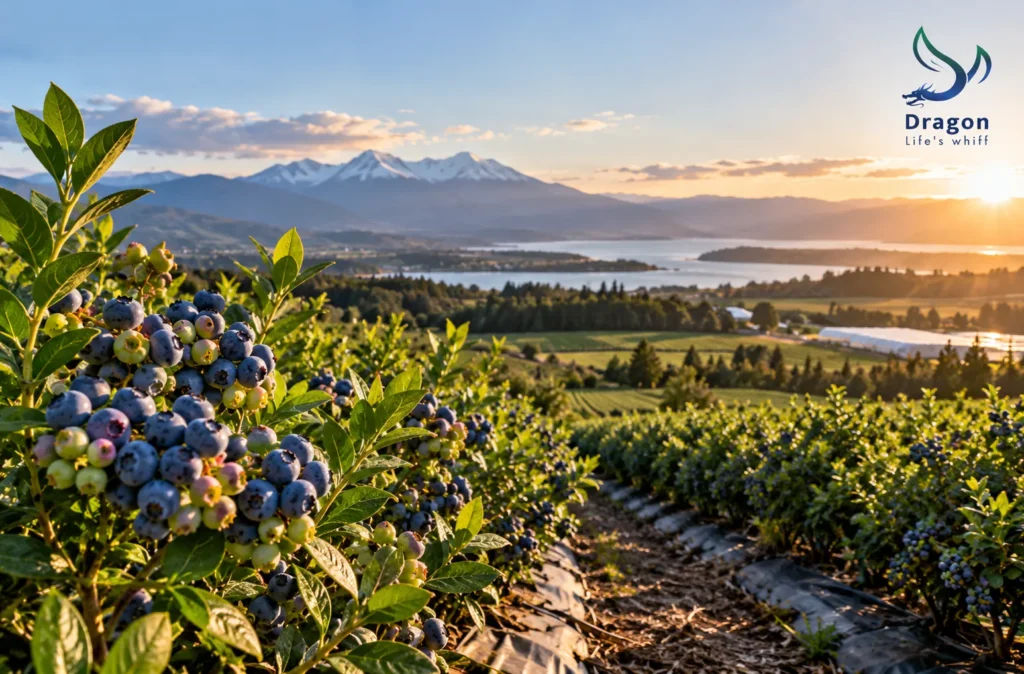
Chilean blueberry exports fell from close to 120,000 tonnes to a low of about 86,000 as Peru's industry grew into the world's largest. In the 2025/26 season, Chile turned the trend: fresh exports reached about 92,900 tonnes, up 2.7 per cent, according to the IBO Global Blueberry Report and the Chilean Blueberry Committee.
The shape of the recovery says more than the number. Europe took about half of all Chilean blueberries, up 20 per cent, while shipments to the United States fell by 13 per cent. New varieties rose to 24 per cent of exports. Organic fresh exports grew 15 per cent, to around a fifth of the total.
Chile is not going to outproduce Peru, and it is not trying to. What it is doing is competing on the thing that matters most on a long voyage to Rotterdam: arriving firm, sound and with shelf life left.
Chile and Peru grow the same fruit in different worlds
| Peru | Chile | |
|---|---|---|
| Where it grows | Northern desert coast, La Libertad and Lambayeque | Maule, Nuble and Biobio, extending south to La Araucania, Los Rios and Los Lagos |
| Growing medium | Largely substrate in pots or bags | Largely in the ground |
| Soil pH | Managed entirely through the substrate and water | Naturally acidic in much of the south; can be too high in central valleys with alkaline water |
| Season | Long, built for volume and early windows | Concentrated, roughly November to March |
| Main commercial lever | Scale and timing | Condition, genetics and organic |
Peru's substrate systems give growers precise control, and the guide to blueberry fertilization in Peru covers them in detail. Chile works mostly with real soil, which brings both advantages and problems a substrate grower never faces.
Blueberry breaks the usual rules
Most fruit crops want a near-neutral soil and a mix of nitrogen forms. Blueberry wants neither, and nutrition programmes borrowed from other crops often go wrong for that reason.
It needs acidic soil. Blueberry performs best in a root zone around pH 4.5 to 5.5. Above that, iron becomes unavailable and the plant develops yellowing between the veins of young leaves.
It prefers ammonium nitrogen. Unlike most crops, blueberry takes up and uses ammonium far better than nitrate. A nitrate-heavy programme designed for other fruit can leave a blueberry planting short of usable nitrogen even when plenty is applied.
It has a shallow, fibrous root system without root hairs. That makes it sensitive to salt, to drying out, and to fertilizer applied in large, concentrated doses.
This is where Chile's geography splits in two.
The south: soil that already suits the crop
Much of southern Chile's blueberry ground lies on volcanic soils that are naturally acidic and high in organic matter. On that ground the grower is working with the crop's preferences rather than against them.
The main risks shift to the ones that come with high rainfall and high organic matter: nutrients leaching in wet seasons, phosphorus being held tightly by volcanic minerals, and magnesium, calcium and potassium running low over time. Regular soil and leaf testing tells a grower which is happening. Dragon MagiCal covers magnesium with calcium, and the guide to acid soils and aluminium explains how to read the soil report, with the important difference that blueberry wants the soil to stay acidic, so liming targets are far lower than for most crops.
The central valleys: fighting the water
Further north, in parts of Maule and neighbouring areas, irrigation water often carries bicarbonate that pushes root zone pH up season after season. On that ground the blueberry grower is working against the water.
The response is acidification. Acidifying the irrigation water neutralises bicarbonate before it reaches the root. Using fertilizers that are acidic in solution helps rather than hinders: the Dragon Paste line runs acidic in solution, which suits blueberry better than almost any other crop. Where the water needs correcting on its own terms, Dragon Corrector is built for it.
Where iron chlorosis has already appeared, Dragon Iron corrects it, but it will return unless root zone pH is brought down.
Firmness is where the money is
The 2025/26 season showed how exposed blueberries are to heat. Warmer conditions brought the harvest forward, and Duke was picked around 20 days earlier than usual, with lower dry matter, smaller sizing and softer fruit early in the season. With a possible El Nino developing in 2026, growers across the region are watching for rain and heat that could hit firmness again.
Firmness is the quality a European buyer checks first after weeks at sea, and nutrition influences it in three ways.
Calcium. Calcium strengthens the cell walls that hold a berry together, and it has to be present during fruit development rather than just before harvest. Dragon PureCal and Dragon Calibo supply calcium through that window, and Calibo adds boron for fruit set.
Nitrogen restraint. Excess nitrogen late in the season produces vigorous shoots, delays maturity and softens fruit. Nitrogen belongs in spring growth and post-harvest recovery rather than in the weeks before picking.
Potassium in balance. Potassium supports sugar and fruit fill, but pushed too hard it competes with calcium. Dragon Paste High Potassium supports fill when balanced against calcium.
The same calcium logic governs Chile's cherries on the even longer voyage to China, as the guide to cherry nutrition for the China export market sets out.
New genetics need a matching programme
Chile's varietal renewal is well under way, with new varieties growing 14 per cent in the last season while traditional varieties such as Duke declined. Growers are replacing old plantings with genetics chosen for firmness, size and travel performance.
A new variety does not come with an old variety's nutrition programme. Vigour, cropping pattern and timing all differ, and a programme copied from the block next door can over- or under-feed. The first seasons after planting a new variety are the time to test leaves and fruit more often than usual, and adjust.
Organic is a real advantage
Organic fresh exports grew 15 per cent last season, and Nuble in particular has been described by industry figures as a highly relevant area for organic production, a comparative advantage worth protecting.
Organic blueberry growers face the same pH, calcium and firmness questions with a narrower set of permitted inputs. The Dragon Organic line carries organic-compatible calcium and soil correction products, including Calibo and Corrector. Confirm with your certifier that any input is permitted under your standard before using it.
What this means for a distributor
Chile's blueberry growers are rebuilding around quality, and they buy on results rather than price per bag. The south needs help with leaching and base cation balance on acidic volcanic ground. The central valleys need acidification and iron management against alkaline water. Both need a firmness programme that holds up after weeks in transit to Europe.
Dragon Ferti supplies Certificates of Analysis, Technical Data Sheets, Safety Data Sheets and Free Sale Certificates, and manufactures under ISO 9001, ISO 14001 and ISO 45001 certified management systems. Every product is free of chloride, sodium and heavy metals, which matters for a crop as salt-sensitive as blueberry. Growers in the saline, boron-affected north face a very different set of rules, covered in the guide to salinity and boron in northern Chile.
Conclusion
Chile will not match Peru on blueberry volume, and it does not need to. Its advantage lies in soil-grown fruit, new genetics, organic production and above all in condition on arrival in Europe. That depends on keeping the root zone acidic, respecting the crop's preference for ammonium nitrogen, supplying calcium during fruit development and holding back nitrogen before harvest. For specifications or distribution enquiries, see the Dragon Ferti range, review field trial results, or contact the export team through the contact page.
Frequently asked questions
How much blueberry does Chile export?
Chile exported about 92,900 tonnes of fresh blueberries in the 2025/26 season, up 2.7 per cent, after several years of decline from close to 120,000 tonnes. Europe took about half of the total, and organic fresh exports grew by 15 per cent.
What soil pH do blueberries need?
Blueberry performs best in a root zone around pH 4.5 to 5.5. Above that range, iron becomes unavailable and plants develop chlorosis between the veins of young leaves. Much of southern Chile's volcanic soil is naturally acidic, while central valleys with alkaline water often need acidification.
Why do blueberries need ammonium nitrogen?
Blueberry takes up and uses ammonium nitrogen far more efficiently than nitrate, unlike most fruit crops. A nitrogen programme designed for other crops, weighted toward nitrate, can leave blueberries short of usable nitrogen even when plenty is applied.
How can blueberry firmness be improved?
Supply calcium during fruit development rather than just before harvest, avoid excess nitrogen late in the season, and keep potassium balanced against calcium. Harvest timing and cold chain management also matter, particularly in hot seasons that bring harvest forward.
How is blueberry growing in Chile different from Peru?
Peru grows largely in substrate on its northern desert coast, which gives growers precise control over the root zone. Chile grows mostly in the ground, with naturally acidic volcanic soils in the south and alkaline irrigation water in some central valleys, so soil and water management play a much larger role.


Looking for a reliable specialty fertilizer partner?
We work with importers and distributors who want products that set their portfolio apart.