
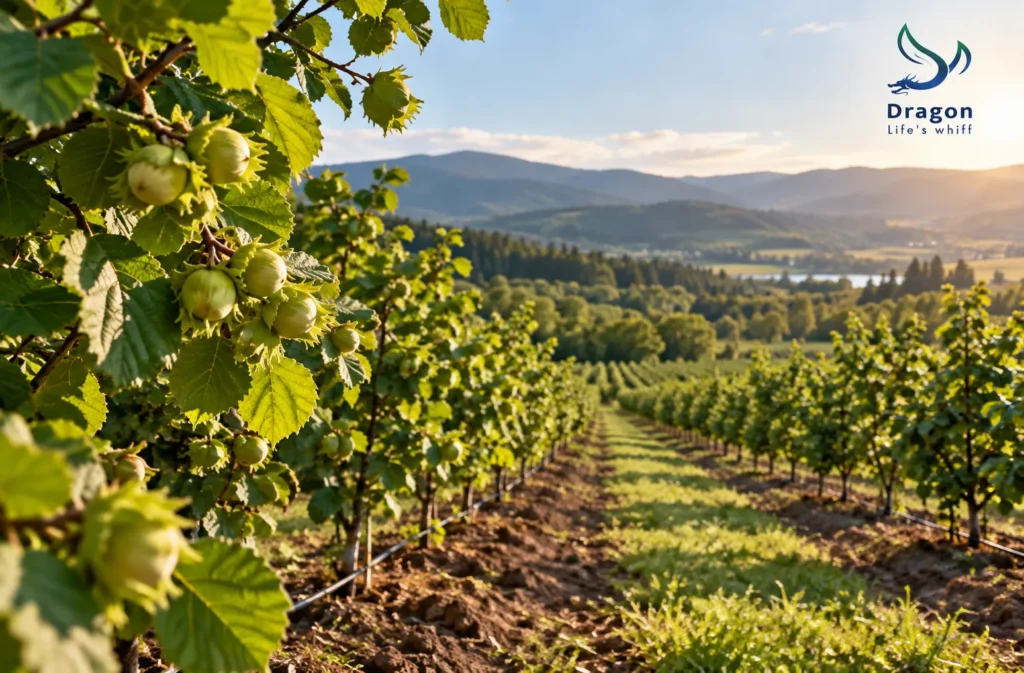
Twenty-five years ago there was almost no European hazelnut in Chile. By 2024 the official fruit survey by Odepa counted about 49,000 hectares, mostly in Maule, La Araucania and Nuble, and industry figures from AgriChile, the Ferrero subsidiary that led the expansion, put the total above 65,000 hectares by early 2026. Hazelnut is now the second-largest fruit crop in the country by area after cherry, and Chile has become the world's second-largest hazelnut exporter.
One number reshapes how Chilean growers should think about the crop. Of the roughly 49,000 hectares in the official survey, only about 11,100 were producing at full capacity. More than 33,500 hectares were young orchards still growing toward maturity.
Most of Chile's hazelnut is not yet a hazelnut business. It is an orchard-building business. And young trees need different feeding from mature ones.
A tree that takes a decade to mature
Oregon State University Extension, working with a long-established hazelnut industry, gives a useful timeline. Trees produce their first commercial crop in the third to fifth year, take 10 to 12 years to reach full production, and can remain productive for 40 to 60 years or more if well managed.
That long runway means the decisions made in the first years echo for decades.
| Orchard age | What the tree is doing | Nutrition priority |
|---|---|---|
| Years 1 to 2 | Establishing roots and a framework | Root development and steady growth. Dragon Rooty after planting, with moderate nitrogen and phosphorus |
| Years 3 to 5 | Building canopy while first crops appear | Nitrogen to fill the canopy, with potassium rising as nuts appear |
| Years 5 to 10 | Growing into full production | Balanced feeding, with boron and zinc for nut set becoming important |
| Mature orchard | Carrying full crops | Replacing what each harvest removes, protecting nut set and kernel fill |
Because hazelnuts are borne mostly on new wood, the tree has to keep producing vigorous growth every year. Oregon State notes that adequate fertilization and pruning are what maintain that vigour. An orchard allowed to stall in its early years reaches full production later and at a lower ceiling.
The strangest flowers in the orchard
Hazelnut has one of the most unusual reproductive systems of any fruit crop, and it explains why some nutrients matter so much.
The tree is wind-pollinated and flowers in winter. When pollen lands on a female flower, there is almost nothing there to fertilise. Oregon State describes the tissue at the base of the flower at pollination as tiny, about a quarter of a millimetre. The ovary has not yet formed. The pollen waits while the flower slowly develops over the following months, and fertilization happens much later in the season.
That long gap is a period of risk. Oregon State reports that in the Barcelona variety, 35 to 50 per cent of female clusters can drop prematurely, a loss it estimates at 75 to 85 per cent of the individual flowers the tree produces. These "developmental dropouts" were pollinated and began developing normally before growth stopped. Later in the season a second loss appears: blanks, nuts with shells but no kernel.
Both losses are where boron and zinc come in.
Boron and zinc: the evidence, stated honestly
Oregon State reports that foliar-applied boron can increase nut cluster set by as much as 33 per cent. That is a large effect, and it is why boron is a standard part of hazelnut programmes in Oregon.
The evidence is not uniform, and growers deserve to know that. A review of hazelnut fertilization notes that in Oregon boron sprays sometimes increase nut set even on trees that are not deficient, but that no response to boron has been observed in the Mediterranean. The response seems to depend on conditions.
For Chile, the most relevant evidence comes from Chile itself. A study on Tonda di Giffoni hazelnut in southern Chile tested combined boron and zinc sprays at different times in spring. The best programme increased stabilised nut production about 2.5-fold and reduced the percentage of blank nuts. The researchers concluded that for temperate areas such as southern Chile, combined boron and zinc should be applied toward the end of spring, and that earlier applications produced irregular results.
That points to a practical approach: boron and zinc together, timed to late spring, at moderate and split rates rather than one heavy dose. Dragon Calibo supplies boron with calcium, and Dragon Zinc supplies zinc. Boron has a narrow margin between enough and too much, so leaf analysis should guide the rate.
Feeding the kernel
Once nut set is secured, the grower is paid for kernel weight and quality.
Potassium supports kernel fill and is removed with every harvest. Dragon Paste High Potassium and Dragon PotaMax carry the fill period.
Nitrogen builds the new wood that carries next year's crop, and it also matters for kernel development. Balance is the goal. Too little stalls the orchard, and too much produces excessive vegetative growth.
Magnesium and calcium are commonly short on acidic southern soils. Dragon MagiCal covers both.
Research on hazelnut elsewhere has found that foliar nutrition can improve kernel weight and reduce the incidence of blanks, which supports treating foliar feeding as a regular part of the programme rather than an emergency measure.
Chilean conditions
Chile's hazelnut belt runs from Maule south into La Araucania and beyond, and two features of the region shape the programme.
Summers are dry. Industry figures note that hazelnut in Chile needs irrigation, and much of the recent expansion has been planted with drip. That makes fertigation the natural way to feed, and the Dragon Paste and Dragon Fert soluble powder lines dissolve completely for it.
Southern soils are often volcanic and acidic. In La Araucania and further south, volcanic soils hold phosphorus tightly and can be low in calcium and magnesium. Soil testing before and during establishment matters, and the guide to acid soils and aluminium explains how to read the results.
A crop apart from Chile's fresh fruit
Chile's cherry, blueberry and table grape growers are judged on fruit that arrives firm after a long voyage. Hazelnut is judged on kernels, which travel far more easily. The nutrition logic is correspondingly different, with far more weight on nut set and kernel fill than on firmness. The fresh-fruit side of Chilean horticulture is covered in the guides to cherry nutrition for China, blueberry fertilization in Chile, and table grape and cherry fertilization.
What this means for a distributor
Chile's hazelnut industry is growing quickly and is dominated by young orchards whose owners, from smallholders to investment funds, are still learning the crop. That makes the next decade a period of orchard building rather than orchard maintenance.
A supplier who understands the difference between feeding a three-year-old tree and a twelve-year-old one, and who can explain the evidence on boron and zinc honestly, is more useful than one selling a single standard programme. Orchards built for a 40-year life deserve inputs with a clear paper trail: Dragon Ferti supplies a Certificate of Analysis, Technical Data Sheet, Safety Data Sheet and Free Sale Certificate with its products, all made under ISO 9001, ISO 14001 and ISO 45001 certified management systems. The whole range is formulated without chloride, sodium or heavy metals, so nothing in the programme adds to the soil what a long-lived orchard would have to live with for decades.
Conclusion
Most of Chile's hazelnut area is still young and years from full production, so the most important nutrition work is building strong orchards that reach maturity sooner. Hazelnut's unusual biology, with winter pollination and fertilization months later, exposes the crop to large losses of developing flowers and to blank nuts. Chilean research supports combined boron and zinc sprays in late spring to reduce those losses, alongside steady nitrogen for new wood and potassium for kernel fill. Whether your trees are in their first year or their tenth, you can explore the Dragon Ferti range, look at field trial results from other crops, or contact the export team through the contact page.
Frequently asked questions
How much hazelnut is planted in Chile?
Odepa's official survey counted about 49,000 hectares by 2024, mostly in Maule, La Araucania and Nuble, and industry figures from AgriChile put the total above 65,000 hectares by early 2026. Only about 11,100 hectares of the official total were at full production, with more than 33,500 still in young orchards.
How long does a hazelnut orchard take to reach full production?
According to Oregon State University Extension, hazelnut trees produce their first commercial crop in the third to fifth year and take about 10 to 12 years to reach full production. Well-managed orchards can remain productive for 40 to 60 years or more.
What causes blank hazelnuts?
Blanks are nuts that develop a shell but no kernel. They are linked to problems in the long interval between pollination and fertilization and to nutritional and stress factors. Research in southern Chile found that combined boron and zinc sprays in late spring reduced the proportion of blanks.
Does boron increase hazelnut yield?
Often, but not everywhere. Oregon State reports foliar boron can increase nut cluster set by up to 33 per cent, while no response has been observed in Mediterranean orchards. A study in southern Chile found combined boron and zinc increased stabilised nut production about 2.5-fold when applied in late spring.
When should boron and zinc be applied to hazelnut in Chile?
Research in southern Chile recommends combined boron and zinc toward the end of spring, at moderate, split rates. Earlier applications gave irregular results. Leaf analysis should guide the rate because boron has a narrow margin between adequate and excessive.


Looking for a reliable specialty fertilizer partner?
We work with importers and distributors who want products that set their portfolio apart.