
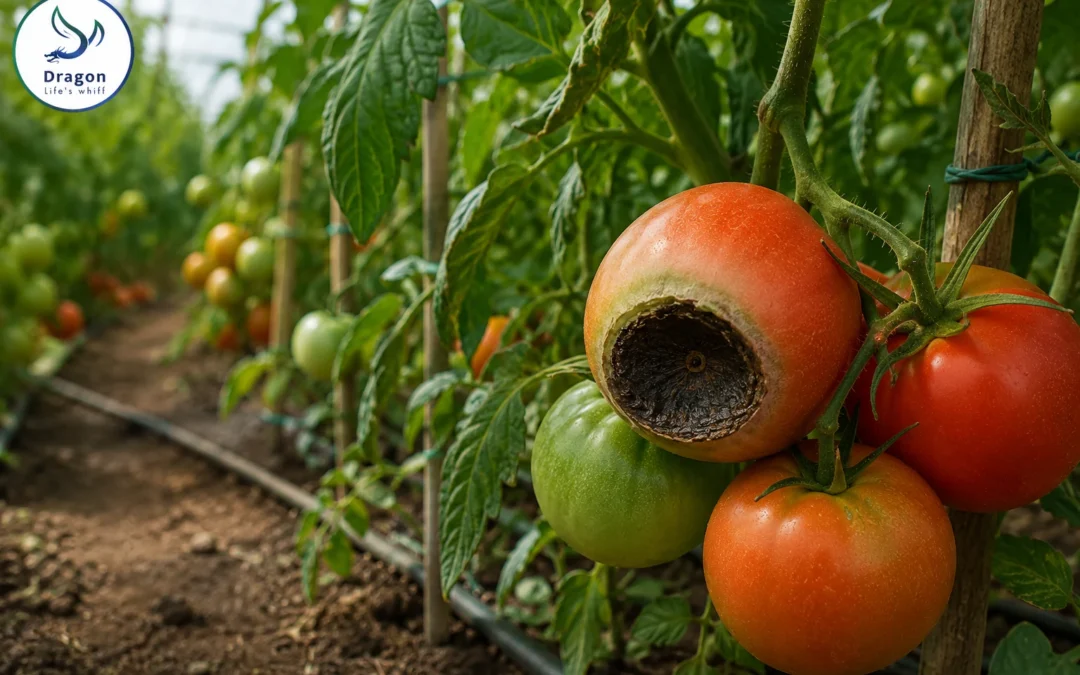
A grower finds sunken black patches on the underside of the fruit, looks it up, reads that it is a calcium deficiency, and applies calcium. The next picking looks the same.
That sequence repeats across Indian tomato growing every season, and the reason it fails is that the diagnosis is only half right. Blossom end rot is a calcium problem in the fruit. It is usually not a calcium shortage in the soil.
India grows tomato at scale across Maharashtra, Karnataka, Andhra Pradesh, Madhya Pradesh and Odisha, in open field and increasingly under cover. The crop is high input, high risk and priced brutally at the mandi, so the difference between marketable and rejected fruit is the whole margin.
Why calcium does not reach the fruit
Calcium moves through the plant in the transpiration stream, pulled along by water evaporating from leaves. It does not move again once deposited. There is no redistribution from an old leaf to a young fruit the way there is with nitrogen or potassium.
That creates a delivery problem with three common causes.
Fruit transpires very little compared with leaves. Water and the calcium in it preferentially go to foliage, and the fruit gets what is left. A vigorous leafy plant is a worse calcium distributor than a balanced one.
Irregular watering interrupts the stream. A dry spell followed by heavy irrigation produces a burst of growth that outruns calcium supply, which is why blossom end rot often appears after exactly that pattern.
Competing cations block uptake at the root. High ammonium nitrogen, high potassium and high magnesium all compete with calcium for the same uptake pathway. A grower pushing potassium hard for fruit size can suppress the calcium uptake that fruit also needs.
So the fix is not more calcium. It is steadier water, restrained nitrogen, and calcium supplied continuously in a form the plant can take up at the moment cells are dividing.
Dragon PureCal supplies calcium through that window. Dragon Calibo and Dragon BorCal pair calcium with boron, which matters because boron builds the cell wall structure calcium is deposited into. Dragon NPK+CaO carries calcium in the base feed rather than as a separate pass, which suits a crop that needs it continuously rather than occasionally.
Timing is the part growers most often get wrong. Calcium has to be present while cells are dividing, in the first two or three weeks after fruit set. Applying it once symptoms appear treats fruit whose cell walls were built weeks earlier.
The nitrogen trap
Tomato responds visibly to nitrogen. The plant darkens, the canopy fills, and the field looks healthy.
It also gets worse at growing tomatoes. Heavy nitrogen produces vegetative bulk that competes with fruit for water and calcium, delays maturity, softens the fruit and shortens shelf life. On a crop that has to survive transport to a distant mandi, softness is a direct financial loss.
Nitrogen belongs in the establishment and early vegetative phase, where Dragon Triple N and Dragon Paste High Nitrogen do useful work. After first fruit set, the programme should be moving away from it.
The same mistake shows up in onion as thick necks and storage failure and in chilli as poor colour value. It is the most expensive habit in Indian horticulture.
Potassium builds what the buyer sees
Fruit size, firmness, sugar and colour development all run on potassium, and demand rises steeply once fruit is setting.
Dragon Paste High Potassium and Dragon Fert High Potassium carry that phase. Dragon PotaMax suits a block where size is the specific constraint.
One caution follows from the section above. Pushing potassium extremely hard suppresses calcium uptake, so a programme built to maximise fruit size can create the blossom end rot the grower is simultaneously trying to fix. Potassium and calcium have to be balanced rather than maximised independently.
The potassium source matters too. Muriate of potash is potassium chloride, and tomato is among the crops that respond poorly to chloride accumulation in a small wetted zone under drip. The Dragon Ferti range is free of chloride, sodium and heavy metals, which removes that variable.
Fruit cracking is a water problem with a nutritional component
Radial and concentric cracking costs Indian tomato growers a large share of marketable fruit, particularly where irrigation is irregular and temperatures swing.
The primary driver is a sudden influx of water into fruit whose skin has already stopped expanding. Steady irrigation is the main control. But skin elasticity and strength are built by calcium and boron, so a crop adequately supplied with both cracks less at the same water stress than one that is not.
That is worth stating carefully to a grower. Nutrition reduces cracking. It does not eliminate it, and no product substitutes for irrigation scheduling.
Micronutrients and the alkaline soil problem
Much of India’s tomato ground runs alkaline, and the national survey data on zinc and boron shows how widely those two read below threshold.
Zinc shortage shows as small leaves and short internodes early. Boron shortage shows later, as poor set, corky tissue and cracking. Dragon Zinc corrects a confirmed deficiency, and Dragon Mix Plus covers the group where several read low.
On high pH soils, foliar application is generally more reliable than soil application because it bypasses soil chemistry entirely. Where the irrigation water is also alkaline, correcting the water is the more durable fix.
Under cover, the same crop behaves differently
Polyhouse tomato in India runs far longer and yields far more, and blossom end rot is more common rather than less.
The reason is humidity. Under cover, transpiration slows, and calcium delivery slows with it even where soil calcium is ample. Venting and humidity management do as much for calcium distribution as any product. The polyhouse nutrition guide covers the wider set of differences.
Conclusion
Blossom end rot in tomato is a transport failure, not usually a supply failure. Steady irrigation, restrained nitrogen, balanced potassium and continuous calcium during the weeks after fruit set will do more than any rescue application after symptoms appear. For specifications, registration support or distribution enquiries, see the Dragon Ferti range, read grower reports on the testimonials page, or contact the export team through the contact page.
Frequently asked questions
What causes blossom end rot in tomato?
Calcium failing to reach the developing fruit, which is usually a delivery problem rather than a soil shortage. Fruit transpires little compared with leaves, irregular watering interrupts the flow, and high ammonium, potassium or magnesium compete with calcium at the root. Soil calcium is often adequate throughout.
When should calcium be applied to tomato?
During cell division, in roughly the first two to three weeks after fruit set. Calcium is fixed permanently where it is deposited and does not move again, so applications made after symptoms are visible cannot repair fruit whose cell walls were already formed.
Does too much potassium cause blossom end rot?
It can contribute. Potassium competes with calcium for uptake, so a programme pushing potassium hard for fruit size can suppress calcium uptake at the same time. The two need balancing rather than maximising separately.
How do I stop tomato fruit from cracking?
Consistent irrigation is the main control, since cracking is driven by sudden water influx into fruit whose skin has stopped expanding. Adequate calcium and boron improve skin strength and elasticity, so a well-supplied crop cracks less under the same stress, but nutrition supplements irrigation scheduling rather than replacing it.
Is Dragon Ferti available in India?
Dragon Ferti exports to more than 50 countries and works with importers and distributors across Asia, Africa and the Middle East. Paste ships in 5, 10 and 20 kilogram formats, soluble powder in 10 and 25 kilogram sacks, and liquid in 1, 5 and 20 litre containers. Registration and distribution status for India is best confirmed with the export team.