
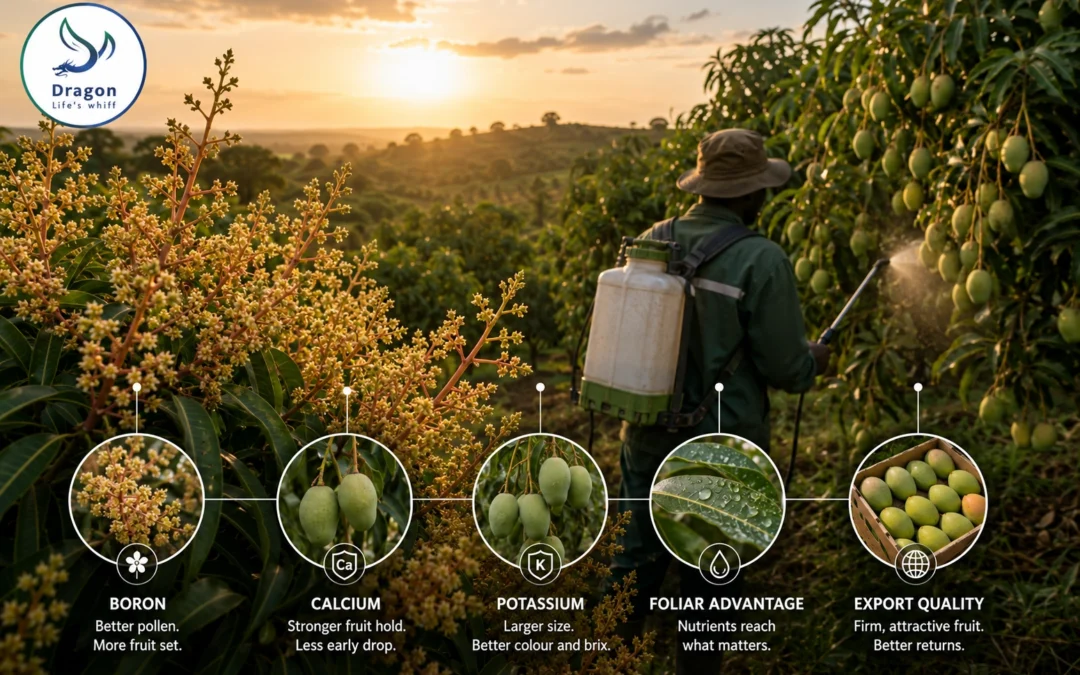
Stand under a mango tree in the Ghanaian transition zone at flowering and it is covered in panicles carrying hundreds of flowers each. A mature tree flowers by the thousand and might carry a few hundred fruit to harvest.
That conversion rate decides a grower’s income, and it responds to nutrition. Not to more fertilizer, which is the usual assumption, but to a few specific nutrients over a few weeks.
Boron is the cheapest yield you will buy
Boron governs pollen viability and fruit retention. Where it is short, pollen does not perform, flowers abort, and fruitlets drop in the weeks after set. The tree looks healthy throughout, so the problem gets blamed on weather or variety.
The correction is cheap against what it protects. Dragon BorCal delivers boron with calcium as a foliar spray at panicle emergence and again during flowering. Boron leaches, so a soil adequate two seasons ago may not be now.
Timing is everything. Boron applied after flowering does nothing for a crop that has already failed to set.
Calcium during early fruit development
Once fruit sets, the next loss point is early fruit drop, and calcium is central to holding what you have. Calcium builds the cell structure that keeps a young fruit attached and developing rather than abscising.
Dragon PhoCal supplies phosphorus with calcium, which suits the period just after set when both are in demand. Dragon Calibo continues the calcium and boron supply through development.
Calcium keeps working long after set. It is what gives a Keitt or Kent the firmness to reach a European buyer in sellable condition, and firmness is graded.
Potassium for what the buyer sees
Size, sugar and skin finish all track potassium through fruit development. European buyers grade on appearance and eating quality, and the difference between a first-grade mango and a second-grade one is often the potassium the tree had available while the fruit was filling.
Dragon Paste High-PK covers this phase. Dragon Spark supports development through the stages where the tree is carrying a heavy load.
Foliar is the practical route
A lot of Ghanaian mango sits on smallholder and medium-scale farms without irrigation infrastructure, which rules out fertigation for much of the sector.
That is less of a limitation than it sounds, because the nutrients that matter most for fruit set are exactly the ones that work well through the leaf. Boron and calcium applied as a spray at flowering reach the tissue that needs them without any irrigation system at all.
Mango leaves are waxy and shed water-based sprays readily. Dragon Stick improves how much of the application stays on the leaf and gets absorbed, which changes the return on every spray you make.
Anthracnose and what nutrition can honestly do
Anthracnose is a serious problem in humid Ghanaian conditions, showing up as black lesions on fruit and causing losses after harvest as well as in the field.
Good calcium and potassium nutrition supports tissue integrity, and firmer tissue is somewhat less vulnerable. That is a real effect and worth having. It is not disease control. Nutrition does not replace a fungicide programme or good orchard hygiene, and any supplier suggesting otherwise is selling you something that will not work.
Treat nutrition as one part of managing anthracnose pressure, alongside the practices your extension officer or agronomist recommends.
The on and off year problem
Mango tends toward alternate bearing, a heavy crop followed by a light one. The mechanism is reserve depletion: a big year strips stored carbohydrates and nutrients, leaving too little for next season’s flowering. Post-harvest feeding smooths that curve. We covered the pattern in depth for avocado in Mexico, and it transfers directly.
Organic and dried fruit
Solar-drying processors supplying European health food retailers actively seek organic-certified mango, and it is a genuine premium channel for Ghanaian growers. The programme above adapts without redesign, using organic-compatible BorCal and Stick from the Dragon Organic line.
Conclusion
Mango rewards precise feeding at two moments rather than heavy feeding. Boron before and during flowering decides how many fruit set. Calcium and potassium through development decide what they are worth and whether they arrive in condition. To build a programme for an orchard or grower group, see the Dragon Ferti range or contact the team through the contact page.
Frequently asked questions
Why does my mango tree flower heavily but produce few fruit?
Mango naturally sets only a small share of its flowers, but boron shortage makes the conversion much worse by reducing pollen viability and increasing early fruitlet drop. A foliar boron and calcium application at panicle emergence and again during flowering is the most reliable correction. Applied after flowering ends, it is too late to help that crop.
What causes young mango fruit to drop?
Some drop is normal as the tree sheds what it cannot carry. Excessive drop usually points to calcium shortage during early fruit development, sometimes combined with water stress. Calcium builds the cell structure that holds a developing fruit on the tree, and it needs to be supplied continuously through that period rather than in one application.
Can fertilizer control anthracnose?
No. Good calcium and potassium nutrition supports firmer tissue that is somewhat less vulnerable, which is worth having, but it is not disease control and does not replace a fungicide programme or orchard hygiene. Treat nutrition as one contributing factor in managing anthracnose rather than a solution to it.
Is foliar feeding enough without irrigation?
For the nutrients that decide fruit set, largely yes. Boron and calcium work well applied through the leaf, and flowering is exactly when they are needed, so a spray programme reaches the critical window without any irrigation system. Fertigation gets more out of a season overall, but the highest-return applications on mango do not depend on it.