
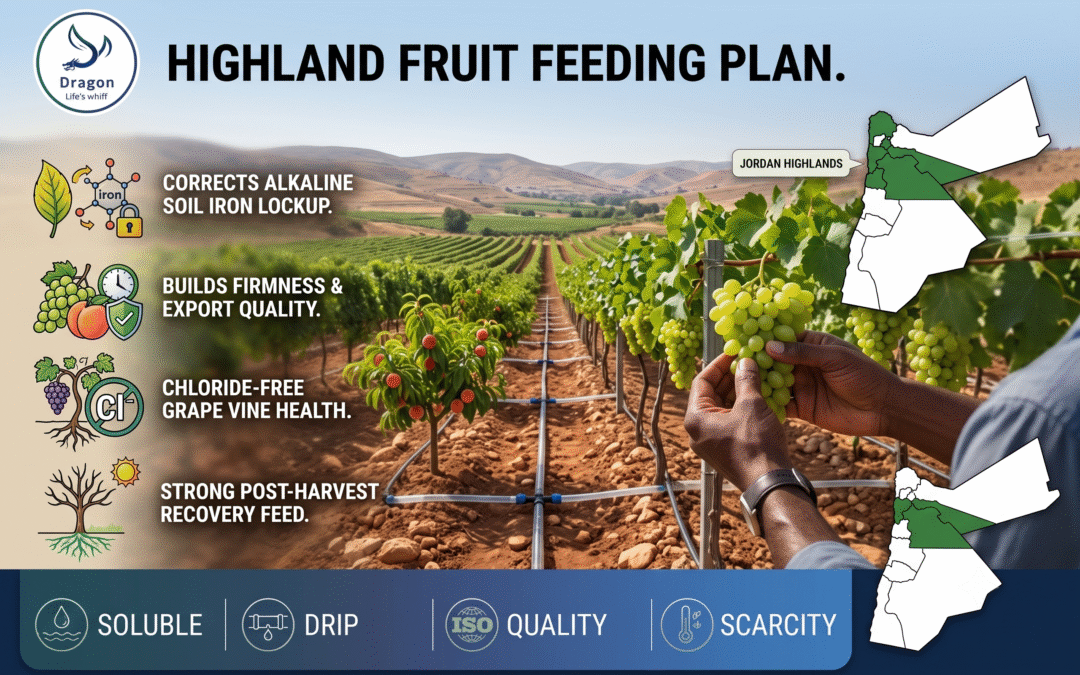
Jordan’s farming is not all in the warm Jordan Valley. Up on the highlands around Amman, Madaba, Al-Salt, and the northern governorates, the cooler climate and higher elevation suit a different set of crops: stone fruit like peach, apricot, plum, and almond, alongside table grapes and figs. These are the fruits Jordanians grow for the domestic table and for Gulf export, and they ask for a nutrition program quite different from the vegetables of the Ghor.
Because Dragon Ferti is made in Jordan, a highland grower gets the whole specialty range locally, without the import lead times that slow down every purchase from abroad. Here is how to feed these crops across a season.
Why highland fruit is its own problem
Stone fruit and grapes are deciduous. They go dormant in winter, wake in spring, and pack their entire productive cycle into a few intense months. That compressed schedule means nutrition timing is unforgiving: miss the window for a nutrient and the tree has moved on. The highland soils add their own wrinkle, often calcareous and alkaline, which locks up iron and zinc and shows as yellowing leaves in spring.
Water is the other constant. Jordan is among the most water-scarce countries anywhere, so highland orchards run on drip, and every nutrient goes in through the line. That makes fully soluble fertilizer not a preference but a requirement.
A season-long plan
Walk the year in five moves:
- Dormancy to bud break (late winter). Feed the root system before the canopy wakes. A phosphorus-forward start with Dragon Fert High Phosphorus and a root push from Dragon Rooty sets up strong spring growth.
- Bud break to flowering (spring). Nitrogen builds the canopy, but boron and calcium decide the fruit set. Pair Dragon Triple N for vegetative drive with Dragon BorCal for set. This is also when spring iron chlorosis appears on alkaline highland soils, corrected with Dragon Iron.
- Fruit set to development. Shift toward balanced feeding and keep calcium flowing for firmness. Dragon Fert Balanced carries this phase.
- Fruit fill and ripening. Potassium takes over for size, sugar, and colour, with calcium still running for firmness and shelf life. Dragon Fert High Potassium is the workhorse here.
- Post-harvest. Feed the tree to rebuild reserves for next year before the leaves drop, so dormancy starts from strength rather than exhaustion.
Calcium is what travels
Whether a Jordanian peach or bunch of grapes is sold in an Amman market or shipped to the Gulf, firmness on arrival is what protects its value. Firmness is calcium loaded into the fruit during development. Steady calcium through fertigation, rather than one heavy dose, is what builds it. Highland growers who chase size with potassium but neglect calcium end up with big fruit that bruises, which is a poor trade.
Table grapes carry an extra sensitivity: they take up chloride easily, and cheap potassium chloride fertilizers leave a mark on both vine and fruit over the years. Every Dragon Ferti product is chloride-free, which protects grape quality over the life of a vineyard.
The local advantage, again
It is worth repeating because it genuinely matters for a highland grower. Buying locally made fertilizer means no waiting on a shipment, no customs delay during a tight spraying window, and technical support from a team that knows Jordanian conditions and the company’s ISO-certified quality standards firsthand. For the vegetable side of Jordanian farming, the Jordan Valley feeding guide covers the Ghor.
Conclusion
Highland stone fruit and grapes reward a grower who feeds them on the crop’s schedule, not the calendar’s: roots before bud break, boron and calcium at set, iron for spring chlorosis, potassium and steady calcium through fill, and a post-harvest recovery feed. Dragon Ferti supplies the whole program locally, chloride-free, and fully soluble for drip. Browse the product range or reach the team through the contact page to build a plan for your orchard or vineyard.
Frequently asked questions
Why do highland fruit trees show yellow leaves in spring?
That is usually iron chlorosis, caused by alkaline highland soils locking up iron so roots cannot absorb it. The yellowing shows between the veins of young leaves. Chelated iron like Dragon Iron stays available even on high-pH soil and corrects it, applied through fertigation as growth resumes in spring.
When should I apply calcium to stone fruit and grapes?
Steadily, through the whole fruit-development period, not in a single dose. Calcium builds fruit firmness and shelf life, and it moves into the fruit only during active growth. A little and often through fertigation outperforms occasional heavy applications, and it is what lets fruit travel to market without bruising.
Why does buying fertilizer locally matter for a Jordanian grower?
Deciduous fruit has tight nutrition windows, and a delayed import shipment can cause a missed application. Dragon Ferti is made in Jordan, so highland growers get dependable local supply, no customs delays, and technical support from a team that knows the conditions, all backed by ISO-certified quality systems.
Are Dragon Ferti products suitable for table grapes?
Yes, and the chloride-free formulation is a particular advantage. Grapes take up chloride readily, and cheap potassium chloride fertilizers degrade vine and fruit quality over the years. Dragon Ferti products carry no chloride or sodium, protecting grape quality over the productive life of a vineyard.