
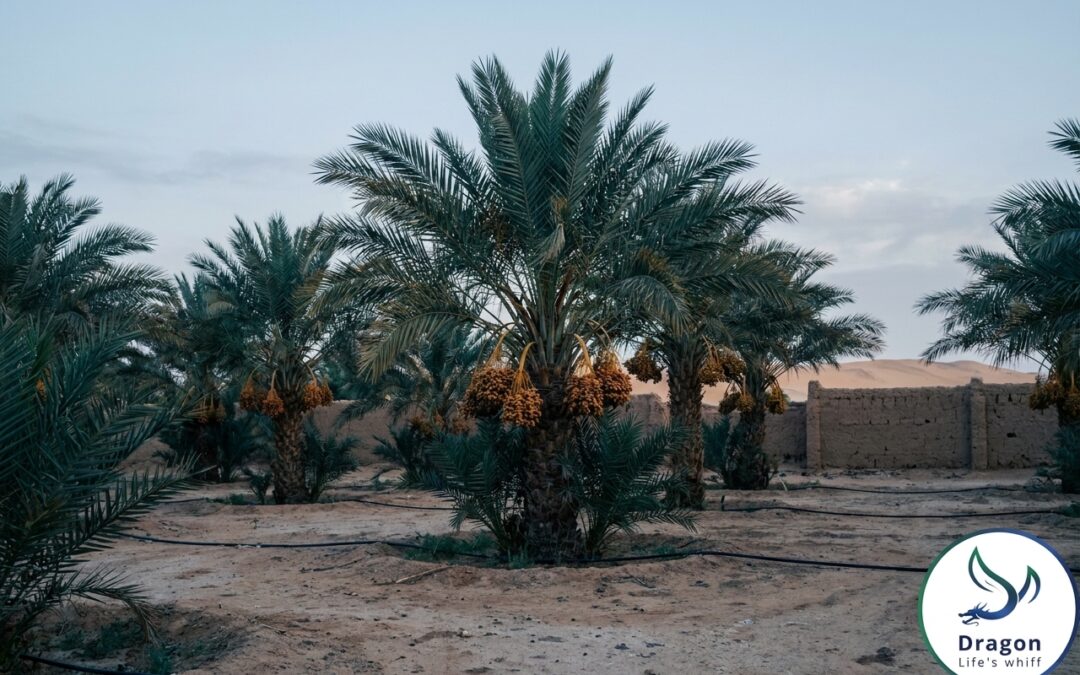
Egypt produces about 1.7 million tons of dates every year – close to one in every five dates eaten anywhere in the world. The orchards stretch from the Nile Delta down through Aswan, out into the New Valley, and across Siwa Oasis. Most of them are productive. Many of them could produce far more.
The agronomic ceiling on Egyptian date palm yield isn’t variety or climate. Both are excellent. The ceiling is nutrition. Specifically, it’s the way alkaline desert soils interact with conventional NPK fertilization to lock up exactly the nutrients date palms need most.
This article walks through what a serious nutrition program looks like for date palms grown in Egyptian conditions – what to apply, when to apply it, and how Dragon’s water-soluble paste, soluble powder, and chelated micronutrient lines fit a date orchard’s actual demand curve.
What makes date palms different from other tree crops
A mature date palm removes about 1.5 to 2 kg of K₂O per palm per year. That’s a heavy potassium feeder by any measure – higher than citrus, higher than olive, comparable to banana. Nitrogen and phosphorus matter, but potassium is the limiting nutrient in most Egyptian orchards by a wide margin.
The other thing date palms care about: magnesium, and the four key micronutrients – iron, zinc, manganese, boron. All four show up as deficiency symptoms in calcareous Egyptian soils within two or three seasons of inadequate fertilization. Interveinal chlorosis on younger fronds is usually iron. Stunted new spear growth is usually zinc. Reduced pollen viability that turns up as poor fruit set is usually boron.
A program that delivers high potassium, balanced N and P, magnesium, and chelated micronutrients – applied through drip fertigation in the modern orchards or through targeted soil and foliar application in traditional ones – is what gets a Medjool or Barhi orchard to its real yield ceiling.
The seasonal calendar
Date palm nutrition follows the reproductive cycle. The program below assumes a mature producing orchard on calcareous soil, fertigated through drip. Adjust dose rates to your specific soil analysis and palm density.
| Period | Stage | Primary nutrition | Dragon products |
|---|---|---|---|
| Feb – Mar | Pre-bloom flush | Balanced NPK + Fe correction | Dragon Paste Balanced + Dragon Iron 10% |
| Apr – May | Pollination, early fruit set | High-P/K + B + Ca | Dragon Paste High-PK + Dragon BorCal |
| Jun – Aug | Fruit fill (Kimri → Khalal) | High-K + micros | Dragon Paste High Potassium + Dragon Mix Plus |
| Sep – Oct | Late ripening, harvest | Reduced N, sustained K | Dragon Paste High Potassium (reducing rate) |
| Nov – Jan | Post-harvest reserve building | Balanced NPK + biostimulant | Dragon Paste Balanced + Dragon Sea |
The window that pays back fastest is April-May. Boron deficiency at pollination produces what farmers call “shis” – small, malformed, low-grade fruit that’s effectively unsellable for the fresh market. A foliar BorCal application on flowering spadices, combined with a calcium boost through fertigation, prevents most of it.
The alkaline-soil problem
Egyptian date palm zones share a common soil chemistry profile: high calcium carbonate (often 15-30%), pH between 7.8 and 8.5, low organic matter (under 1%), and high bicarbonate in the irrigation water from deep groundwater wells. That combination creates two specific nutritional problems.
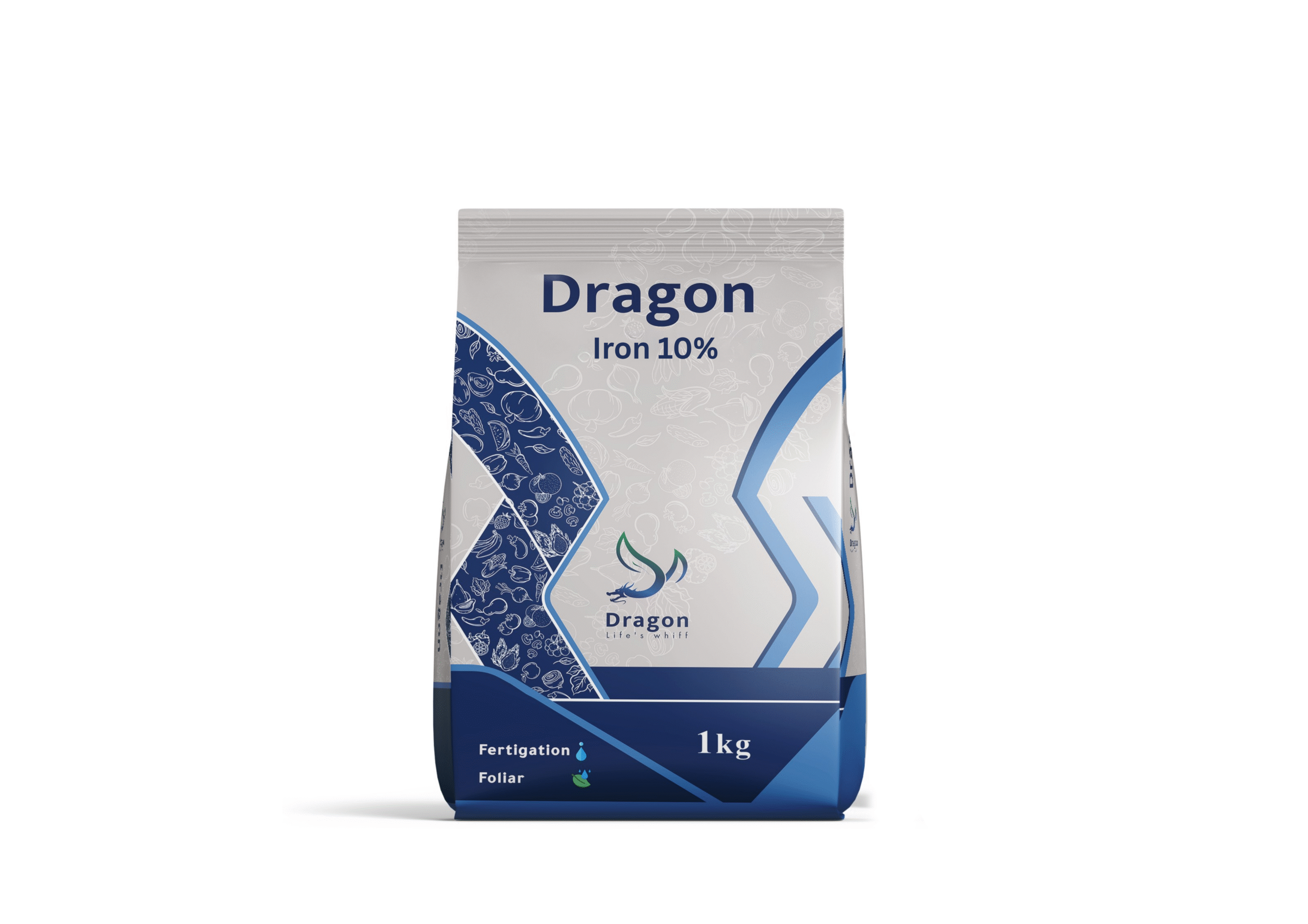
First, iron, zinc, and manganese precipitate into forms roots can’t access. A soil test might show “adequate” iron, but the palm can’t reach it. Chlorotic young fronds tell the real story. The solution is chelated micronutrients applied through fertigation, where the chelate keeps the element in solution all the way to the root.
Second, the irrigation water itself reduces fertilizer efficiency. High-bicarbonate well water raises the pH of the fertigation solution, which precipitates phosphate and calcium inside the irrigation lines. Dragon Paste’s pH 2.5 formulation actively counteracts this, lowering the solution pH on injection and dissolving scale that would otherwise build up at the drip emitters. For orchards using deep groundwater with bicarbonate above 200 ppm, this is the single most useful chemical property Dragon offers.
Micronutrient corrections that actually work
Egyptian date orchards typically need targeted corrections, not blanket multi-micronutrient sprays. Tissue analysis from a single block, taken from recently-mature fronds, costs very little and points to exactly what’s missing.
- Iron chlorosis (yellow young fronds, green veins visible): Dragon Iron 10% chelated, applied via fertigation and as a foliar spray during spring flush.
- Zinc deficiency (short, narrow new fronds, “little leaf” symptom): Dragon Zinc 13%, two foliar applications six weeks apart.
- Manganese deficiency (interveinal yellowing on middle-aged fronds): Dragon Manganese 13%, as needed based on tissue analysis.
- Multiple-element deficiency (mixed symptoms across a block): Dragon Mix Plus – a higher-concentration multi-element blend.
For organic-certified date operations, Dragon Mix (the organic-compatible blend) and Dragon HV15 cover the same elements through humic-acid chelation – slower-acting but compliant with organic certification.
Sourcing for Egyptian importers and orchards
Packaging matters. Dragon Paste ships in 5, 10, and 20 kg formats. Dragon Fert soluble powder comes in 10 and 25 kg. Dragon Liquid is in 1, 5, and 20 L containers. For Egyptian importers serving the New Valley, Aswan, and Beheira agricultural belts, the soluble powder and paste formats are usually the right starting point – they’re concentrated, fertigation-ready, and travel well through Damietta and Alexandria port-warehouse channels.
The ROI case for specialty fertilizers on export-oriented operations applies directly to high-end fresh date production. The premium fresh-date market – Medjool to the Gulf and Europe, Barhi to Southeast Asia – rewards fruit quality far more than yield alone, and fruit quality is downstream of nutrition. For the spray side of any of these programs, see the foliar fertilization guide.
For samples, technical documentation, or distributor inquiries, the export team is reachable at info@dragonagricultural.com, or via the contact page. The full product catalog covers all six lines.
Frequently asked questions
What NPK ratio works best for mature date palms?
There isn’t one ratio for the whole year. A mature producing palm needs balanced N-P-K with potassium leadership through fruit fill, shifting to high-K from May through August. Dragon Paste Balanced (30-30-30+TE) for early spring and post-harvest, Dragon Paste High-PK at flowering, and Dragon Paste High Potassium during fruit fill covers the cycle.
How do I correct iron chlorosis in date palms on alkaline soils?
Chelated iron, not iron sulfate. Iron sulfate precipitates in calcareous soils within days. Dragon Iron 10% is formulated as a stable chelate that stays plant-available even at pH 8+. Apply it through fertigation in the root zone, and add a foliar spray on young fronds during the spring flush for fastest correction.
Can Dragon products be applied through traditional flood irrigation, or only drip?
Drip fertigation is far more efficient, especially for water-soluble specialty fertilizers. In traditional flood-irrigated orchards, Dragon products can still be applied as foliar sprays for micronutrient correction, and as soil-applied dissolved solutions during a flood cycle – but the cost-per-result ratio improves dramatically once an orchard converts to drip.
How often should I apply boron during palm fruit set?
One foliar spray on flowering spadices at the start of pollination, and a second through fertigation about two weeks after pollination completes. Boron deficiency at this stage produces malformed “shis” fruit that’s unsellable in the fresh market. Dragon BorCal delivers both boron and calcium together – the calcium supports cell wall strength as the fruitlets expand.
Does Dragon ship to Egyptian importers, and what packaging is available?
Yes. Dragon exports to 50+ countries including the MENA region. Paste packaging is 5/10/20 kg, soluble powder is 10/25 kg, liquid is 1/5/20 L. Contact the export team via the contact page for pricing, shipping documentation, and distributor partnership inquiries.