
Most fertilizer buying decisions in India are made on the analysis. Two products both say 13-0-45, so the cheaper one wins.
The format is a separate decision, and it usually matters more to whether the season goes well. Format determines how fast the product dissolves, whether it leaves anything behind in the tank, how much a dealer can store, and how much of a container’s volume is spent shipping water.
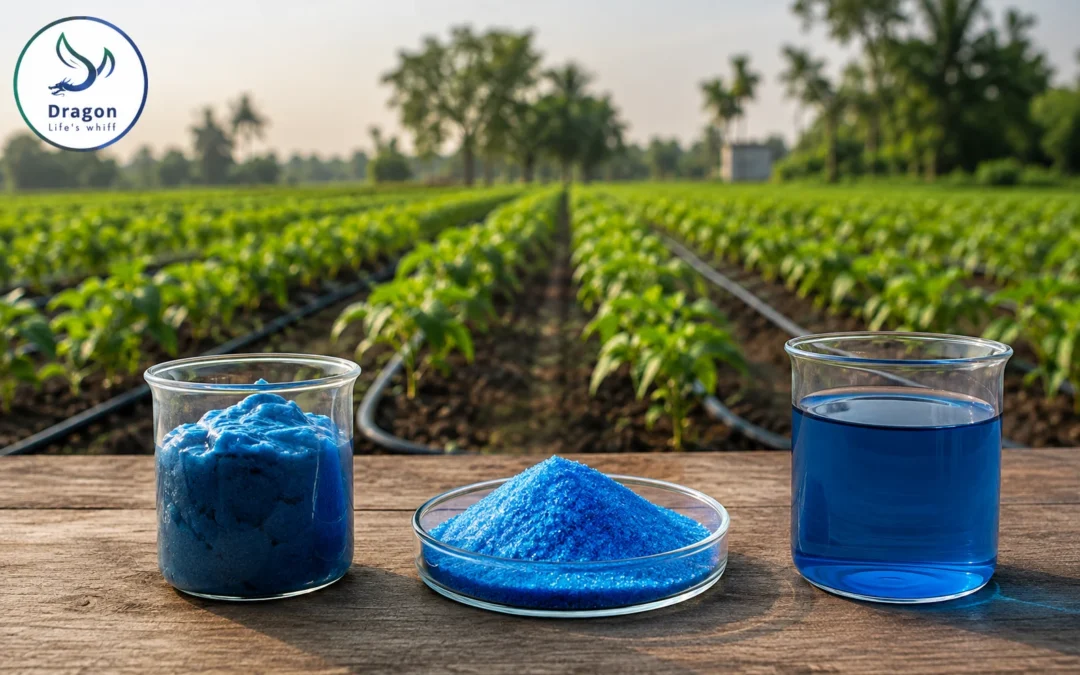
Dragon Ferti manufactures in three: paste, soluble powder and liquid.
Paste
Paste is a fully water-soluble NPK fertilizer supplied in a paste form rather than as a crystal or a solution. It is the format Dragon Ferti was built around, and it is uncommon in the market.
What it does well: it dissolves quickly and completely, without the undissolved residue that blocks emitters. It runs acidic in solution, which pushes back against the high bicarbonate borewell water common across Maharashtra, Gujarat and Rajasthan rather than adding to the problem. It handles cleanly, without the dust of a powder. And because it is not shipped as a dilute solution, freight is spent on nutrient rather than on water.
Where it fits: drip fertigation on high-value crops where emitter blockage is expensive and where the water runs alkaline. That describes most Indian horticulture under drip, including table grapes, banana, pomegranate, tomato and protected cultivation.
The Dragon Paste range covers balanced, high nitrogen, high phosphorus, high potassium and the NPK+CaO grade, which supplies calcium alongside the base feed. Packing runs 5, 10 and 20 kilograms.
Soluble powder
Powder is the format most Indian growers already know, supplied as crystals to be dissolved before use.
What it does well: it is the most concentrated way to move nutrient, since there is no water and no carrier volume. It is the cheapest to freight per unit of nutrient. It stores compactly, which matters to a dealer holding stock across a season. And it works for both fertigation and foliar spraying, which gives a grower without drip a route to the same nutrition.
Where it needs care: dissolution is not automatic. Cold water slows it, hard water can cause precipitation, and mixing several products in the wrong order produces solids in the tank. A high-purity powder dissolves cleanly. A low-grade one is where most emitter blockage originates.
The Dragon Fert soluble powder range is made from high-purity crystal and packed in 10 and 25 kilogram sacks. It is the natural choice for large area crops, for foliar programmes, and for any dealer whose customers are mostly working without drip.
Liquid
Liquid arrives already in solution, ready to inject.
What it does well: nothing to dissolve means nothing to go wrong at mixing, no dust, and no waiting. Dosing is precise and repeatable. For an operation running automated injection, or for specialty products applied in small quantities, that convenience is worth paying for.
Where it costs: a liquid is largely water, and that water is shipped, stored and handled. Over a long supply chain from Jordan to an Indian dealer’s godown, freight per unit of nutrient is materially higher than for paste or powder. Storage volume is higher too, and containers are bulkier to move around a farm.
The Dragon Liquid range is packed in 1, 5 and 20 litre containers, which suits smaller doses and trial quantities as much as routine use.
How to choose
Start with the delivery system. If the farm fertigates through drip, emitter safety is the first filter, and a format that dissolves without residue is worth more than a small price difference. If the farm sprays, powder is usually the practical answer.
Then look at the water. Alkaline borewell water is common across the Indian horticulture belt, and a product that is acidic in solution does part of the correction work for free. That points to paste. Where the water needs treating on its own terms, Dragon Corrector handles it, and the guide to fertigation water quality covers what to test for.
Then look at scale and distance. A large area crop needs the lowest freight per unit of nutrient, which favours powder. A high-value block where a blocked line costs a week of growth favours paste. A precision operation applying small specialty doses favours liquid.
Most working farms end up using more than one, and that is the right answer rather than a compromise. Powder as the volume base, paste where the drip line and the water demand it, liquid for the specialty products applied in small amounts.
What sits outside the format question
Two things are not format decisions and are worth separating out.
Specialty single-nutrient products solve problems no NPK grade addresses. Dragon PureCal and Dragon BorCal for calcium and boron, Dragon Thio for potassium with sulphur, Dragon PotaMax where potassium alone is the constraint.
Micronutrients are their own category. Dragon Zinc, Dragon Iron and Dragon Mix Plus from the minor elements range address deficiencies that a balanced NPK grade will not touch, and India has a lot of them.
For certified production, the Dragon Organic line covers organic-compatible versions of the same nutritional logic, which matters as Indian horticulture moves further into audited export channels.
What this means for a dealer
Format is a stocking decision before it is an agronomic one.
Powder gives the most nutrient per rupee of shelf space and serves the widest customer base. Paste is the differentiator: it solves the emitter and alkaline water problems that cause most complaints, and few competitors in the Indian market carry a true paste line. Liquid rounds out the range for precision users and makes trial quantities easy to place.
The commercial point is that a dealer carrying all three can serve a two-acre grape block and a large banana estate from the same relationship, rather than choosing which one to be. The case for stocking water-soluble fertilizer in India sets out how that argument goes with a price-sensitive farmer.
Dragon Ferti supplies importers with Certificates of Analysis, Technical Data Sheets, Safety Data Sheets, full composition labels and Free Sale Certificates, and manufactures under ISO 9001, ISO 14001 and ISO 45001 certified management systems. The import and registration process covers what to plan for.
Conclusion
The analysis tells you what nutrients are in the sack. The format decides whether they arrive intact, what the freight costs, and whether the drip line survives the season. Paste for emitter safety and alkaline water, powder for volume and foliar work, liquid for precision and small doses. For specifications, registration support or distribution enquiries, see the Dragon Ferti range, read grower reports on the testimonials page, or contact the export team through the contact page.
Frequently asked questions
What is paste fertilizer?
A fully water-soluble NPK fertilizer supplied in paste form rather than as crystals or a ready-made solution. It dissolves quickly and completely, handles without dust, and because it is not diluted with water it carries more nutrient per kilogram of freight than a liquid.
Which format is best for drip irrigation?
Paste or a high-purity soluble powder. The requirement is complete dissolution without residue, since undissolved matter blocks emitters and is difficult to clear under a standing crop. Solution pH also matters where borewell water is alkaline, which favours a product that is acidic in solution.
Is liquid fertilizer more expensive than powder?
Per unit of nutrient delivered, usually yes over a long supply chain, because a liquid is largely water and that water is shipped, stored and handled. Liquid earns its place through convenience, precise dosing and suitability for small specialty applications rather than through cost per nutrient.
Can soluble powder be used as a foliar spray?
Yes, and it is the usual choice for foliar work. That makes powder the practical route for farms without drip, and foliar application has a further advantage on alkaline soils because it bypasses root zone chemistry entirely.
Should a dealer stock more than one format?
Generally yes. Powder covers volume crops and foliar users, paste serves drip-irrigated high-value blocks and alkaline water conditions, and liquid suits precision applications and trial quantities. Carrying all three lets one dealer serve smallholders and large estates without choosing between them.