
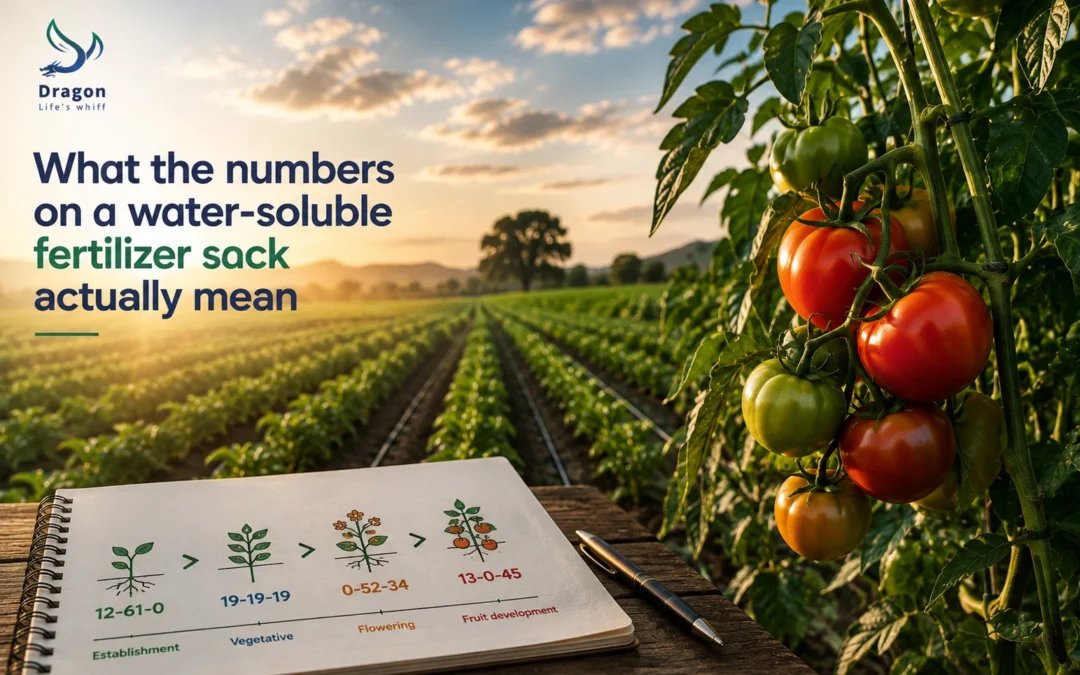
The three numbers on a fertilizer label are the percentage by weight of nitrogen, phosphorus as P2O5, and potassium as K2O. A 25 kilogram sack of 19-19-19 holds 4.75 kg of each. That much most growers know.
What decides the result is not the analysis. It is whether that analysis matches what the crop is doing in the week you apply it. The same grade that produces a strong vegetative frame in June will cost you fruit quality in September.
India has a large and growing water-soluble market, and the Fertiliser (Control) Order has progressively notified more grades as the segment has expanded. That means a dealer’s shelf now carries a dozen ratios that look interchangeable and are not.
What each common grade is for
| Grade | Ratio character | Where it belongs |
|---|---|---|
| 19-19-19 | Balanced | General purpose feed, early to mid season, when nothing in particular is limiting |
| 30-30-30 | Balanced, high concentration | Same balance at higher nutrient density, so less product moves per acre and freight cost per unit of nutrient falls |
| 12-61-0 | Phosphorus dominant | Root establishment after transplant, and again ahead of flowering |
| 13-40-13 | Phosphorus dominant with support | Early growth where some nitrogen and potassium are still needed alongside root development |
| 0-52-34 | Phosphorus and potassium, no nitrogen | The transition out of vegetative growth into flowering, when adding nitrogen would delay the crop |
| 13-0-45 | Potassium dominant, no phosphorus | Fruit fill, sizing, sugar accumulation and colour development |
| 0-0-50 | Potassium and sulphur only | Late fruit fill and quality building, particularly where sulphur is also wanted |
| 12-12-36 | Potassium weighted, balanced base | Fruit development where the crop still needs some nitrogen for canopy maintenance |
Read that table as a season rather than a menu. Phosphorus early, balance through the middle, potassium at the end, and the switch out of nitrogen happening earlier than most growers are comfortable with.
The mistake that costs the most money
Nitrogen applied late.
It is the single most common error across Indian horticulture, and it looks like the opposite of a mistake while it is happening. The crop goes dark green, the canopy thickens, and the field looks better than the neighbour’s.
Then the bill arrives. Late nitrogen delays maturity, softens fruit, thickens onion necks so they cure badly, keeps chilli vegetative when it should be building colour, and pushes grape harvest into a window where the berry will not survive a long shipment. In each case the loss appears weeks or months after the decision, which is exactly why the habit persists.
The counter is structural rather than persuasive. Move to a grade with little or no nitrogen at the point the crop shifts from building frame to building yield. That is what 0-52-34 and 13-0-45 exist for.
Why the same analysis is not the same product
Two sacks marked 19-19-19 can behave very differently in the tank and in the soil.
Solubility and residue. A grade made from lower-purity raw material leaves undissolved matter that blocks emitters. On a standing crop under drip, that is expensive to fix.
Chloride, sodium and heavy metal content. The analysis on the front of the sack does not list what else is in it. Muriate of potash is the cheapest potassium source and roughly half of it by weight is chloride, which accumulates in the small wetted zone under drip. Chloride-sensitive crops including grape, potato, onion, tomato and citrus pay for that slowly.
Solution pH. A fertilizer that runs acidic in solution pushes against the alkaline borewell water common across Maharashtra, Gujarat and Rajasthan. One that runs neutral or alkaline does not.
The Dragon Paste and Dragon Fert soluble powder lines are formulated free of chloride, sodium and heavy metals, and the paste line runs acidic in solution. That is the difference between two products carrying the same three numbers.
Matching the grade to the crop
The stage logic is general. The weighting is crop specific.
Banana removes more potassium than almost anything else grown in India, and the demand peaks around shooting and bunch fill, so potassium-dominant grades carry the second half of the cycle. Table grapes need potassium for berry size and sugar but punish late nitrogen harder than most crops because the fruit has to survive a sea voyage. Chilli builds its colour value during ripening, which is potassium-dependent and happens after most programmes have already tapered off. Onion wants potassium with sulphur, since sulphur builds the pungency that tracks storage life.
Where a single nutrient is the constraint rather than the ratio, the specialty range is more precise than any NPK grade. Dragon PotaMax and Dragon Fruity push potassium alone. Dragon Thio supplies potassium with sulphur. Dragon PureCal and Dragon BorCal handle calcium and boron, which no NPK grade covers.
Micronutrients sit outside the NPK question entirely. A grade marked “+ TE” carries trace elements, but a confirmed deficiency needs a targeted product such as Dragon Zinc or the broader Dragon Mix Plus.
Concentration is a freight decision
Higher-analysis grades matter more in India than in shorter supply chains.
A balanced grade at 30-30-30 delivers substantially more nutrient per kilogram than one at 19-19-19. For an importer moving containers from origin to port to warehouse to dealer to farm, that difference shows up in freight, in storage space, and in how many sacks a dealer has to handle to serve the same acreage.
It also shows up on the farm. Fewer kilograms mixed per tank means less handling, and a concentrated product that dissolves cleanly is faster to work with than a bulkier one that does not.
Conclusion
The three numbers tell you the ratio, not the outcome. The outcome depends on applying the right ratio at the right stage, on what the product carries besides the nutrients, and on whether it dissolves cleanly enough to reach the root. Phosphorus early, balance through the middle, potassium at the end, and nitrogen stopped sooner than instinct suggests. For specifications, registration support or distribution enquiries, see the Dragon Ferti range, read grower reports on the testimonials page, or contact the export team through the contact page.
Frequently asked questions
What does 19-19-19 mean on a fertilizer label?
It means the product is 19 per cent nitrogen, 19 per cent phosphorus expressed as P2O5, and 19 per cent potassium expressed as K2O, by weight. A 25 kilogram sack therefore contains 4.75 kilograms of each. The remainder is carrier and any accompanying elements.
What is the difference between 19-19-19 and 30-30-30?
Both are balanced, but 30-30-30 is more concentrated, so a kilogram delivers considerably more nutrient. The practical differences are freight and handling cost per unit of nutrient, and how much product has to be mixed to feed the same area.
When should I switch to a high-potassium grade?
At the point the crop moves from building vegetative frame to building yield, which for most fruiting crops is around fruit set. Grades such as 0-52-34 through the transition and 13-0-45 through fill exist for this, and their low or zero nitrogen is the feature rather than a limitation.
Do two fertilizers with the same NPK numbers perform the same?
Not necessarily. The analysis does not disclose solubility, residue, solution pH, or chloride, sodium and heavy metal content. Those determine whether the product blocks emitters, whether it fights or worsens alkaline irrigation water, and whether it accumulates salt in the root zone over successive seasons.
Which grades are approved for sale in India?
Water-soluble fertilizer grades are notified under the Fertiliser (Control) Order 1985 and the list has expanded as the segment has grown. Because amendments are issued periodically, verify the current schedule rather than relying on an older list, and confirm the status of any specific product with the supplier.