
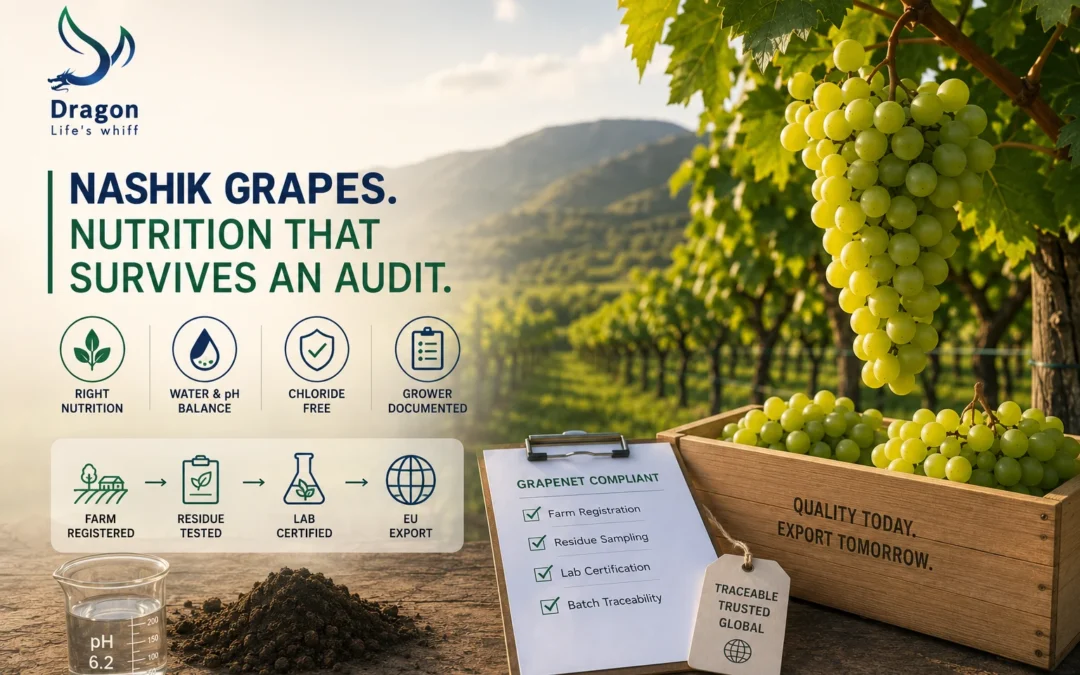
Nashik accounts for the large majority of India’s table grape exports, and the season is short. Shipping runs from late December into April, with the best fruit moving in February and March.
What makes grape different from every other crop a distributor stocks is that the nutrition programme is no longer a private decision. Since GrapeNet, every consignment going to the European Union is traced from the plot to the shelf, with farm registration, residue sampling and lab certification along the way. APEDA built that system after Indian grapes came close to being shut out of Europe over residues.
So a grower is not just buying a fertilizer. They are adding something to a file that gets inspected.
What the ground gives you and what it takes back
Nashik vineyards sit largely on shallow black basaltic soils with free lime and a high pH. That combination does two things at once.
It locks up iron, zinc and manganese, which is why chlorosis is a routine sight in the region rather than an unusual one. The national survey data on zinc and boron in Indian soils puts numbers on how widespread that chemistry is across Maharashtra.
It also means bicarbonate in the irrigation water compounds the problem rather than diluting it. Where borewell water carries bicarbonate above about 3 meq/L, root zone pH climbs regardless of what the soil report said in May.
Acidifying the irrigation stream matters more here than in most Indian growing regions. The Dragon Paste line runs acidic in solution, which works against alkaline water rather than adding to the problem. Where the water needs correcting directly, Dragon Corrector is built for it.
Chloride is the wrong salt for this crop
Grapes are chloride sensitive. That is not a marketing distinction, it is a physiological one.
Under drip, the wetted volume is small and salts concentrate at its edge. Muriate of potash is the cheapest potassium in the market and it is potassium chloride, so a vineyard fertigating MOP season after season is building chloride in the exact zone the roots occupy. The decline that follows is gradual. It shows up as reduced vigour and smaller berries somewhere around the third or fourth year, and it usually gets blamed on the season, the rootstock or the pruning.
The same problem appears on onion in the same district and on banana in Jalgaon, where the crop is perennial and the chloride accumulates across ratoons.
Every product in the Dragon range is free of chloride, sodium and heavy metals. On a crop grown for a European buyer, on soil that already holds salt, that is the specification that matters most.
Potassium is what the buyer pays for
Berry size, sugar accumulation and colour development in the black varieties all run on potassium, and demand peaks after fruit set rather than before it.
Dragon Paste High Potassium and Dragon Fert High Potassium cover the fruit development window. Dragon PotaMax and Dragon Fruity push it harder where berry size is the constraint and the block is already adequate on nitrogen.
Adding nitrogen at this stage is the common mistake. Late nitrogen produces vegetative growth, delays maturity and softens the berry, which is the opposite of what a 25-day sea shipment needs.
Calcium decides whether it arrives
Thompson Seedless holds its condition on a long sea voyage because the berry is firm and the skin is intact. Both are calcium jobs.
Calcium moves in the transpiration stream and is not redistributed once deposited, so it has to be present during cell division, in the weeks right after fruit set. Applying calcium near harvest does very little, though it is frequently attempted.
Dragon PureCal and Dragon Calibo cover this window, and Dragon NPK+CaO delivers calcium alongside the base programme rather than as a separate pass.
Boron belongs earlier still. It is required for pollen tube growth before flowering, so applying it at flowering is late. Dragon BorCal handles boron and calcium together at the pre-flowering stage, which suits the double pruning cycle Nashik works to. The same timing decides fruit set on pomegranate, the other high-value crop across this belt.
Micronutrients are not optional here
The free lime that defines these soils is also what makes iron and zinc unavailable. Dragon Iron and Dragon Zinc address the two that show most often, and Dragon Mix covers the group in one application where the soil test flags several at once. Dragon Mix is organic-compatible, which matters on blocks working toward certified export.
Foliar application is worth understanding properly on this crop. It bypasses soil chemistry entirely, which is exactly what you want above pH 8. It also puts material on the fruit surface, which brings it into scope for residue testing. Nutrient products are not agrochemicals and are treated differently, but a grower under GrapeNet documentation should know what went on the vine and when regardless.
What a Nashik dealer is actually selling
The grower’s economics are not about tonnes. A block that grades up for export earns several times what the same fruit earns on the domestic market, so the export fraction is where the money sits, and the export fraction responds to nutrition rather than to yield chasing.
That gives a dealer a technical sale rather than a price argument. Explaining why late nitrogen costs a grower shelf life, or why calcium after véraison is too late to help, is a conversation that ends with a farmer coming back next season. The wider case for stocking water-soluble fertilizer in India covers how that plays out across a territory.
Dragon Ferti supplies the documentation importers and growers need: Certificate of Analysis, Technical Data Sheet, Safety Data Sheet, labels with full composition and Free Sale Certificates. Manufacturing runs under ISO 9001, ISO 14001 and ISO 45001 certified management systems. For importers, the registration and documentation process sets out what to plan for, and product-specific registration status is a question for the export team.
Conclusion
Grape nutrition in Nashik is decided by three things the soil test will not tell you: the chloride you are adding, the calcium you applied too late, and the pH of the water carrying it all. Fix those and the export fraction moves. For specifications, registration support or distribution enquiries, see the Dragon Ferti range, read grower reports on the testimonials page, or contact the export team through the contact page.
Frequently asked questions
Why avoid muriate of potash on grapes?
Because muriate of potash is potassium chloride and grapes are chloride sensitive. Under drip the wetted zone is small, so chloride concentrates where the roots are and accumulates across seasons. The resulting decline in vigour and berry size usually appears in year three or four and gets attributed to something else.
When should calcium be applied to table grapes?
During cell division, in the weeks after fruit set. Calcium travels in the transpiration stream and does not move again once deposited, so applications close to harvest have limited effect on berry firmness or shelf life even though they are commonly attempted.
Does fertilizer choice affect GrapeNet compliance?
GrapeNet monitors agrochemical residues rather than plant nutrients, so nutritional products are handled differently from pesticides. That said, a grower operating under farm registration and residue sampling should be able to document everything applied to the vine, which is a reason to buy from a supplier who provides full composition labels and certificates of analysis.
Will these products work with the water quality in Nashik?
The paste line runs acidic in solution, which helps against the high bicarbonate common in the region’s borewell water rather than adding to it. Where the water itself needs correcting, a dedicated soil and water corrector is the better route. Confirm tank compatibility before combining products in one injection.