
Walk into a fertilizer warehouse in most growing regions and you’ll see the same stacks: 50-kilo bags of NPK 15-15-15, 17-17-17, 20-10-10. Commodity granular product, priced by the ton, sold by the truckload. It works. It’s worked for decades. And for an export-oriented farm chasing premium markets, it’s often the wrong choice.
That’s an uncomfortable thing to say out loud, because cheap NPK is what most operations are built around. But the math changes when you account for total cost – not just the price on the bag.
What you’re really paying for in commodity NPK
The sticker price of a 50-kilo bag of granular NPK doesn’t include the costs that show up later in the season. Some of those costs are easy to see. Most aren’t.
Visible costs in commodity NPK:
- Chloride and sodium content (often 3–8% of total weight) that accumulates in the soil season after season
- Variable nutrient distribution within the bag – granule analysis frequently shows ±15% variance from the label NPK
- Heavy-metal traces from lower-grade phosphate rock sources
- Insolubility in fertigation tanks, with residue that clogs drip emitters and shortens irrigation system life
Invisible costs that hit later:
- Nutrient-use efficiency typically 30–50% for nitrogen, 10–25% for phosphorus. The rest leaches, volatilizes, or fixes in the soil.
- Chloride accumulation in chloride-sensitive crops (avocado, citrus, strawberry, blueberry, table grape) shows up as reduced yield and quality grade by year 3–4
- Salinity buildup in greenhouse and irrigated environments – a slow yield decline that usually gets blamed on weather
- Higher application labor, because granular has to be broadcast or banded, not injected
- Rejection rates at export inspection for residue exceedances, quality issues, or heavy-metal limits
A farm using 10 tons of NPK 15-15-15 per hectare each season pays for those tons. It also pays for everything the soil, the irrigation system, and the export market quietly absorb.
What specialty fertilizers actually deliver
Specialty fertilizers cost more per kilogram. The reason they cost more is the reason they pay back.
| Feature | Commodity granular | Dragon specialty |
|---|---|---|
| Solubility | Slow, partial | 100% water-soluble |
| Chloride / sodium / heavy metals | Common contaminants | Free of all three |
| Solution pH | Neutral or slightly alkaline | pH 2.5 (Dragon Paste) – corrects alkaline irrigation water |
| Nutrient release | Soil-microbe and weather-dependent | Immediate availability |
| Fertigation-compatible | No (granular) or poor (powder) | Designed for it |
| Micronutrient inclusion | Rare in commodity | Standard in Dragon Paste and most Dragon Fert ratios |
| Precision NPK ratios per stage | Limited to a handful of mixes | 14+ ratios across paste, powder, and liquid formats |
For an export operation, three of those rows matter most: solubility, contamination, and micronutrient inclusion. Together they’re what enable a fertigation program that meets European Union maximum residue limits, delivers fruit that grades up at packout, and keeps drip systems clean for ten years instead of three.
The export-market premium math
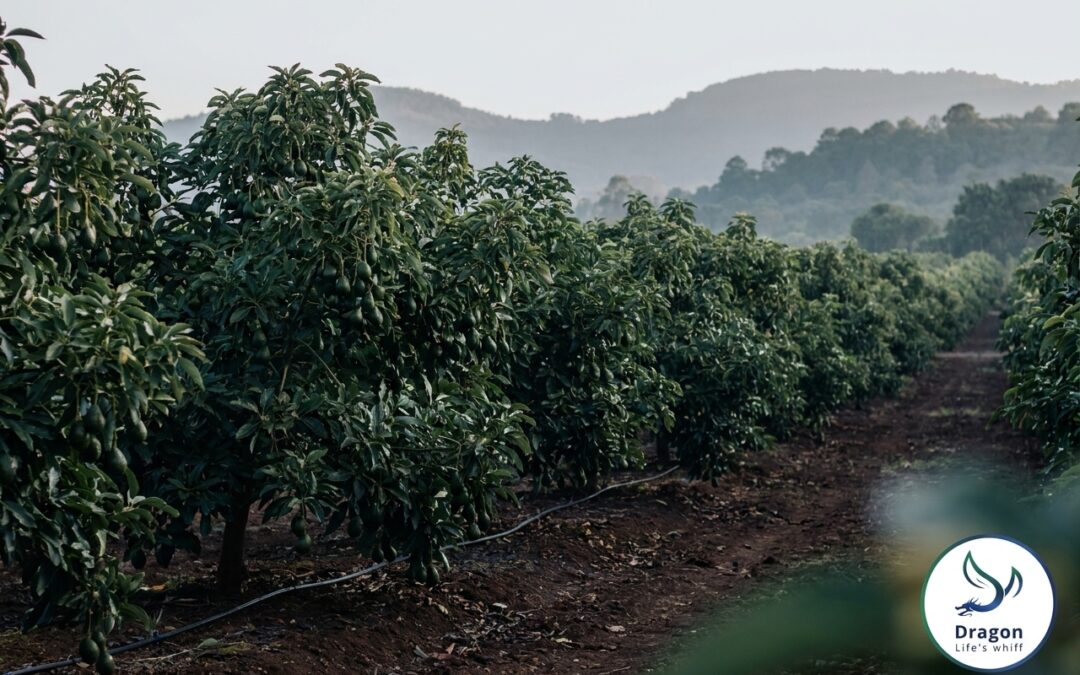
Here’s a worked example for a 20-hectare commercial avocado orchard in Mexico – the kind of operation Dragon’s specialty range is built for.
Baseline (commodity NPK program):
- Annual fertilizer spend: $85,000
- Yield: 12 tons/ha × 20 ha = 240 tons total
- Export-grade fraction: 75% (180 tons)
- Export price (Hass to US): $2.20/kg → $396,000
- Domestic-grade balance: 60 tons × $0.80/kg → $48,000
- Total revenue: $444,000
With a Dragon specialty program (paste, soluble powder, Ca-B specialty, micronutrient corrections):
- Annual fertilizer spend: $108,000 (a $23,000 increase)
- Yield: 13.5 tons/ha × 20 ha = 270 tons total (modest improvement, common with better N efficiency and stress mitigation)
- Export-grade fraction: 86% (232 tons – driven by Ca-B nutrition reducing rejection)
- Export price: $2.30/kg → $533,600 (better firmness and shelf life lift the per-kilo price slightly)
- Domestic-grade balance: 38 tons × $0.80/kg → $30,400
- Total revenue: $564,000
Fertilizer cost went up $23,000. Revenue went up $120,000. Net gain: $97,000 on a 20-hectare orchard, in one season.
Those numbers aren’t universal. They assume a serious fertigation program, real export-market access, and accurate execution. But the structure of the math holds across Mexican avocado, Peruvian blueberry, Kenyan cut flowers, and Colombian premium coffee. The export-grade fraction is where the money is, and the export-grade fraction responds to nutrition.
Why distributors should care more than farmers do
Most fertilizer content addresses the farmer making the buying decision. That’s a partial view. The distributor who imports, warehouses, and resells specialty fertilizer is often where the structural advantage actually sits.
Specialty fertilizer has a higher gross margin per ton than commodity NPK – sometimes 2x to 3x. It moves slower (lower velocity, lower volume), but the absolute margin per pallet is larger. For a distributor whose warehouse is already full of commodity 15-15-15, adding specialty SKUs creates a higher-margin tier and retains customers who were quietly switching to imported alternatives on their own.
There’s a differentiation argument too. Every regional fertilizer distributor sells the same urea, the same DAP, the same potash. A specialty line gives a distributor something the competitor down the street doesn’t have: a story to tell, a technical sale to make, and a reason for the farm to call back. Dragon’s Algeria distribution is a case study in this – watch the field-trial testimonial from a watermelon grower who went from commodity NPK to Dragon Paste 20-10-60+TE and tracked the difference in yield and fruit weight.
Dragon’s specialty portfolio at a glance
Dragon’s specialty positioning rests on six product lines:
- Dragon Paste – six NPK paste formulations at pH 2.5, free of chloride, sodium, and heavy metals. The 30-30-30+TE balanced is the first of its kind produced in Jordan, sourced from Jordanian Potash and Phosphate reserves.
- Dragon Fert Soluble Powder – five NPK ratios, crystal-pure, designed for fertigation and foliar.
- Dragon Liquid – three ready-to-inject NPK formulations in 1/5/20 L packaging.
- Dragon Specialty – 23 targeted products covering biostimulants, calcium-boron specialty, soil correctors, and stage-specific support.
- Dragon Minor Elements – chelated Iron, Zinc, Manganese, Copper plus mix blends.
- Dragon Organic – a curated subset of organic-compatible products for certified operations.
The portfolio matters because export-oriented agriculture isn’t one product. It’s a season-long program. A farm needs root-stage phosphorus, vegetative nitrogen, flowering Ca-B, fruit-fill K, and ongoing micronutrient support. A single supplier delivering all of that, contamination-free, is what makes the ROI math actually work in practice. For a worked guide on one piece of that program, see foliar fertilization for commercial agriculture – usually the part where the fastest visible returns show up.
To talk through a specific operation, contact the export team at info@dragonagricultural.com or through the contact page. The full product catalog is the starting point for a closer look at SKUs and packaging options.