
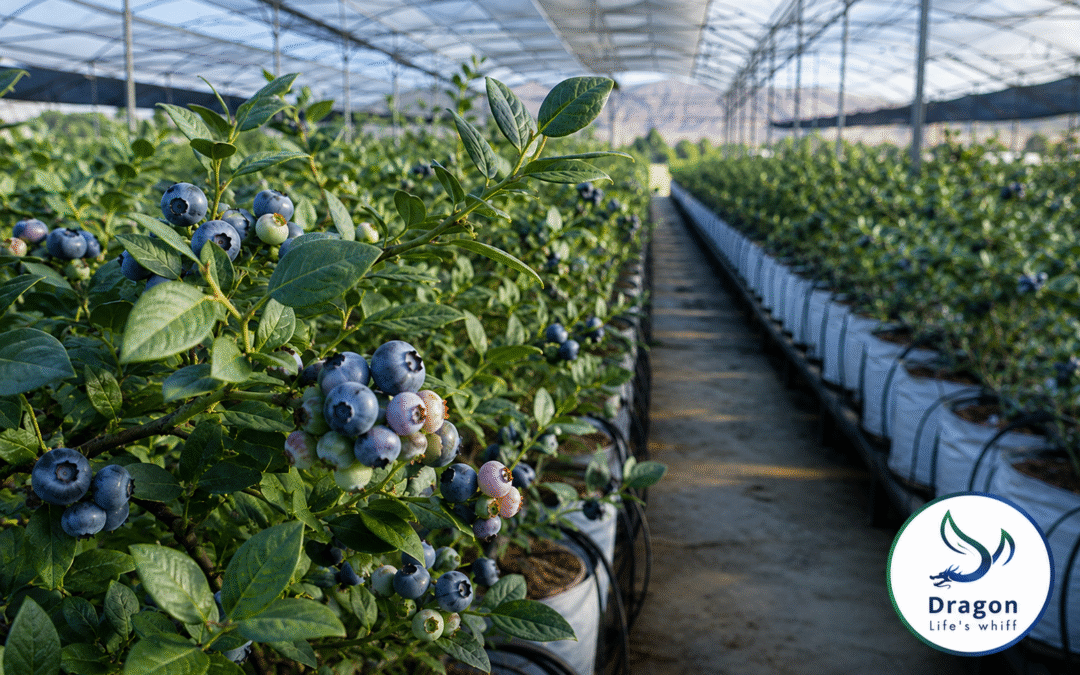
Peruvian blueberries don’t grow in soil. They grow in pots filled with coconut coir, drip-irrigated several times a day, with every nutrient delivered through the fertigation tank. The entire industry is built on this substrate-based production system, and it’s the reason a country with zero blueberry production in 2014 became the world’s largest exporter by 2019.
Around 290,000 tons of fresh blueberries left Peru in 2023, mostly destined for the United States, China, the Netherlands, and the UK. The fruit ships 20 to 25 days in refrigerated containers from Paita and Callao to consumers who expect a 14-day shelf life on arrival. That entire economic model rests on precision nutrition delivered through substrate fertigation.
This article covers what specialty fertilization for Peruvian blueberry production actually looks like, why conventional NPK programs don’t work in coconut coir, and how Dragon’s soluble powder, liquid, and specialty lines apply to the Ica, La Libertad, Lambayeque, and Áncash production zones.
The substrate revolution
Peruvian blueberry growing solved a problem that breaks production almost everywhere else. Blueberries need acidic root environments (pH 4.5 to 5.5), excellent drainage, low chloride and sodium exposure, and a specific nitrogen form preference (ammonium over nitrate). Native Peruvian soils, especially in the desert coastal zones, are alkaline, high in sodium, and have none of the right properties.
The solution was to ignore the soil entirely. Production blocks use raised beds or pots filled with coconut coir, a substrate with excellent drainage, naturally slightly acidic pH, and inert mineral content. Every nutrient comes from the fertigation tank. Every input is controlled.
This makes specialty fertilizers not optional but mandatory. There’s no soil buffering. There’s no slow nutrient release from organic matter. There’s no margin for error in the fertilizer chemistry. A commodity NPK with 5 percent chloride in coconut coir damages the root system within weeks. A poorly soluble product clogs drip emitters and creates uneven nutrient distribution across the block. The fertilizer has to be 100 percent water-soluble, contamination-free, and exactly the right ratio for the growth stage.
What blueberry actually wants
Blueberries are unusual among commercial fruit crops in several ways:
| Nutritional preference | What blueberry needs | What conventional fertilizer offers |
|---|---|---|
| pH of root environment | 4.5 to 5.5 | Most products work at 6.0 to 7.0 |
| Nitrogen form preference | Ammonium (NH₄⁺) over nitrate (NO₃⁻) | Most NPK is nitrate-dominant |
| Chloride tolerance | Zero (severe leaf and root damage) | Most K sources are potassium chloride |
| Iron form requirement | Chelated, stable at low pH (Fe-EDDHA) | Most iron is sulfate or weak chelate |
| Calcium for firmness | High and continuous during fruit fill | Most programs underdose calcium |
| Magnesium in coir | Often supplemented separately | Standard NPK often inadequate |
That table summarizes why Peruvian blueberry operations rarely use commodity fertilizer. The agronomic gap is too wide. The fix is a specialty program built around water-soluble, chloride-free, chelated-micronutrient products.
Iron chelation and the low-pH requirement
Iron is the trickiest element to manage in blueberry production. The plant needs it constantly for chlorophyll synthesis, and a deficiency shows up as interveinal chlorosis on young leaves within a week. But iron is also unstable in fertigation solutions, precipitating out quickly if the pH or EC drifts, and degrading under sunlight in the storage tank.
Dragon Iron 10% is formulated as a stable chelate that holds together across the pH and EC ranges Peruvian blueberry production actually operates in. Applied through drip fertigation at low concentrations multiple times per week, it keeps young leaves green and active without the recurring chlorosis cycles that plague growers using iron sulfate.
For broader micronutrient coverage, Dragon Mix Plus delivers zinc, manganese, copper, boron, and iron in one application. For coconut coir specifically, magnesium often needs separate supplementation since coir is naturally low in Mg.
Calcium and the shelf-life problem
A Peruvian blueberry destined for the US market is picked, packed, cooled, loaded into a refrigerated container, shipped to Paita, transported to a US port over 14 to 18 days, distributed to a supermarket DC, and finally reaches a consumer. The fruit needs to maintain firmness and flavor across that entire journey, with 14 days of shelf life remaining when the consumer buys it.
Firmness is calcium. Calcium loaded into the fruit cell walls during the last three weeks before harvest is what determines whether the berry holds together at the end of the supply chain.
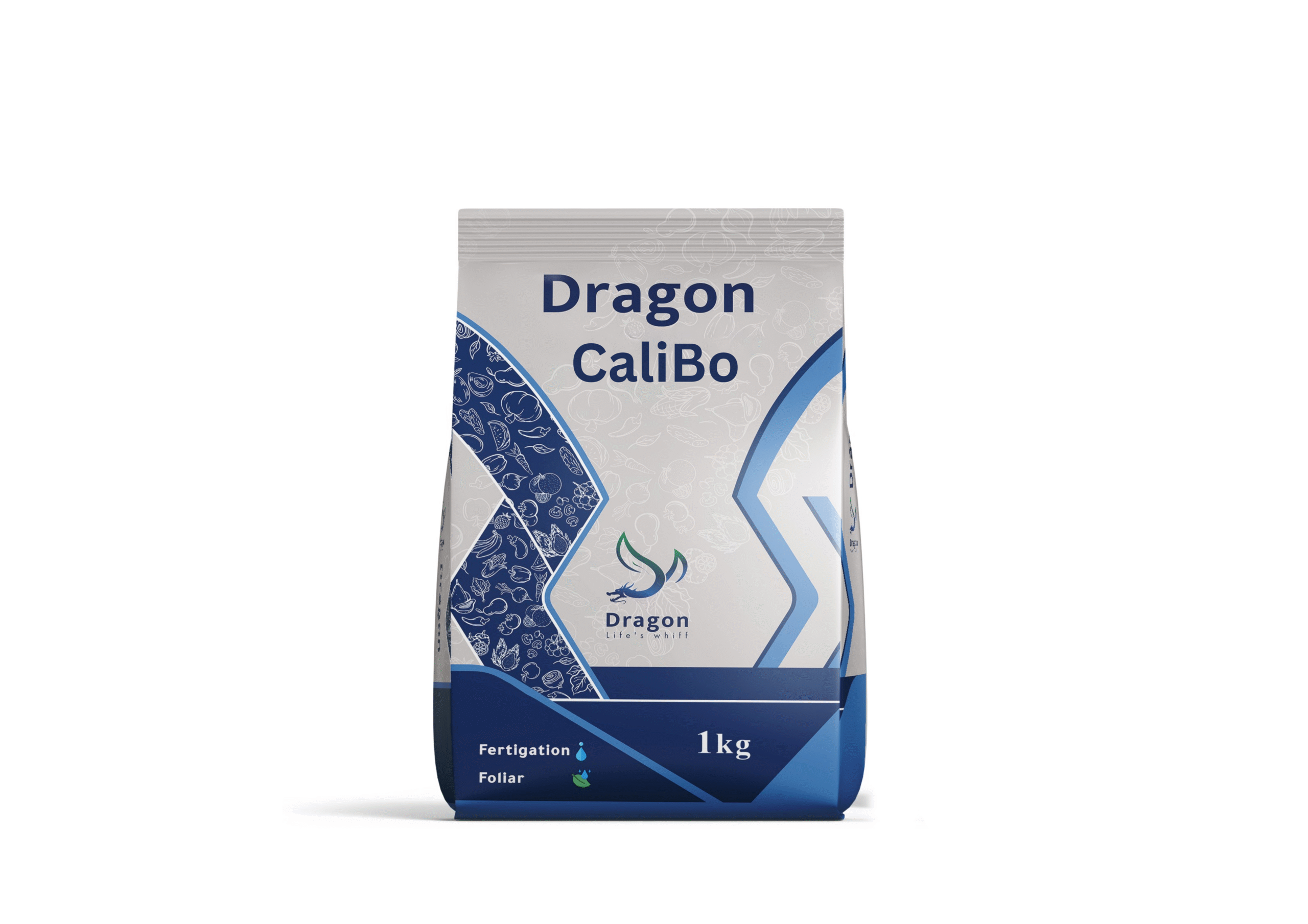
Dragon PureCal and Dragon Calibo (calcium plus boron) are designed for continuous calcium delivery through fertigation. The pattern that works in Peruvian production is small, frequent doses (two to three times per week through fruit development), not a single high-dose application. Continuous low-rate calcium loads into the developing fruit; high-dose pulses mostly accumulate in leaves.
The fertigation program
Peruvian blueberry runs on different reproductive cycles than soil-grown blueberry. The low-chill varieties (Ventura, Biloxi, Snowchaser, Magnolia) used in Peru can fruit year-round on rotating bed schedules. The fertilization program adjusts continuously based on which beds are in which stage.
A generalized framework:
- Establishment and vegetative phase: Dragon Fert High Nitrogen at low EC. Ammonium-dominant N forms preferred.
- Bud initiation: Dragon Fert High-PK supports flower induction.
- Flowering and early fruit set: Continuous Dragon BorCal and Dragon PureCal through fertigation.
- Fruit development and fill: Dragon Fert High Potassium plus sustained Dragon PureCal.
- Continuous pH and EC management: Dragon Corrector maintains target root-zone pH against natural drift.
- Iron and micronutrient maintenance: Dragon Iron 10% multiple times per week, Dragon Mix Plus every 2 to 3 weeks.
- Stress recovery (heatwaves, transplant): Dragon Sea biostimulant.
For the spray-side complement to this fertigation program, the foliar fertilization guide covers the technical detail. The specialty fertilizer ROI breakdown walks through the economics for export-grade operations.
Distribution to Peruvian operations
The Peruvian blueberry industry is dominated by a handful of large export operations: Camposol, Hortifrut, Agrokasa, Beta, Danper, and several others. These operations have technical procurement teams that evaluate fertilizer inputs on chemistry specifications, contamination profiles, lead times, and packaging logistics. They’re sophisticated buyers, and they’re exactly the audience Dragon’s specialty line is built for.
Smaller and mid-size operations in Olmos, Ica, and Virú are also expanding, often supplied through regional agricultural input distributors. For operations and distributors evaluating Dragon products for substrate-grown blueberry, the contact page is the starting point. The full product catalog covers all six lines.
Frequently asked questions
Why are Peruvian blueberries grown in coconut coir instead of soil?
Peruvian coastal soils are alkaline, sodium-rich, and have none of the acidic, well-drained properties blueberry roots need. Rather than try to amend an unsuitable soil, the Peruvian model bypasses the soil entirely with raised beds or pots filled with coconut coir, an inert substrate that drains well and starts naturally slightly acidic. Every nutrient comes from the fertigation tank, which gives total control over the chemistry the roots see.
What’s the safe chloride level for substrate-grown blueberry?
As close to zero as possible. Blueberry roots are exceptionally chloride-sensitive, and substrate production has no soil buffering to dilute exposure. A single application of chloride-bearing fertilizer can damage roots within a week. Dragon’s chloride-free formulations, especially the Dragon Fert soluble powder line, are designed for exactly this kind of zero-tolerance environment.
How often should iron be applied in Peruvian blueberry fertigation?
Iron deficiency develops fast in substrate production, often within a week of stopping iron application. The standard approach is low-concentration Dragon Iron 10% in the fertigation rotation three to four times per week. Tank stability is important: iron degrades under sunlight, so storage tanks should be covered and freshly mixed solutions used within 24 to 48 hours.
What’s the role of calcium in shelf life for Peruvian blueberries shipped to the US?
It’s central. Calcium loaded into the fruit cell walls during the last three weeks before harvest is what holds the berry together through 14 to 18 days of ocean shipping plus distribution. Insufficient calcium leads to soft fruit at retail, which means rejected shipments and lost revenue. Continuous small-dose Dragon PureCal or Dragon Calibo through fertigation outperforms intermittent high-dose applications.
Does Dragon supply Peruvian export operations like Camposol or Hortifrut?
Dragon’s specialty line is designed for sophisticated procurement teams at large export operations. Whether the company supplies a specific operation depends on the procurement relationship in place. For inquiries about supplying Peruvian blueberry operations, or about distribution through regional input chains in Ica, La Libertad, or Lambayeque, contact the export team via the contact page.