
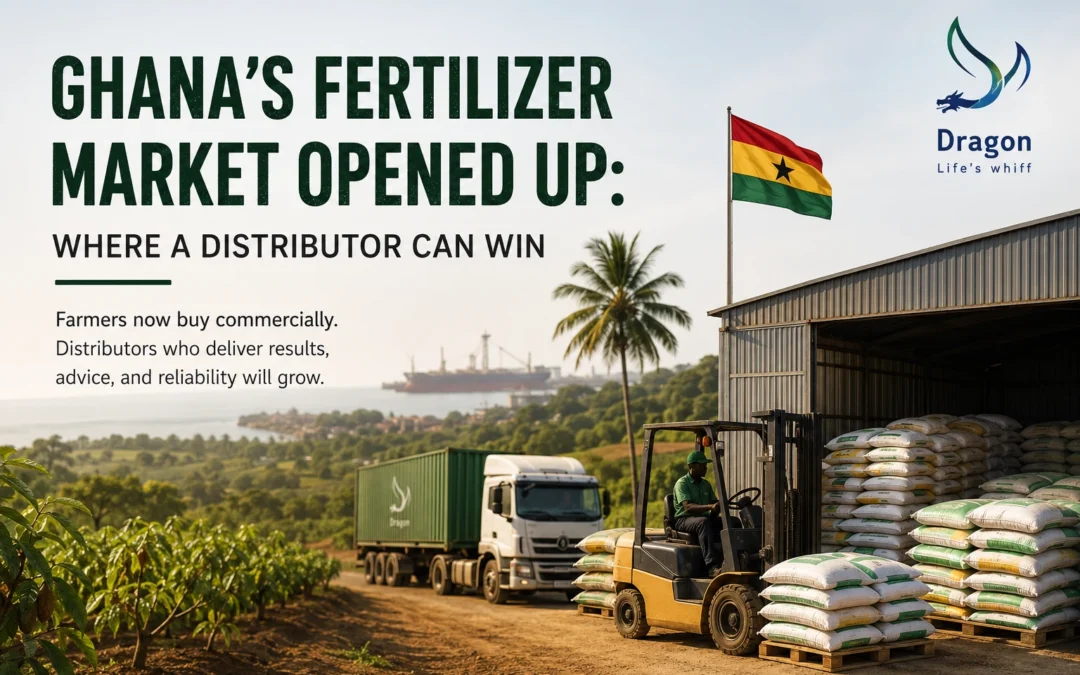
For years the biggest question in Ghana’s fertilizer trade was what the government would tender for. Ministry procurement moved large volumes under the subsidy programme, COCOBOD procured separately for cocoa, and a few large suppliers handled most of what reached farmers.
When the fertilizer and seed component of Planting for Food and Jobs Phase I was discontinued, supply shifted toward the private sector, with banks financing suppliers and government moving to a facilitation role. Farmers who waited for an allocation now buy commercially.
Harder for a farmer, more interesting for a distributor.
What an open market rewards
Under tender-led procurement the winning supplier met the specification at the lowest price. Differentiation barely mattered when the buyer was the state.
Selling to farmers and agro-dealers works differently. They repeat-buy or they do not, based on whether the last bag did what the dealer said. That puts weight on consistency, on advice that proves right, and on stocking something the shop across the road does not. Commodity NPK and urea fail that last test.
The gap in the current offer
Ghana’s fertilizer supply is concentrated around a few large players, and the volume is overwhelmingly commodity: compound NPK blends and urea sold on price.
Thinly represented is everything else: water-soluble products for fertigation, chelated micronutrients that stay available on acidic soils, and organic-compatible inputs for certified production.
That gap sits on Ghana’s fastest-growing agricultural value. Pineapple and mango exports are graded on quality that responds to calcium, boron and potassium rather than bulk NPK. Cocoa farms need phosphorus in a form acidic Ferralsols cannot lock away. A compound blend serves none of it well.
Three demand geographies, not one
Ghana is not a single market and a distributor’s plan should reflect that.
The cocoa belt across the Western, Central, Eastern, Ashanti, Bono and Volta areas has its own procurement rhythm shaped by COCOBOD programmes, and remains the largest block of fertilizer demand in the country. The horticultural export zone near the coast runs on quality specifications set by European buyers. The northern regions around Tamale carry the most farmers, growing maize, rice, soybean and yam on soils running a nutrient deficit.
Each needs different stock and a different sales conversation. A dealer treating them as one market carries the wrong inventory for at least two.
What a farmer now asks that they did not before
The shift from allocation to purchase changed the question a dealer gets asked. It used to be when the fertilizer would arrive. Now it is whether this bag is worth the price and what it does that a cheaper one will not.
A dealer who answers that builds a customer. One who cannot competes on price alone, a losing position when the product is identical to everyone else’s. Explaining why soybean still needs phosphorus and potassium, or why calcium stops a mango bruising in transit, is a sale that ends with a farmer coming back.
Import reliability is part of the product
Ghana imports nearly all its fertilizer, so currency movement and freight timing are real exposures for anyone bringing product in. Domestic manufacturing has been studied but not built, so imported specialty supply remains necessary.
That makes supplier reliability worth more than the last few percent on price. A shipment arriving late for a cocoa application window or a pineapple cycle is not a discount, it is a lost season.
Dragon Ferti manufactures in Jordan from Jordanian potash and phosphate, ships through Aqaba, and works to the documentation standards importers need: Certificate of Analysis, Technical Data Sheet, Safety Data Sheet, labels with full composition and Free Sale Certificates. Manufacturing runs under ISO 9001, ISO 14001 and ISO 45001 certified management systems.
What the range covers
Six lines sized for different customers. Dragon Paste in 5, 10 and 20 kilogram formats, Dragon Fert soluble powder in 10 and 25 kilogram sacks, Dragon Liquid in 1, 5 and 20 litre containers. Dragon Specialty for stage-specific applications, Dragon Minor Elements for chelated correction, and Dragon Organic for certified production, which matters given Ghana’s organic pineapple and cocoa trade.
Tema and Takoradi handle imports. Kumasi and Tamale are the inland hubs.
Conclusion
An opening market with concentrated incumbents and a thin specialty offer suits a distributor willing to sell technically rather than on price. Stock the three demand geographies separately, carry something the shop across the road does not, and treat supplier reliability as part of what you buy. For specifications, registration support or distribution enquiries, see the Dragon Ferti range, read grower reports on the testimonials page, or contact the export team through the contact page.
Frequently asked questions
What changed in Ghana’s fertilizer market?
The fertilizer and seed component of Planting for Food and Jobs Phase I was discontinued, moving supply from government tender toward private distribution, with banks financing suppliers. Farmers who once received allocations now buy commercially, which changes what they ask a dealer and what makes a supplier worth choosing.
Is there still subsidised fertilizer in Ghana?
Support programmes have continued in various forms, and COCOBOD procurement for cocoa operates on its own terms. A distributor should understand both, since they shape seasonal demand and what farmers expect to pay. Programme details change, so verify rather than relying on last season.
Why would a Ghanaian distributor stock specialty fertilizer?
Margin and differentiation. Everyone sells commodity NPK and urea at thin margins, so a dealer competing there competes only on price. Specialty products carry higher margin per tonne and serve the horticultural export and cocoa quality demand compound blends do not address.
Which ports and inland hubs matter for fertilizer distribution in Ghana?
Tema and Takoradi are the main import gateways, with Kumasi and Tamale as inland hubs. The cocoa belt, the horticultural export zone near the coast, and the northern grain and legume regions behave as separate markets with different stock requirements and seasonality.