
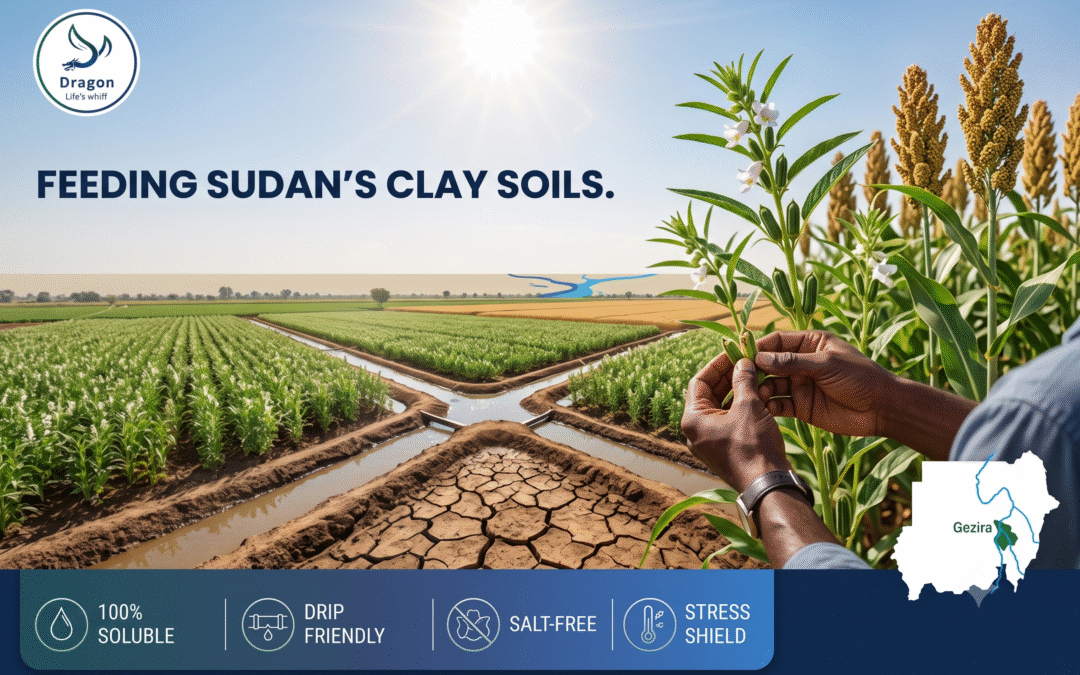
Sudan sits on some of the most fertile irrigated land in Africa. The Gezira Scheme, spread across the clay plain between the Blue and White Niles, is one of the largest irrigation projects in the world, and the semi-mechanized belt to its east has long been called the country’s granary. Sesame, sorghum, and cotton come off this land, and Sudan has historically ranked among the world’s top sesame exporters.
The land is not the problem. The nutrition is. Sudanese field crops are chronically under-fed, and the heavy cracking-clay soils they grow on hold their own quirks that a fertilizer program has to work around. As farming recovers and financing returns to the summer season, the opportunity to lift yields through better crop nutrition is large.
The vertisol challenge
Gezira and the eastern rainfed belt sit on vertisols, the dark cracking clays that swell when wet and split open when dry. These soils have real strengths and real awkwardness:
Vertisols hold water and nutrients well once charged, but their tight structure limits root oxygen, ties up phosphorus, and makes timing everything. Nutrients applied at the wrong moment sit unavailable until the next wetting cycle.
The practical consequences for a fertilizer program:
- Phosphorus gets fixed by the clay and needs an efficient, available form to reach the crop
- Potassium is often present but not always available to the plant when demand peaks
- Waterlogging in the wet phase stresses roots and slows uptake
- The cracking-and-sealing cycle means fertigation timing matters more than on lighter soils
Sesame: an export crop worth feeding properly
Sesame is Sudan’s quiet success, a high-value oilseed shipped to China, Turkey, and the Gulf. Yet most Sudanese sesame is grown with little or no fertilizer, which is exactly why yields sit far below potential. Sesame responds well to balanced nutrition with steady phosphorus for root and pod development and potassium for oil content and seed fill.
A balanced, fully soluble feed such as Dragon Fert Balanced suits sesame where irrigation allows it, shifting to Dragon Fert High Potassium as seeds fill and oil accumulates. Because Dragon Ferti products carry no chloride or sodium, they feed without adding to any salt already in the irrigation water.
Sorghum: the food-security staple
Sorghum feeds the country, and lifting its yield is a national priority. Grain nutrition is uncomplicated but it has to actually happen: adequate nitrogen for the canopy, phosphorus for early root establishment on those phosphorus-fixing clays, and the trace elements the soil withholds.
Dragon Fert High Nitrogen drives the vegetative growth that sets grain yield, and Dragon Fighter helps the crop hold through the heat and moisture stress that Sudanese summers deliver. The principle behind managing difficult irrigation water on these plains is covered in the guide to salinity and alkaline water.
A practical starting checklist
For a distributor or farm manager building a first program on Gezira-type clay, the essentials:
- Test soil and water for pH, salinity, and phosphorus status before planning
- Lead with an efficient phosphorus source to beat clay fixation early
- Use fully soluble, chloride-free inputs so nothing adds to salt load
- Time fertigation to the wetting cycle, not the calendar
- Correct micronutrients with a foliar pass using Dragon Mix Plus
- Support the crop through heat stress with a biostimulant
Conclusion
Sudan’s clay plains have carried agriculture for a century, and their yield ceiling is far above what most fields produce today. The gap is nutrition, not land. As financing and stability return to the farming seasons, distributors who can bring clean, soluble, efficiently-formulated fertilizer to sesame and sorghum growers have a real role to play in the recovery. Dragon Ferti, produced in nearby Jordan with Red Sea access through the region, is positioned to supply that effort. Browse the product range or reach the team through the contact page.
Frequently asked questions
Why do vertisol clay soils need a different fertilizer approach?
Vertisols swell when wet and crack when dry, which limits root oxygen and fixes phosphorus in the clay. Nutrients have to be supplied in efficient, available forms and timed to the soil’s wetting cycle rather than a fixed calendar, or they sit unavailable until the next irrigation. An efficient phosphorus source early is especially important.
What nutrition does sesame need for good oil content?
Sesame wants balanced feeding with steady phosphorus for root and pod development, then a shift toward potassium as seeds fill, since potassium drives oil accumulation. Most Sudanese sesame is under-fertilized, so even a modest, well-timed program lifts both yield and oil quality significantly.
Can Dragon Ferti products handle Sudan’s irrigation water?
Yes. Every Dragon Ferti product is free of chloride and sodium, so it feeds the crop without adding to any salt already present in irrigation water. For water with high alkalinity, the guidance in the salinity and alkaline water guide applies directly to Sudanese conditions.
Is Dragon Ferti able to supply the Sudanese market?
Dragon Ferti is manufactured in Jordan, within the region and with Red Sea shipping access, and works through regional distribution channels. For current sourcing and distributor inquiries, the team can be reached through the contact page.