
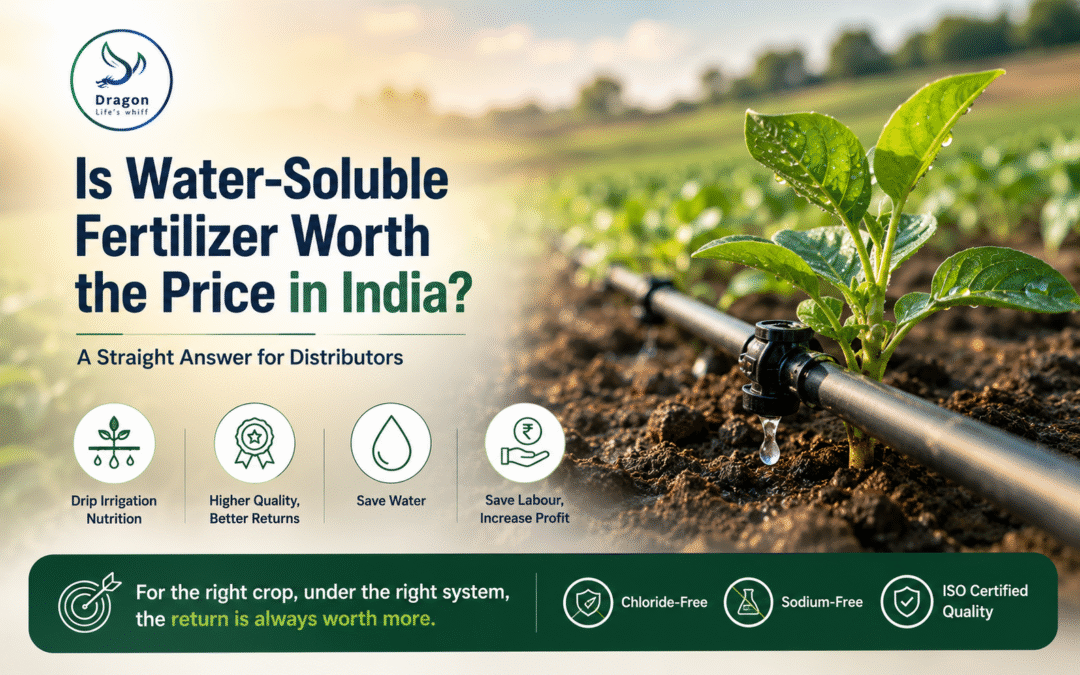
Every fertilizer distributor in Maharashtra, Gujarat, or Karnataka has heard the objection. A farmer looks at the price of water-soluble fertilizer, compares it to a bag of conventional urea or DAP, and says the soluble product costs too much. The objection is real. Water-soluble fertilizer does cost more per kilogram. The question is whether it costs more per rupee of crop value, and that is a very different calculation.
This is written for distributors who need to answer that objection with something better than “it’s higher quality.” Here is the actual decision framework.
Start with the crop, not the price tag
The single biggest factor is what the farmer grows. Water-soluble fertilizer pays back on high-value crops under drip and rarely pays back on low-value broadcast field crops. That is the honest dividing line.
Walk the decision in this order:
- Is the crop high-value? Grapes, pomegranate, banana, tomato, capsicum, and other horticultural crops carry enough margin per hectare to absorb premium inputs. Broadcast wheat or rice usually does not.
- Is there drip or sprinkler irrigation? Fertigation is how soluble fertilizer earns its keep. Without micro-irrigation, most of the advantage disappears and the price gap is hard to justify.
- Is the crop headed for export or premium markets? Export buyers pay for size, colour, and shelf life, all of which respond to precise nutrition. A farmer selling into a graded export chain has a reason to invest that a farmer selling to the local mandi may not.
If the answer to all three is yes, water-soluble fertilizer is almost always worth it. If the answer to all three is no, it usually is not, and a good distributor says so.
Where the money actually comes back
The premium is not recovered by yield alone. It comes back through four channels, and it helps to name them for the farmer:
- Nutrient efficiency. Fertigation delivers nutrients straight to the root zone, cutting the losses that broadcast fertilizer suffers to leaching and volatilization. Studies of fertigation put the fertilizer saving as high as a quarter or more.
- Quality grade. Better calcium and potassium nutrition lifts fruit into higher grades that fetch better prices. On export crops this is usually the biggest lever.
- Water saving. Drip plus soluble uses far less water than flood irrigation, which matters where groundwater is stressed.
- Labour. Injecting fertilizer through the existing irrigation system costs far less labour than broadcasting by hand.
Add those up and the premium per kilogram often disappears against the return per hectare. That is the argument to make, and it is more convincing than a claim about purity.
The trust factor: clean, verifiable product
Indian farmers have been burned by adulterated and low-quality soluble products. A distributor’s credibility rests on carrying material that is genuinely what the label says. Dragon Ferti’s positioning here is straightforward: every product is fully water-soluble, chloride-free, and free of sodium and heavy metals, produced under ISO-certified quality systems. For a distributor building a reputation, a clean, consistent, verifiable product line is worth more than a cheaper one that generates complaints.
The guide to reading a fertilizer label is a useful tool to share with farmers who want to compare products on more than price.
Match the product to the stage
Part of the value case is that soluble fertilizer lets a farmer feed the crop differently at each stage rather than applying one blend all season. A distributor who can recommend a stage-based program sells the system, not just the sack:
- Rooting and establishment: Dragon Fert High Phosphorus
- Vegetative growth: Dragon Fert High Nitrogen
- Flowering and fruit set: Dragon Fert High-PK with Dragon BorCal
- Fruit fill: Dragon Fert High Potassium with Dragon PureCal
Conclusion
The price objection is answered by reframing the question. Water-soluble fertilizer is not for every farmer or every field, and a distributor who admits that builds trust. But for high-value crops under drip heading to good markets, the premium comes back through efficiency, grade, water, and labour, usually several times over. Carry a clean, verifiable line, teach the stage-based program, and the price stops being the conversation. Explore the full Dragon Ferti range or reach out through the contact page to discuss distribution.
Frequently asked questions
Is water-soluble fertilizer really worth the higher price?
For high-value horticultural crops grown under drip irrigation and sold into premium or export markets, yes, almost always. The premium per kilogram is recovered through better nutrient efficiency, higher quality grades, water savings, and lower labour. For low-value broadcast field crops without micro-irrigation, it often is not worth it, and an honest distributor says so.
How much fertilizer can fertigation actually save?
By delivering nutrients directly to the root zone, fertigation sharply reduces the leaching and volatilization losses that broadcast application suffers. Reported savings run to a quarter or more of total fertilizer use, which offsets much of the price premium on soluble products. The exact figure depends on crop, soil, and system.
How do I convince a farmer worried about cost?
Reframe from price per kilogram to return per hectare. Walk through the crop value, the irrigation system, and the target market. Then name where the money comes back: efficiency, grade, water, and labour. Farmers respond to a concrete return argument far better than to a claim about product quality alone.
What makes Dragon Ferti soluble products trustworthy?
They are fully water-soluble, chloride-free, and free of sodium and heavy metals, produced under ISO-certified quality systems. In a market where farmers have encountered adulterated products, a consistent and verifiable line protects both the farmer’s crop and the distributor’s reputation.